"To those fleeing persecution, terror & war, Canadians will welcome you, regardless of your faith." "Diversity is our strength #WelcomeToCanada". Prime Minister Justin Trudeau, Twitter "Public support often aided by a diversity of prominent stakeholders] is indispensable." "But there could be a tipping point that, once reached, undermines the history of relative Canadian consensus." "Engagement with the Canadian public is necessary, however, any high-profile debate will have to be carefully managed." Immigration Department internal data briefing "About 30 percent of Canadians think immigration levels are too high ... There's a cluster of people who are simply opposed." "At the other extreme, there's another group who are super-keen." "In
the middle are what we call the conditional multiculturalists. They
are, in principle, comfortable with [immigration], but subject to a
whole set of qualifications which really turn on whether it is working." Keith Banting, research chair, public policy, Queen's University
An asylum seekers, claiming to be from Eritrea, is
confronted by an RCMP officer as he crosses the border into Canada from
the United States on August 21, 2017 near Champlain, N.Y. The federal
government has been warned to take a cautious approach to publicly
debating immigration over fears of reaching a "tipping point" that could
undermine the public's support for welcoming immigrants into the
country. Internal data prepared by the Immigration Department for a
committee of deputy ministers shows a majority of Canadians support
current immigration levels, but this support drops when they are
informed of how many immigrants actually come to Canada every year. THE
CANADIAN PRESS/Paul Chiasson
The briefing notes were prepared to enable a committee of deputy
ministers in the federal government to fully comprehend that among
usually compliant and amenable Canadians there are limits to the numbers
of immigrants, refugees, asylum seekers they feel can be absorbed and
assimilated into the Canadian population, taking into account all manner
of important details; whether the culture might be compatible with
Canada's, the economic cost of absorbing them, and the potential of
destabilization in the process, among them.
These are all issues that politicians are normally very sensitive to,
for longevity purposes of their own governance, in reflecting the public
pulse on any given issue, much less one as vital to Canada's future in
its population make-up and the numbers that can be safely integrated. A
majority of Canadians, the briefing clearly pointed out, do support
immigration levels -- but at a level they are comfortable with. When
those supporters are informed of increasing numbers their comfort level
drops in lock-step with the rise of the incoming.
Polling data reveals that slightly over 50 percent of Canadians feel
that the number of immigrants permitted to arrive in Canada annually is
"about right", a number that has bee consistent since 2012. On the
other hand, most of that slight majority believe the immigrant number
arriving yearly to be under 150,000. Once informed that the true number
had been 260,000 for the past number of years, those who claimed it to
be "too many" increased to 32 percent from 23 percent.
Hardening attitudes caused by events taking place in other countries
where immigration and refugee numbers have swamped Europe, for example,
causing unrest and fears for the future, alongside attitudes of empathy
for the plight of refugees fleeing violence and conflict arise and clash
with one another in public opinion. Economic downturns and feelings of
disenfranchisement auger ill, however, for support of greater numbers.
The current Liberal government released its three-year immigration
strategy late in 2017, planning for incremental increases to levels of
immigration over the next three years. Advocates for increasing
immigration levels urge that greater numbers be allowed to enter Canada
for more significant increases. The government's more 'measured'
approach, pointed out Dr. Banting, reflects fears of a public
"backlash".
One horrific event that took place in Quebec a year and a half ago was a
violent assault on a mosque in which six worshippers were shot to death
and others severely injured, when a perturbed and unstable young man in
the throes of a mental crisis interpreted rising immigration levels as
an existential threat to himself and his family personally, and sought
to minimize it by terrorizing and killing Muslims as he had noted
Muslims to have done to those like himself, in Europe.
"When
I saw that [an announcement that Canada was preparing to accept
refugees the U.S. was turning away] I lost it. I was like, sure that
they were going to come and kill my parents also, and my family. I was
sure about that ... that's why, that's why I had to do something." Alexandre Bissonnette, 29, mass killer, Quebec
"I think the low number of Canadians who celebrate the fact that we have religious freedom is very troubling and really speaks to the forces of secularization that are at work in Canadian society." "It really is time for the religious communities in this country to set aside some of their doctrinal differences and look at coming together to communicate better with Canadians on the role of religion and faith in Canada." Angus Reid, founder, president, Angus Reid Institute
"I don't think the people answering this poll are answering from the consequence of day-to-day experience. I think what we're talking about is a public narrative." "[Might it be that those religions receiving negative views are distinguished by the hijab and turban] is a discomfort with the particulars of their faith? Or is it a discomfort with the fact that they're different than us?" "Ray Pennings, executive vice-president, Cardus
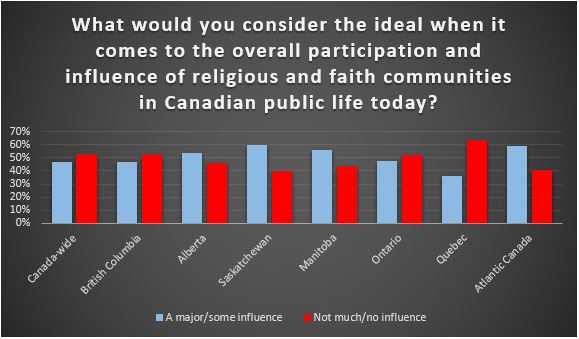
These statements resulted from an online poll of just under two thousand Canadian adults, conducted from October 15 to the 23rd of this year. The poll result gave evidence that Canadians, traditionally fairly comfortable with the presence of visible minorities among them, in an essentially immigrant-based society as a whole long accustomed to living and working among people originally from all parts of the world, have now grown restive with the concept of a multicultural society.
To anyone with an ounce of brains, it would be obvious why, as Mr. Pennings points out, a level of suspicion has been evident among respondents to the poll with respect to Sikhs and Muslims. Canada's most horrific terrorist experience came out of a Sikh plot among Canadian Sikhs living in British Columbia to strike a blow for Khalistan, a wished-for separation from India for Indian Sikhs.
Explosives aboard an Air India flight full of Indo-Canadians was blown up over the Atlantic. The perpetrators were put on trial, but the result was inconclusive and they were never fully held to criminal account for the devastating horror of 329 innocent people losing their lives, in 1985. Little wonder the memory of that dreadful event still shapes peoples' thoughts about Sikh-Canadians. But reasonable people know that the actions of a handful if malcontents with malicious intentions do not represent all those who share a common background.
Jagmeet Singh, the newly minted leader of the federal NDP: An Angus Reid
poll explores the attitudes of Canadians to the idea of a Sikh leader.(Chris Young / THE CANADIAN PRESS file photo)
On the other hand, the simple fact is Sikh-Canadians are an integral part of Canadian society. So much so that under the current government, Canadians now have a Sikh as their Minister of Defence, and another Sikh Canadian lawyer has been elected as leader of of the federal New Democratic Party. As for suspicions of Muslims being high on peoples' minds, the reasons are obvious enough. Most of the terrorist groups bedevilling world society are Muslim.
Muslims have been attacking one another in bloodthirsty violence reflecting sectarian hatred -- and Muslim countries have spectacularly failed to govern their populations, instead exploiting and visiting violence on them. The world's premier terrorist groups are Muslim, threatening not only their own, but destabilizing and terrorizing the West, from Europe to North America and beyond. Little wonder Muslims are held in suspicion. They are the latest source of the most virulent anti-Semitism.
In Quebec which has just adopted a law prohibiting women wearing niqabs from receiving or giving government services, 26 percent of respondents accepted religious diversity while 23 percent rejected it and 44 percent agreed diversity represents a mixture of good and bad. Anti-Islam sentiment however, stands at 46 percent claiming Islam damages Canada.
This poll was a joint venture between Angus Reid and Faith in Canada 150.
"...If Islam is involved, a significant segment of Canadians will react negatively", an analysis of the numbers by the Angus Reid Institute clarified. Generally, Catholicism, Protestantism, evangelical Christianity and Judaism all received positive ratings overall. With the exception of Quebec where 55 percent claim Islam is damaging and 22 percent claimed the same for Judaism.
Overall, a slight majority of 55 percent of respondents felt freedom of religion results in Canada being a better country. Angus Reid perceives the results reflecting a "potential for intolerance toward those of faith, in particular toward adherents of minority religions". On the other hand several groups stood out for growing influence, representing Islam, Sikhism and Hinduism, where the established, traditional religions in Canada appeared to have a dimished influence.
In the opinion of the House of Commons, the government should:
(a) recognize the need to quell the increasing public climate of hate
and fear; (b) condemn Islamophobia and all forms of systemic racism and
religious discrimination and take note of House of Commons’ petition
e-411 and the issues raised by it; and (c) request that the Standing
Committee on Canadian Heritage undertake a study on how the government
could (i) develop a whole-of-government approach to reducing or eliminating
systemic racism and religious discrimination including Islamophobia, in
Canada, while ensuring a community-centered focus with a holistic
response through evidence-based policy-making,
(ii) collect data to contextualize hate crime reports and to conduct
needs assessments for impacted communities, and that the Committee
should present its findings and recommendations to the House no later
than 240 calendar days from the adoption of this motion, provided that
in its report, the Committee should make recommendations that the
government may use to better reflect the enshrined rights and freedoms
in the Constitution Acts, including the Canadian Charter of Rights and
Freedoms. Iqra Khan, MP, Private Members’ Business M-103
The government that gave the world the wonderful news that "Canada is
Back!" -- ostensibly from wherever it was when it was hiding its light
unto the world under a Conservative barrel when the government of the
day under Prime Minister Justin Trudeau's predecessor viewed the United
Nations as an unfortunately failed enterprise, championed Israel, was
leery of Islamist groups portraying themselves as misunderstood, and
viewed Russia and China's penchant for practising abuse of human rights
-- has turned Canada's back on those moral issues that Stephen Harper's
government distinguished itself by.
This is a government that endlessly praises itself for being pluralist
to the extreme, elevating immigrant rookies to cabinet posts, priding
itself on its unbending degree of 'feminism', led by a prime minister
and a minister of finance whose family fortunes helped vault them to
power, while they promise to tax the 'rich' to benefit the middle class
-- not, mind, the impoverished. A government for whom no amount of
immigration and embrace of refugees is too much, with or without
appropriate security clearances.
This government approves of political correctness, in fact invented it
and happily scatters its excesses as far abroad as it can toss them to
the winds of inexorable change, kissing each wisp as it floats off, with
a sunny smile. The latest iteration of political correctness, that of
cultural appropriation, has become an institutionally-approved lesson in
'tolerance' for Indigenous and LGBTQ empowerment. In perfect accord
with academia where the intolerance of 'progessives' has altered the
acquisition of knowledge to a fountain spewing political correctness ad
nauseum.
There are exceptions in stark evidence, however. As when, for example,
the long-delayed national Holocaust memorial was finally erected and
formally opened in Ottawa, closing the gap represented by Canada being
the only Western Allied country without such a memorial to World War
Two's Nazi plan of extermination of world Jewry. The plaque installed to
explain the purpose of the memorial somehow failed to mention Jews at
all at it happens, lingering on the unfortunate deaths of 'men, women
and children' who happened to be Roma, Jehovah's Witnesses, political
adversaries and Gays -- oh and assuredly Jews as well.
On the other hand, much attention to detail and 'getting it right' has
been exhausted on the introduction of Motion 103, condemning "Islamophobia and all forms of systemic racism and religious discrimination".
The very word Islamophobia is an Islamic invention meant to paste
'racist' on the forehead of anyone incautious enough to take from the
prevailing news of ongoing terrorism invoked in the name of Islamic
jihad, to quell suspicion of Islam as a religion promoting violence to
achieve dominance.
Liberal MP Iqra Khalid, who brought forward the motion to combat
Islamophobia (PATRICK DOYLE / THE CANADIAN PRESS file photo)
How strange that the Member of Parliament who proposed the principles
and moral sanctimony behind M-103, Iqra Khalid, is a Muslim
Pakistani-Canadian. Enabled by her position as an activist, female,
Muslim, Parliamentarian, to effect in Canada what the Organization of
Islamic Cooperation has been attempting to persuade the United Nations
to accommodate for years. To formally introduce the concept of any
criticism of Islam as being tantamount to an illegal act of blasphemy.
The Toronto District School Board's Islamic Heritage Month Guidebook defines Islamophobia as "fear, prejudice, hatred or dislike directed against Islam or Muslims, or towards Islamic politics or culture",
a designation of denigration most pleasing to some, but not all of
Canada's Muslims, for there are groups of Muslims in Canadian society,
aghast at this turn of events. By no means are Muslims foremost among
religions experiencing episodes of clear racism, since police reports
point to anti-Semitism by a wide margin.
This motion should have included anti-Islam prejudice as among many
other bigoted public displays of racism, but the focus was meant to be
Islam, a religion whose practitioners are in the news on a daily basis,
relentlessly pointing to the slaughter of tens of thousands of their own
adherents by their religious brethren in Syria and Iraq, Afghanistan
and Yemen. The call to the faithful from mosques around the world to
battle the unbelievers is near-unanimous.
"Why are only Muslims mentioned by name? It's not the government's responsibility to babysit just one community",
offers Raheel Raza, president of Muslims Facing Tomorrow. Instead --
she offered the Heritage committee tasked to examine the issue -- of the
bogus attention to 'Islamophobia' meant to take attention away from
honour killings and polygamy, she recommends Canada encourage the "free
thinking" once-normal model of Islam.
Tarek Fatah, a Muslim accustomed to receiving death threats resulting
from his rejection of Islamist fundamentalism, testified before the
committee that secular, free-thinking Muslims who arrived in Canada for
the privilege the freedoms offered of speaking their mind to Islamic
authority figures denied them in their home countries, would be harmed
by discouraging criticism of Islam. "You cannot define [Islamophobia], because the word is a fraud", he observed.
For his troubles, he was subjected to "intimidation and bullying" by
members of the committee themselves. Retired Major Russ Cooper, a
decorated combat veteran of the first Gulf War launched a M-103 pushback
campaign through an anti-M-103 petition drive, which garnered 200,000
signatures. Peter Bhatti, chair of International Christian Voices, spoke
of Pakistan's blasphemy laws that victimizes perceived critics of
Islam.
It is becoming a criminal offence to link Islam with violence and
conflict, sectarian medievalism, of being in any way supportive of
terrorism. As for its being a backward, barbaric, sexist and primitive
religion of conquest ... perish the thought.
Europe's Open Generosity to Muslim Immigration and Refugees
Sweden was once one of the safest countries in the world, until it began focusing on a multicultural immigration program.
"The troubles that Sweden has gone through in recent years, since mass migration began in earnest, are hard indeed to ignore. These troubles include the setting up of what the American scholar of Islam, Daniel Pipes, most accurately referred to
as 'semi-autonomous sectors'. Although non-Muslims can enter, the areas
are different from the rest of the country. These are areas where, for
instance, police, fire and ambulance services refuse to enter because
they and other authority figures representing the state frequently come
under attack. The filmmaker, Ami Horowitz, experienced the downside of
some of these areas. On a recent visit to Sweden he was attacked for taking a film crew
into a suburb of Stockholm when some of the locals objected. We are
being given an accurate representation of a serious problem." "Car-burnings and riots do break out in Sweden today with considerable regularity, and sexual assaults
have sky-rocketed in the country (although these figures are the
subject of heated debate over whether they represent a rise in incidents
or a rise in reporting). Either way, rapes carried out by immigrants remain a real and underreported issue. The authorities – including the Swedish media – have refused to run stories about these unpleasant facts." "In Sweden, more than in perhaps any other European country, the media
is homogeneous in its support for the left-wing status quo in the
country, and this includes a support for the views of recent governments
on immigration policy. Anything which could give ammunition to critics
of that policy is -- as in Germany -- deliberately under-reported or actively covered over by the majority of the media." Douglas Murray, British author, commentator, public affairs analyst
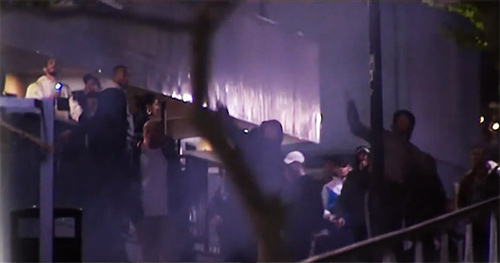
Swedish police escort U.S. journalist @Timcast out of migrant area fearing for his safety - still from video, Gatestone Institute
A former Prime Minister of Sweden was quick to pen and publish an article meant for mass distribution, to contradict any unfortunate impression that people listening to the President of the United States -- during a speech when he used Sweden as an example of good intentions gone awry through its immigration file -- may have come away with. Nothing awry in Sweden, he wrote cheerily. The Muslim immigrants have assimilated nicely and all is sweetness and light.
Swedes in general also responded to that astonishing slight against their nation's generous political stance in absorbing Muslim immigrants and refugees into their welfare state by mocking Donald Trump's clumsily interpreted assertion that Sweden is no longer what it once was, overwhelmed by the suffocating presence of an ideological and political theism that in fact is in full denial of Swedish values and concerns, bringing with them a system of laws and justice in contravention of its own.
What is considered criminal in Western countries is not reflected as such in countries under Shariah law, however. And this is where much 'misunderstanding' takes place. In Islam in a 'country of war' which is how all non-Muslim nations are designated, it is permissible for Muslim men to feel free to rape non-Muslim women, seen as 'spoils of war'. Islam warns against co-mingling with non-Muslims so Muslims gravitate to ghettos where they look askance at non-Muslims in their midst as defiling 'their' areas of residence and business.
Volunteers distribute food and drinks to migrants who arrived at Malmo
train station in Sweden in this September 10, 2015 file photo.
REUTERS/Ola Torkelsson/TT News Agency/Files
The past several decades have altered Sweden enormously. There are still Jews living in Malmo, but they know their time there is numbered, despite their long-time residence in a country that lauded equality and their social contract of inclusiveness. Malmo has been made exclusive to Muslim settlement and no longer looks kindly on the prospect of a pluralist in-gathering. Muslims are jealous of their possessions and the geography where they settle en masse is considered consecrated to Islam.
As such, firemen, police, paramedics and any other symbols of safety, security and authority of the state are decidedly unwelcome, the atmosphere made hostile and dangerous for their entry. Consequently, knowing that danger lurks there for 'interlopers' in their own country, they are loathe to enter those ghettoized confines for any reason. People who visit and are familiar with the old Malmo are thunderstruck by the aura of ethnic tensions between Swedes still living in Malmo and those newly arrived.
Immigrant
youths from a mainly Muslim area of Stockholm hurl rocks at police
during a week of rioting in May 2013. (Image source: RT YouTube video)
Districts in the city are reserved and confined to Muslims, where residents of other districts know they are unwelcome, and where Arabic and Islamic culture and clothing predominate. What might have seemed quaint and colourful at first has taken on an aura of dark menace echoing attitudes of those who have no intention whatever of assimilating and taking on values and customs clearly contradicting those they have brought with them from countries they have fled.
And what pertains now in Sweden is reflected throughout western Europe. Where France, the Netherlands, Belgium, Germany, Denmark, Norway and Finland now know first-hand and very personally how their nations have been forever altered from what they have so long been familiar with and comforted by. The charming, initial settling-in visions of graceful minarets and the exotically arresting Muslim call to prayer have become an intrusion.
Throughout Europe, Saudi Arabia, Iran and Turkey have invested heavily in the building of mosques and madrassas in spreading the two brands of fundamentalist Islamism, Wahhabism and Salafism. Ankara delights in dictating to Berlin how it must view its German-Turkish citizens, cognizant of their dualism and their religious rights. The sheer weight of the Muslim population base in those nations, including in particular France and Britain, and the terrorist threats make for a sobering atmosphere.
That which has been done is difficult now to reverse.
A recent survey published by Aftonbladet
on women’s fears in Sweden found that 46 percent of women felt either
very or somewhat unsafe when alone after dark compared to just 20
percent for Swedish men.
"Since the beginning of last year, I have been treated as public enemy No. 1 when all I try to do is make people laugh, and laugh about death, because death laughs at us all, as Charlie knows now, unfortunately." "Whenever I express myself, some people will not even try to understand me, they will not listen. They try to find some kind of pretext to suppress me. I am looked upon as if I were Amedy Coulibaly, when I am no different from Charlie." French comedian Dieudonne
Quenelle' comedian appeared to express sympathy for Amedy Coulibaly
Tauntingly ingenuous, he prods and he pokes and he unerringly exposes the soft spots in freedom of speech, for it cannot escape anyone's notice that some freedoms are more tolerable than others. This man who despicably winks and nods, knowing that he is communicating unspoken but very well understood pathologies of ethnic and religious hatred feels free to do so because he lives where any and all expressions of thought, however socially deplorable, are meant to be celebrated.
That his expressions, crude slanders and sly digs at the ancient presence within France of French Jews as representative of what he and his champions consider to be fodder for anti-Semitism anywhere Jews live, lead to and support the enthusiasm among violent Islamists and other anti-Semites to commit crimes targeting Jews; the embers that light the fire. The satirical magazine, whose mode of expression was often as crude, targeted anything and anyone the journalists and cartoonists felt obligated to bring scorn upon.
Jews do not rampage, committing atrocities against those who seek to defame them. In sheer numbers and influence, Muslim populations anywhere they exist -- and they exist increasingly, everywhere -- have the upper hand as opposed to the more meagre numbers of Jews however long they have existed in any society. Jewish-inspired attacks against their anti-Semitic tormentors simply do not take place, while Arab-Muslim or simply anti-Semitic-sourced attacks against vulnerable Jews are universal and innumerable.
But the French comedian does present a vexing problem facing French authorities. If all of society can be assured of the right under French social norms, French cultural and legal auspices to enjoy freedom of speech, then too must those who disturbingly assault the morals and well-being of a select group of people. Except that when they do so, they increase exponentially incidents of active anti-Semitic acts of destruction of property, threats against the security of persons, and physical attacks, too often resulting in murder.
Does balance and freedom in ensuring equal rights in such matters trump the dangers inherent in giving voice to the destructive elements within society singling out a religious/ethnic group for episodes of violence justify permitting anyone to say anything at any time, however dangerously provocative? It all depends on whose ox is being gored, does it not? And in this particular instance, the ox being gored has through antiquity to the presence, been so often assaulted and decimated, the wonder is it still lives.
The warning that the bigots and racists come first for the Jews, then turn their malevolence on others who defy their right to degrade the human condition, all too often expresses reality. In this case, the crowds of Muslims who blame Israel for its existence rather than abandoning the land it sits upon to the Palestinians, taking out their rage on French Jews by killing Jewish schoolchildren, by defacing synagogues and by torturing and killing and raping French citizens who happen also to be Jews proved their umbrage against non-believers who dare make light of Islam and Mohammad by exampling Charlie Hebdo.
Who and what is next on the agenda is a matter for all of Europe -- which has charitably taken to its bosom hordes of Muslim migrants desperate to escape the oppression and raging violence that their own impose upon them -- to consider, as the growing numbers of Islamists in their welcoming countries now increasingly insist on their new countries reflecting the image and the essence of Islam, blanketing the indigenous culture and its heritage with that of Islam.
In the West, the Arabization of
Muslim communities has occurred with government assistance, which,
through imposed policies of multiculturalism in the name of diversity,
has effected the destruction of South Asian culture.
Britain's multiculturalism policies have imposed Islamist leadership
upon Britain's Muslim communities and brought about the destruction of
South Asian culture.
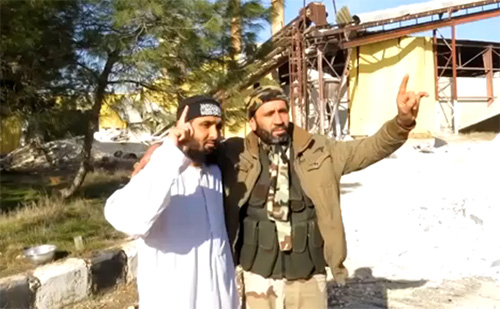
British suicide bomber and jihadist, Abdul Waheed Majeed, in his last
moments before ramming a truck laden with explosives into a Syrian
prison, posed
in a white Islamic tunic and black scarf for the cameras. Asked by the
cameraman to say a few words in Arabic before his "martyrdom," Majeed
replied: "Sorry? I can't speak. Everyone asks me that and ... I'm not a
very good speaker."
Abdul
Waheed Majeed (left), of Crawley, England, poses for photographs
moments before driving a truck-bomb into a prison in Aleppo, Syria.
(Image source: Jabhat al-Nusra video)
Majeed, like a large number of British Muslims, was not an Arabic speaker. He was of Pakistani heritage. About 70% of British Muslims
are, in fact, South Asian. A mere 6.6% are believed to be of Arab
descent. And very few British Muslims can actually speak Arabic.
Nevertheless, British Islam is firmly focussed on the Middle East.
The poet Hamza Beg, writing in the journal of a taxpayer-funded
organization, Asfar, noted:
"Since 1999, Pakistan, for example, has had a military coup, a
purported return to democracy, and the assassination of the leader of
the opposition, Benazir Bhutto. However, an entire generation of
British-born Pakistanis have been more interested in Israeli incursions
into Lebanon, the occupation of Palestine, and the war on Iraq. How has
this occurred and what does it mean?"
British Muslims, Beg continued, have rejected "their parents'
cultural understanding of Islam as a religion. British-Pakistani Muslims
have become Muslims first, and are losing patience with the Pakistani
practice of the religion embedded in Sufi traditions."
"In rejecting a culturally conditioned Islam," Beg concludes, "Muslims in Britain have given up their equal footing and fallen prey to Arab imperialism." Indonesian scholar Azyumardi Azra refers to this process as "Arabization."
In a similar story, one South Asian blogger in the United States writes,
"Why hasn't South Asian poetry, art and dress impacted any of the large
American Islamic organizations of today? Why are nearly all Muslim
converts distinctly Arabic in appearance, style, and culture? ... This
idea of Arabization of tongue and culture, of course, has been
devastatingly successful, and fed right into the weaknesses of the
colonized South-Asian inferiority complex. Hence South Asia began
marginalizing their own culture only a few decades after the Saudi's
[sic] began the propaganda machine. The rich colors of the South Asian
woman have been discarded..."
Over the past century, Arab-focussed Islamists have attempted to
homogenize Islamic cultures outside the Middle East. This process
initially occurred in South Asia – Pakistan, Bangladesh and parts of
India.
The Indian academic Baladas Ghoshal blames
the "Wahhabi creed" of Saudi Arabia, which, he claims, has attempted to
purge South Asian Islam of its cultural practises and emblems, and has
instead imposed a "pure and ideal form of Islam to be followed by
Muslims all over the world."
Wahhabis, Ghoshal writes,
believe that the "adaptation of other customs, traditions and cultures
in its path toward the expansion of the religion had only led to
aberration and corruption of original and pristine ideas of Islam. It is
only through the practice of mediaeval [sic] Arab traditions and way of
life that the evil eyes of other religions can be kept at bay."
Islamist movements in South Asia also adopted these efforts at
Arabization. In the 1930s, ideologues such as Abul Hasan Nadwi – part of
the radical Islamic Deobandi sect, which later gave birth to the
Taliban – attempted to establish in India a single, unique Islamic
identity based on "pure Islam." According to Nadwi, this meant dressing
like Arabs, speaking Arabic and reading the Arabic language press.[1] Islamic revivalism, Nadwi claimed, required "emphasizing its affinities to his Muslim confreres in the Middle East."[2]
Islamist groups such as Jamaat-e-Islami have since adopted these ideas; they claim
that culture cannot exist outside of Islam and that Pakistani Muslims
were part of the "Arab nation." The Jamaat-e-Islami ideologue, Abdul Ala
Mawdudi, has said that culture destroys the "inner vitality" of Islam:
it "blurs its vision, befogs its critical faculties, breeds inferiority
complexes, and gradually but assuredly saps all the springs of culture
and sounds its death-knell."[3]
Over the past decades, since Saudi Arabia, Kuwait and the United Arab Emirates have distributed
vast amounts of money to non-profit groups and schools run by South
Asian Islamist movements, Jamaat-e-Islami, for example, set about
purging Pakistani and Bengali Muslims of their cultural ideas. The
Muslim writer Sazzad Hussain observed the consequences of Islamist-led homogenization of his culture in the Indian state of Assam:
"The Islamist fundamentalist has one very distinctive
characteristic—the denial of modern nation-state identity of Muslims to
form a uniformed 'Islamic' identity at the cost of local tradition and
cultural practices. … These days the Muslims of Assam are not identified
as Assamese Muslims or Muslim of East Bengali descent. Instead they are
merely homogenized as 'Muslims' … The use of Burqa and Hijab are
alarmingly rising among the Muslim women in Assam. The ankle length
Thaub, a Bedouin male dress and the red and white chequered headgear
Kaffaiah are now in fashion for many Mollahs and Maulvis [clerics] and
Madrassa students in Assam. It has reached to such an extent that this
red-white or green-white chequered Kaffaiah is now replacing the Phoolam
Gamocha, the symbol of Assamese culture…"
"Arabization and Islamization," Ghosal writes,
"are inseparable parts of a single cultural ideal." In the West, and
particularly in Britain, the loss of South Asian identity to the
pervasively unifying label of "Islam" is readily apparent. The change of
Muslim dress, some British Muslims believe, is a telling sign of this
Islamization. Muslim cultures in the West, some claim, became Arabized
before parts of the Muslim world itself. Pakistani writer Bina Shah has written:
"Growing up in Pakistan, I'd never seen anyone wear a
hijab …. It was only in the late 1980s that I saw my first hijab, worn
by the mother of a Pakistani-American girl from Peoria, Illinois.
Saudi-Wahabi social influence filtered to Pakistan and much of the rest
of the non-Arab world throughout the next two decades, thanks to a
campaign that attempted to export the kingdom's religio-social values to
its would-be satellite states. Slowly, more and more women started to
wear the black burqa and the tight hijab."
The Islamization of Western Muslim communities has occurred with
government assistance, which, through imposed policies of
multiculturalism in the name of diversity, has effected the destruction
of South Asian culture.
British multiculturalism has encouraged British society to exist as a
federation of communities in which each minority community was not
required to adopt the values of the majority. This inverse segregation
only served to chain particular communities to their self-appointed
community groups. Among Britain's South Asian community, these groups
were Islamist-run. Consequently, multiculturalist polices served to
homogenize a community whose very diversity it had promised to preserve.
Former Islamic extremist Ed Husain has referred to the result of "25
years of multiculturalism" as not "multicultural communities" but plural
"monoculturalism." Husain recalls:
"Many Muslims want to live apart from mainstream British
society; official government policy has helped them do so. I grew up
without any white friends. My school was almost entirely Muslim. I had
almost no direct experience of 'British life' or 'British institutions'.
So it was easy for the extremists to say to me: 'You see? You're not
part of British society. You never will be. You can only be part of an
Islamic society.' The first part of what they said was true. I wasn't
part of British society: nothing in my life overlapped with it."
Kenan Malik, a British writer of Asian heritage, noted: "Where once
[it was] argued that everyone should be treated equally, despite their
radical, ethnic, religious or cultural differences, now it pushed the
idea that different people should be treated differently because of such differences."[4]
The first victim of multiculturalist policies was the individual. The Indian economist, Amartya Sen, has stated:
"The way that British authorities have interpreted multiculturalism has
very much undermined individual freedom. A British Muslim is not asked
to act within the civil society or the political arena but as a Muslim.
His British identity has to be mediated by his community."
Groups such as Jamaat-e-Islami have never achieved popular support in
South Asia, not even in Pakistan – despite the best efforts of their
Wahhabi patrons. When Hassan Butt, a former member of the British
extremist group, Al Muhajiroun, visited Pakistan – the home of his
parents – he said he was regarded as a stranger "because he had rejected
traditional Islam." Butt said he felt similarly isolated in Britain
because the establishment treated him "as a Muslim, not a British
citizen."[5]
The second victim of multiculturalism was the very cultural
expressions that multiculturalism claimed to preserve. Britain's
multiculturalism policies offered taxpayer funds and political
legitimacy to anyone who claimed to represent a community. As with all
communities, it was the politicized activists who rose to the top and
asserted their authority with little opposition. In the case of the
British Muslim community, these activists belonged to Jamaat-e-Islami,
the Bangladeshi Islamist group responsible for acts of genocide during
the 1971 Independence War in Bangladesh.
Groups such as the Muslim Council of Britain are mostly run by
individuals and groups tied closely to Jamaat-e-Islami. A 2007 poll by Policy Exchange revealed, however, that 94% of British Muslims do not believe that the Muslim Council of Britain represents their views.
The Italian academic Lorenzo Vidino has observed: [6]
"The British multicultural model has traditionally relied
heavily on community leaders who act as trusted intermediaries between
the community and the state, to whom the latter can delegate the
administration of various services. No such class existed among the
masses of poorly educated South Asian immigrants in postwar Britain. The
situation created the opportunity for the Mawdudists [Jamaat-e-Islami],
thanks to their superior resources, organizational skills and good
understanding of the British political system to surpass other groups in
the competition for the role of community leaders."
British Islamists, exploiting the imposition of multiculturalism,
forced their officially recognized and publicly funded model of Muslim
identity upon their conscripted South Asian constituents. The bright
colors and sounds of Pakistani and Bengali culture were lost to the dark
homogeneity of Wahhabi-inspired Islam.
As Amartya Sen has noted:
"It is … not surprising at all that the champions of Islamic
fundamentalism would like to suppress all other identities of Muslims in
favour of being only Islamic."
In the 1970s, British Asians had identified themselves in racial
terms. They described themselves as Pakistani, Indian or Bangladeshi.
After the imposition of multiculturalism, however, these labels became
"Muslims" and "non-Muslims." The academic Delwar Hussein writes
that in the 1980s, the British establishment embraced the concept of
"Muslim community" and started to fund Jamaat-e-Islami groups such as
the East London Mosque to deliver social welfare programs.
Lorenzo Vidino concluded that, "the funds received from councils ...
allowed Mawdudist [Jamaat-e-Islami] organizations to significantly alter
the balance of power in East London as secular organizations struggled
to compete."[7]
As groups that actually represented Britain's South Asian community
disappeared under competition from well-organized, well-funded – and yet
unrepresentative – Islamist groups, the diversity of South Asian
identities started to fade:
"At the time of independence Bangladeshis who came here
[to Britain] had a very strong sense of Bengali identity. But all that
disappeared, because the official government classification ignored
language, culture and secular politics, and insisted on viewing all
Bangladeshis as Muslims. Suddenly they had lost all identity other than
being Islamic. And suddenly Bangladeshis stopped being Bangladeshis and
were merged with all other Muslims from Morocco to Indonesia."
In 1988, the Rushdie affair helped to consolidate the Islamist hold
over Britain's Muslim community. Although initial protests against
Salmon Rushdie's Satanic Verses began in India, it was in Britain
where the most significant upheavals took place. Saudi Arabia
encouraged Jamaat-e-Islami organizations in the UK to establish the
United Kingdom Action Committee on Islamic Affairs (UKACIA) to
coordinate the campaign against Rushdie. The Deobandi sect contributed
to the anger – organizing book burnings and mass marches.
Several months later, the Iranian regime issued its infamous fatwa
[religious edict] against Rushdie. An Iranian charitable organization
run by the regime offered $3 million for the Muslim who murdered
Rushdie.
The fatwa served to unite British Muslims and to isolate them
even further from a state that had already made clear that they were to
exist as Muslims and not as private citizens. Inayat Bunglawala, a
British Islamist, recalls the importance of the fatwa: "I felt a
thrill. It was incredibly uplifting. The fatwa meant that as British
Muslims we did not have to regard ourselves just as a small, vulnerable
minority; we were part of a truly global and powerful movement."[8]
The establishment's response to the Rushdie crisis was, in part,
pusillanimous. Although the government criticized Iran and provided
police protection for Rushdie, it did not break off diplomatic relations
with the Tehran regime. Moreover, British Foreign Secretary Geoffrey
Howe told the BBC: "We can understand why... [the book] could be
criticized." It was "found deeply offensive by people of the Muslim
faith" and "offensive in other ways as well … The British Government,
the British people have no affection for the book."[9]
Norman Tebbit, then a cabinet minister, called Rushdie "an outstanding
villain" whose "public life had been a record of despicable acts of
betrayal of his upbringing, religion, adopted home and nationality."[10]
By unprecedentedly attacking the content of a novel, British
policymakers chose to legitimize the complaints of the Saudi-backed
Islamists in Britain as well as the mullahs in Tehran – and so portrayed
these extremists as representative voices of Britain's South Asian
Muslim community.
Today, some of the key Islamist figures behind the Rushdie
demonstrations are involved with taxpayer-funded interfaith dialogue
work. Manazir Ahsan, for example, was a key figure within the United
Kingdom Action Committee on Islamic Affairs. During the crisis, Ahsan
approved of Ayatollah Khomeini's support for the murder of Salman
Rushdie. He stated that Khomeini "has expressed the Islamic legal point
of view ... We hope other Islamic governments will confirm this."[11]
Today, Ahsan, is on the executive committee of the Inter Faith Network
for the United Kingdom (which he co-chaired from 2011-2012) – an
organization that has received 80% of its funding from the taxpayer.
British Interfaith Dialogue is a natural product of multiculturalist
policies: the division of citizens into pre-approved identities. The
Inter Faith Network, in fact, rejects
some religious groups, such as the minority Muslim Ahmadiyya community,
as unsuitable partners for dialogue, apparently for fear of upsetting
the Islamist-led organizations that make up its member bodies. Just as
multiculturalism offered supremacy to particular individuals and groups,
so too, today, taxpayer-funded interfaith dialogue has damaged
relations between different religious communities and has falsely
legitimized Islamist groups as representative of all British Muslims.
Of course, Western governments are not morally responsible for the
hateful ideas and murderous actions of the Islamist networks. That
wickedness lies with the Islamist groups themselves. But by continuing
to promote pernicious policies of multiculturalism while failing to
protect the individual liberties on which the West was built, government
policy does serve to provide ammunition and willing recruits to the
Islamist cause.
Against the onslaught of Islamist patronage from the East and the
government complicity in the West, the vitality of South Asian music,
dress, books, poetry and ideas risks disappearing completely.
Multiculturalism has not just failed to bring about a more harmonious
society; it has allowed Islamist mobs to purge communities of the very
cultural ideas multiculturalism promised to preserve. [1] James Toth, Sayyid Qutb: The Life and Legacy of a Radical Islamic Intellectual [2] Ibid. [3] Kenan Malik, From Fatwa to Jihad, page 105 [4] Lorenzo Vidino, The New Muslim Brotherhood, page 136 [5] Malik, page 104 [6] Lorenzo Vidino, The New Muslim Brotherhood, page 135 [7] Ibid. [8] Malik, page 18 [9] Malik, page 32 [10] Malik, page 33 [11] 'Britain: Dilemma Over Rushdie Book Escalates', John Clements, Inter Press Service, 15 February 1989
Archbishop Tutu: Nelson Mandela services excluded Afrikaners
BBC News online -- 17 December 2013
Archbishop Desmond Tutu said Nelson Mandela deliberately included Afrikaners
Archbishop
Desmond Tutu has said that Nelson Mandela would have been appalled that
Afrikaners were excluded from memorial services marking his death.
He highlighted the absence of the Dutch Reformed Church and the limited use of the Afrikaans language at the services.
A mainly Afrikaner party introduced white minority rule, which Mr Mandela opposed, spending 27 years in jail.
But after becoming South Africa's first black president, Mr Mandela preached reconciliation with his former enemies.
Archbishop Tutu criticised the ANC for being too prominent at the services
Analysis
Farouk ChothiaBBC South Africa analyst
Archbishop Desmond Tutu has always seen himself as the moral voice of South Africa. He was a fierce critic of the white minority regime and won
the Nobel peace prize in 1984. Since apartheid ended, he has turned out
to be just as critical of the African National Congress (ANC), the
liberation movement now in power. He has criticised ex-Presidents Nelson Mandela and Thabo Mbeki but, most of all, incumbent Jacob Zuma. He appears to have become increasingly disillusioned with the
ANC. In June, he lamented that people were surrendering to the "altar
of power and wealth", and lauded the formation of the Agang opposition
party. Now, he has raised concern about the future of
nation-building, condemning the "blatant exclusion" of Afrikaner church
leaders during services to honour Mr Mandela after his death. It was typical of "The arch", as he is affectionately known
by South Africans. He speaks his mind and his critics are reluctant to
hit back at him. They know he has moral authority, but very little
political influence to change the course of the nation.
Archbishop Tutu also strongly
criticised the prominence of the governing African National Congress
(ANC) during the week of events following Mr Mandela's death on 5
December.
"I also believe it may have sent out a more inclusive message
had the programme directors at the Memorial and Funeral - both national
and State events - not both been senior office-bearers of the ruling
party," he said.
Archbishop Tutu fought apartheid, along with Mr Mandela and
the ANC, but has become increasingly critical of the party, welcoming
the launch of a new opposition party in June.
He almost did not attend Sunday's funeral for his close friend, saying he had not been invited.
In a statement, he described Mr Mandela as a "nation builder"
who "went out of his way" to include Afrikaners after the end of
apartheid.
"We were amiss in not being as inclusive as Madiba [Mandela's clan name] would certainly have been," he said.
"To the extent that I can do so meaningfully, I apologise to our sisters and brothers in the Afrikaner Community," he added.
Both Archbishop Tutu and Mr Mandela won Nobel Peace Prizes for their work in bringing an end to apartheid.
The former Anglican archbishop of
Cape Town was awarded the prize in 1984 and has since gone on to become
the recipient of other awards, including the Templeton prize which
honours a living person who has "made an exceptional contribution to
affirming life's spiritual dimension".
Mr Mandela won the Nobel award jointly with the former President FW de Klerk, an Afrikaner from the National Party, in 1993.
Archbishop Tutu said Mr Mandela's belief in reconciliation
was evident in the composition of the new national anthem, which has a
verse in Afrikaans, and his involvement in "the 1995 Rugby World Cup,
the lunch and tea engagements with the widows of apartheid presidents."
Rugby was closely associated with Afrikaners and Mr Mandela's
decision to wear the national team shirt in 1995 won him great respect
in the community.
"Madiba was a nation-builder. I pray that we will uphold this critical aspect of his mission forever," the archbishop concluded.
Britain’s Channel 4 hopes for ‘provocation’ in airing Muslim call to prayer
Britain’s Channel 4 hopes for ‘provocation’ in airing Muslim call to prayer
Channel 4 said it would act as a “nationwide tannoy system” for Britain's Muslims. (Photo courtesy: gbcstockport)
Al Arabiya
A popular British television channel says it hopes to provoke
viewers by broadcasting the Muslim call to prayer during Ramadan, in
what is said to be a first for a mainstream UK station.
Channel 4
says it will broadcast the call, known as the “adhan” in Arabic, during
the 30 days of the Muslim holy month of fasting, which starts next
week.
In a statement to the British press, Channel 4’s head of
factual programming Ralph Lee said the channel would act as a
“nationwide tannoy system” for Britain’s 2.8 million Muslims during
Ramadan.
He said it would be a “deliberate ‘provocation’ to all our viewers”, including some who might associate Islam with extremism.
Lee
said there was a need to give a platform to the moderate majority of
British Muslims, especially in the wake of the bloody killing of a
British soldier on the streets of Woolwich in London, in an act linked
to Islamic extremism.
“Following the horrific events in Woolwich
and subsequent reprisals against British Muslims, there has surely never
been a more pressing need to give a voice to the moderate mainstream
majority,” he said. “Let’s not forget that Islam is one of the few
religions that’s flourishing, actually increasing in the UK. Like
Channel 4’s target audience, its followers are young. It’s recently been
reported that half of British Muslims are under 25.”
Channel 4
plans to broadcast the three-minute call to prayer daily at about 3am
during the entire month of Ramadan. It will also include the sunrise and
sunset prayer times during its weather reports. On the first day of the
holy month, which is likely to fall on July 9, it plans to interrupt
programming to mark all five calls to prayer.
The adhan broadcast
will accompany a two-to-three minute short film called “Ramadan
Reflections,” as well as launching a season “4Ramadan” programs during
the month. The broadcaster said it had consulted Muslim clerics about
the series.
The move was praised by the Muslim Council of Britain.
“This
is a very special month for Muslims and its recognition on a mainstream
channel is not only symbolic for belonging and solidarity but will
hopefully help to portray a more realistic account of Islam and
Muslims,” a spokesman told The Guardian on Tuesday.
Channel
4 has built a reputation of being home to controversial programing. In
2008, the channel asked Iranian President Mahmoud Ahmadinejad to
deliver its “Alternative Christmas Message,” a yearly message which
counters the Queen’s annual speech.
Muslims around the world fast between sunrise and sunset during Ramadan, the ninth month of the Islamic calendar.
Lee
said: “The calls to prayer prompt Muslims to carry out quiet moments of
worship, but hopefully they’ll also make other viewers sit up and
notice that this event is taking place.”
But Lee also said the broadcaster is expecting criticism.
“No
doubt Channel 4 will be criticized for focusing attention on a
“minority” religion but that’s what we’re here to do - provide space for
the alternative and a voice to the under-represented.”
Critics
have already begun questioning whether the move by Channel 4 is a
publicity stunt, while others have hit out at the decision.
Terry Sanderson, president of the National Secular Society, said in comments reported by the Daily Mail:
“It seems reasonable that there should be some acknowledgment on TV of
the needs of the growing Muslim population in Britain, although one
can’t help wondering whether this is just another of Channel 4’s
publicity-seeking stunts.
“Given that the BBC devotes hundreds of
hours a year to Christianity, with two or three church services every
day on its radio stations, and hardly any mention of minority religions,
a few minutes devoted to Islam doesn’t seem unreasonable.”
Meanwhile
on Twitter, a group called Britain First, which describes itself as a
‘patriotic political movement,’ posted: “Get ready for a month’s worth
of TV programs pandering to Islam courtesy of Channel 4.”
Controversy on University of Manchester campus as speaker condones killing of homosexuals
An investigation has been launched into a meeting on the
University of Manchester's campus where Islamist speakers promoted the
execution of homosexuals, the stoning of adulterers, and the amputation
of thieves' hands
The University of Manchester Student Union Executive team has launched
an investigation into a meeting which recently took place on the
university’s campus.
The meeting, held on Wednesday, February 13th, by the Global Aspirations of Women society,
featured “various Islamist speakers promoting ideas such as the
execution of homosexuals and the amputation of thieves' hands”,
according to campus watchdog Student Rights.
Colin Cortbus, a student at the university, attended the meeting and
asked the chair whether “in the Islamic society in which you strive for”
they would “feel comfortable, personally and morally, to kill a gay
man?”
“Absolutely”, was the response.
Cortbus went on to make the case for a pluralistic Islam, stating that
many Muslims would not execute homosexuals. He was told "A lot of people
would".
The MancUnion newspaper notes
that the meeting also addressed the issue of stoning adulterers, on
which the chair reasoned: “Who’s to say that someone else might see
that [unpunished adultery] and think ‘well if he’s allowed to do it why
can’t I do it’.”
Similarly, the chair argued that it was not possible to condemn
amputation of thieves’ hands “without looking at the specifics” of the
crime in question.
After video footage of the event came to light, Khadijah Afzal, chair
of Global Aspirations and speaking on behalf of the society, said:
Not once in the discussion was any of this advocated. It was a
hypothetical discussion in which people were open to discuss their
views, which or may not have necessarily been that of the society. The
fact that you have pin pointed only the discussion on the punishment
system in Islam shows that you are ignorant of Islam as a political
system, and hence decided to play the media rhetoric of Islam equates to
harsh punishments and lack of humanity.
People hold various views and opinions about a number of issues on
campus, including fascists who are openly allowed to propagate their
views under the guise of freedom of speech. What I ask of you is not to
be intolerant towards debate especially when it goes against the grain
of what you ardently hold on to.
A statement from Students’ Union Wellbeing Officer Cat Gray addressed
the event, but bizarrely seemed to focus primarily on concerns over the
covert nature of the footage, drawing into question once again how
seriously extremism is taken on campus by the relevant authorities:
We are deeply concerned with the covert filming of a student event
within the Union. We are also deeply concerned by the suggestion that
comments of a homophobic nature have been made. The Union operates a
safe space policy where students should not be subject to any form of
intimidation or discrimination.
Natan Sharansky is one of my heroes. One of the founders of the Refusenik movement,
he was arrested on charges of spying for the United States and treason,
and sentenced to 13 years of forced labor in the infamous Soviet
Gulag. Intense international pressure resulted in his release in 1986,
following which he immediately made aliyah. Despite the tremendous
rigors of his life and incarceration in the former Soviet Union, he
subsequently became a prolific author and a major participant in Israeli
politics. He has been honored with both the Congressional Gold Medal
(1986) and the Presidential Medal of Honor (2006), and currently serves as chairman of the Jewish Agency for Israel.
One of Sharansky’s best-known writings may be one of his briefest. In a 2004 article published in the Jewish Political Studies Review, he proposed a “3D Test” to determine whether criticism of Israel is legitimate or simply antisemitism in disguise.
The 3D Test is a very useful tool for advocates of Israel, since
those who hate Israel are capable of fiendish cleverness. I guess that
when you have such animosity toward something, you will find any way to
attack it, whether directly or indirectly. We see this all the time from
such things as the BDS movement, the absurd pronouncements and rulings
that frequently emanate from the United Nations and its bodies and
agencies, and the annual fantasy week that makes the most specious
allegations against Israel.
One of the newest tactics of those who hate Israel is to assert that
while Israel has an enviable record (though they would never use that
term) in a certain area (such as gay rights), it is all just a cover to
“pinkwash” the underlying crimes of Israel against the Palestinians.
Hence you get the utterly ridiculous notion of Queers Against Israel
Apartheid.Think about that for a second and try not to shake your head
so violently as to give yourself a neck injury.
Taking this extremely dubious method of “thinking” to new extreme
frontiers, a few fringe anti-Israel activists in Atlantic Canada have
criticized renowned Nova Scotia artist Tom Forrestall. The reason? Forrestall painted a series of watercolors while accompanying a 2010 mission to Israel organized by the Atlantic Jewish Council.
The local anti-Israel crowd (really, just a handful of people) claimed
that Mr. Forrestall’s works consist not only of watercolors but
“whitewash,” and that the mission was simply an attempt by Israel to
“change the channel” regarding Israel’s human rights abuses. The
Canadian Broadcasting Corporation Radio station in Halifax was even
somehow convinced that this was a story worthy of airtime.
Let’s look at this more closely. As clearly pointed out by Jon
Goldberg, the executive director of the AJC and the organizer of the
2010 AJC mission to Israel, when belatedly interviewed in response on
CBC Radio, Mr. Forrestall is an acclaimed Nova Scotia artist. It is
outrageous that he would be attacked for simply traveling to Israel and
painting some landscapes. This is Canada. We don’t blacklist artists in
this country. Those who are attacking Mr. Forrestall cannot claim to be
motivated by human rights given that they single out Israel, the only
liberal democracy in the Middle East, at a time when more than 60,000
have been murdered next door in Syria, to cite only one example.
The real story here is that anti-Israel activists can be deeply
obsessive, even to the point of attacking a renowned (and apolitical)
Canadian artist simply for painting Israeli landscapes. That’s shameful
and totally un-Canadian. And I must say – it doesn’t seem particularly
conducive to artistic freedom.
So to bring things back to where I started, and with the utmost and
sincere respect to Mr. Sharansky, I would like to propose a variation of
the 3D Test to describe the people who propose such ridiculous rubbish.
The first “D” is disingenuous. They are neither candid nor
sincere. So, for example, there is no ethnic cleansing of Palestinians
from Jerusalem (where Mr. Forrestall painted one “controversial”
watercolor) and they know it.
The second “D” is deceitful. Not only are they disingenuous,
they are deliberately so. They know full well that there is no ethnic
cleansing in Jerusalem (where, by the way, the Arab population has only
grown since 1967 — when the city was reunited under Israel sovereignty).
But they assert so anyway.
The last “D” is devious. They are so desperate to attack
Israel, that they will seize any opportunity to promote their warped
agenda. As one of my non-Jewish friends said in reaction, “This is the
stupidest thing ever! Should every Canadian landscape painting have to
show a sign saying ‘land disputed’ by First Nations?”
I have no idea why these people hate Israel so much. My personal
opinion is simply that they are jealous of the success of a state that
in 65 years has risen to be a world leader in such areas as the arts,
medicine, and technology — all while under a constant existential threat
that fluctuates but never, ever, goes away.
As for me, I’ll stick to the facts and the incredible true and positive story that is embodied in the modern state of Israel.
Plotnikov family William
Plotnikov, left, a former Toronto boxer and Seneca College student, was
killed by Russian security forces in Dagestan last July while fighting
with Islamist rebels. He had become radicalized by a Toronto imam after
converting, according to his father.
Two years ago, an Australian
police officer named Joe Ilardi arrived in Toronto to try to answer a
disturbing question: what was turning some young Canadians into raving
Islamists who yearned to wage anti-Western violence at home and abroad?
With the help of the RCMP, Senior Sgt. Ilardi interviewed seven young
Toronto men he defined as “Canadian Muslim radicals.” All but one, an
immigrant from Pakistan, were Canadian-born. Four had converted to
Islam, including a former Mohawk Warrior.
After meeting the men several times for up to six hours in total,
Sgt. Ilardi came to an unconventional conclusion: while they had bought
into the narrative that justifies violence as a response to the West’s
so-called “war on Islam,” they had done so largely for personal reasons.
They were not the downtrodden seeking political justice. Rather, they
were deeply troubled youths who had found, in extremism, a reason to
feel superior. In their minds, they had joined an exclusive fraternity
that knew the truth. They weren’t losers after all; they were better
than everyone else.
The appeal of an ideology which replaced feelings of inferiority with superiority
“The appeal of an ideology which replaced feelings of inferiority
with superiority, or which provided clarity of purpose where previously
there was only purposelessness, for some men, seemed irresistible,”
noted Sgt. Ilardi, a member of the Counter-Terrorism Coordination Unit
of the Melbourne-based Victoria Police.
His conclusions on how they become infatuated with jihadist ideology
offer insights into a problem that is putting Canadians at risk and
damaging Canada’s international reputation as more Canadian terrorists
are identified overseas — most recently in Bulgaria and Algeria.
This week, a suspected Canadian member of the Lebanese terrorist
group Hezbollah was blamed for the July 18, 2012 bombing of a bus full
of Israeli tourists on their way to the Black Sea coast. An Australian
is also suspected of involvement. Six died in the blast.
Two weeks ago, Algerian Prime Minister Abdelmalik Sellal said a pair
of Canadians were involved in last month’s siege at the In Amenas gas
plant that left 38 workers dead. Witnesses told reporters one of the
attackers was a blonde-haired Canadian, possibly of Chechen origin.
Algerie TV via Assiaciated Press TVIn
this image taken from Algerian TV broadcast on Sunday Jan. 20 2013,
showing what it said was the aftermath of the hostage crisis at the
remote Ain Amenas gas facility in Algeria.
The RCMP is investigating but has not yet publicly confirmed any of
the attackers were Canadians. “Canadian officials are on the ground in
Algeria working with Algerian officials to get the necessary
information,” Foreign Affairs Minister John Baird’s spokesman, Rick
Roth, said Friday.
Another Canadian, William Plotnikov, a former Toronto boxer and
Seneca College student, was killed by Russian security forces in
Dagestan last July while fighting with Islamist rebels. He had become
radicalized by a Toronto imam after converting, according to his father.
Canadian volunteers have been turning up in Somalia as well. In 2009,
a half-dozen Somali-Canadian youths left to join the al-Qaeda-linked Al
Shabab. In 2011, a 25-year-old was arrested at Toronto’s Pearson
airport as he was allegedly leaving to join.
“CSIS is aware of at least 45 Canadians, possibly as many as 60, many
in their early twenties, who have travelled or attempted to travel from
Canada to Somalia, Afghanistan, Pakistan and Yemen to join al
Qaeda-affiliated organizations and engage in terrorism-related
activities,” Richard Fadden, the Director of the Canadian Security
Intelligence Service, testified last April.
The flow of wide-eyed Canadians to overseas hotspots, and fears they
could return to carry out attacks at home, led to the introduction of
legislation last year specifically making it illegal to leave Canada
with the intent of committing terrorism.
Like Canada, Australia has not been successfully attacked on its
soil, but it has been experiencing similar problems with radicalization —
which prompted Sgt. Ilardi’s trip to Canada between March and June
2011. While he is still finalizing his research paper for publication,
he shared his findings with the National Post.
Seven may be a small sample size from which to draw conclusions, but
Sgt. Ilardi has credentials. A police officer for two decades, he has
been working in counter-terrorism for 10 years and has a PhD in the role
of intelligence in counter-terrorism. He is part of a team studying
radicalization at Monash University in Melbourne.
His analysis of the Canadian extremists he met identified
explanations that run counter to the stereotype that depicts extremists
as inevitable products of the injustices of the Western world. In fact,
he said most of the interviewees were politically unaware before they
were indoctrinated into radical Islam.
Tom Hanson / The Canadian PressMomin Khawaja leaves the Ottawa courthouse under RCMP protection on May 3, 2004.
Certainly, they were not living the Canadian dream. They had come
from broken homes, and had drug, alcohol and gambling addictions. Some
had been imprisoned for violent crimes. One had converted to Islam
moments after he had intended to take his own life.
What extremism gave them was a perch from which to look down on other
Canadians as ignorant and misguided. “These feelings were in stark
contrast with those typically experienced by these men prior to their
immersion in the world of radical Islam,” Sgt. Ilardi said.
A 2009 paper on radicalization, published on the RCMP website, came
to a somewhat similar conclusion, noting extremism provided followers
with “a means of explaining the world but — just as importantly — with a
sense of personal meaning and a cause for which to fight.”
Ever since the 9/11 attacks, Canadians have been puzzling over the
motives of the extremists among them, from the Khadrs and Ontario
al-Qaeda member Mohammad Jabarrah to Ottawa’s Momin Khawaja and the
Toronto 18. In 2010, three men were arrested in Ontario over an alleged
plot to conduct attacks in Canada.
The latest case involves an unnamed Lebanese who moved to Vancouver
with his parents at the age of eight. Although he left Canada four years
later, he had by then acquired a Canadian passport. Last June, he
allegedly used it to enter Bulgaria to conduct a bombing for Hezbollah.
The limited time he spent in Canada suggests he was radicalized in
Lebanon, but as a Canadian citizen, he could have returned at any time.
Instead, he allegedly chose to use his Canadian passport to kill
tourists in Europe.
The Canadians interviewed by Sgt. Ilardi were also eager to engage in
violence. They wanted to fight abroad. Significantly, they didn’t. They
were deterred by the arrests of other extremists, or came to realize
the error of their ways, in some cases when the anti-Western narrative
they had been spoon-fed failed to match their positive interactions with
Canadians.
“Just as personal relationships proved instrumental in these men’s
radicalization,” Sgt. Ilardi noted, “so too were they in helping
individuals reassess and recalibrate the theological and practical
implications of engaging in jihad.”
This represents a general opinion site for its author. It also offers a space for the author to record her experiences and perceptions,both personal and public. This is rendered obvious by the content contained in the blog, but the space is here inviting me to write. And so I do.