Party Over So Soon?
"The United States must carefully contemplate the fate of the planned North Korea-U.S. summit amid the provocative military ruckus that it's causing with South Korean authorities."
"We'll keenly monitor how the United States and South Korean authorities will react."
Central News Agency, North Korea

The love-in over already? The sincere forgiveness displayed by the mercurial Kim Jong Un has run its course, it seems. Applause on the world stage for his purported change of heart in opposing and violently threatening South Korea, Japan, the United States and any other nations that would impede the North's progress toward achieving nuclear weapons stockpiles was perhaps a little premature. North Korea does, truly want denuclearization on the Korean Peninsula. Make no mistake about that aspiration.
There is a slight misapprehension about that singular feature of the talks between Kim Jong Un and his South Korean counterpart, however. It is the nuclear weapons held by the United States within South Korea as a guarantor of prevention and deterrence that Kim Jong Un means must vacate the geography, certainly not his own, attained through the brilliance of the North's science and technology expertise in which time and treasury has been invested for that ultimate success.
Why on Earth would he agree to surrendering all of that? His nuclear treasures and their accompanying ICBMS, the pride of his nation, which attainment has been such an entertaining feature of his leadership and such a pleasurable attainment it has been. Worth its weight in the consternation and apprehension it elicited from his international critics. As for deterrence effect, perfectly suited to ensure that no one takes the North's compliance with any international agreements for granted.
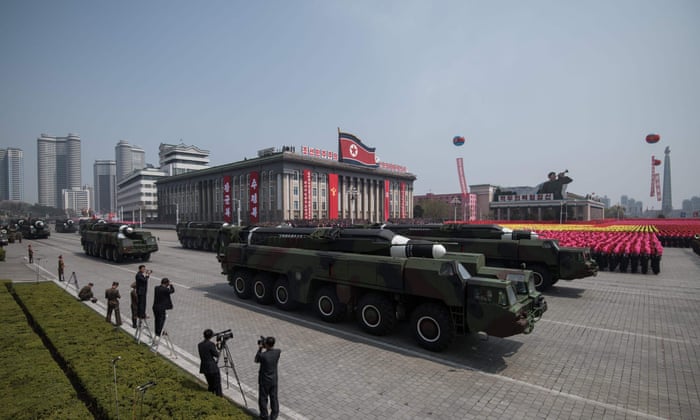 |
| Chinese experts also flagged the need to monitor for radioactive leaks from North Korea’s nuclear test site.
Photograph: Ed Jones/AFP/Getty Images
|
Much less view the North as being vulnerable to invasion, change of administration, or attack by its enemies. Yes, its enemies, the very same South and U.S. that Kim Jong Un has so generously permitted to believe that he had undergone a change of heart. He hadn't, after all, undergone an unimaginable surrender of his autonomy and jurisdiction, merely toyed with the impressions he left on others' gullible imaginations that his coy manipulations reflected an authentic change of heart.
That June 12 meeting between Kim and Trump? Oh, well.
The Max Thunder drills initiated Monday with 100 aircraft whereby South Korea and the United States undertook another iteration of their regular joint military drills is cited as being responsible for the North's withdrawal from civil discussion, representing as it does to the North, an
"intended military provocation" as well as an
"apparent challenge" to the legitimacy of the overtures undertaken at the April summit when Kim's attitude so delighted South Korean President Moon Jae-in.
No more animosity, a future bright with high-level exchanges of trust and mutual regard.
An earlier military drill between Washington and Seoul was conducted without Kim resorting to threats despite that it was a much larger event. No condemnation on that occasion. But that was then and this is now. Of course North Korea will continue dismantling its nuclear test site given the mountain's near collapse on that site thanks to a series of earthquakes occasioned by those nuclear tests. Yes, it will be a geological challenge to find an appropriate alternate site, but the will is there and that's the way of it.
/cdn.vox-cdn.com/uploads/chorus_image/image/59693923/GettyImages_842003638_sized.0.jpg) |
|
This photo was released by North Korea’s state-run
news agency on the same day as North Korea’s sixth nuclear test. North
Korea claims it’s a thermonuclear weapon.
Photo: AFP/Getty Images
|
Labels: North Korea, Rapprochement, South Korea, United States
Turkey's Transformation
Turkey appears to be going through some hard times. Their prime minister, Recep Tayyip Erdogan, who once pointed with pride to the firm economic position he had led his country into, now oversees an economy with a number of hiccoughs. The Turkish currency is falling, foreign investment in the country has come to a bit of a standstill. Perhaps there is some international skittishness in a country whose prime minister has revealed himself as a bad-tempered autocrat.
One who has garnered the reputation of stifling and arresting more journalists than almost any other country. A man who has seen fit to describe Turkish citizens as riff-raff and worse, because they have been protesting in public parks over what they see as a deterioration of their social and natural environment. And the Freedom and Justice party now in power which claimed to be incorruptible has been revealed as quite corrupted.
A national channel
reporter, Hüsna Sarı, and protestors are hit by pressurized water and
teargas as police in Ankara disperse a protest. (Photo: Cihan) 13 February 2014 /ANKARA, TODAY'S ZAMAN
Turkey's long-held bid for membership in the European Union seems of late to have edged a little further away from eventual-if-ever-acceptance, since the EU has expressed its alarm and distaste over the government's arrest of hundreds of police, and its suspension of justices and the arrest of magistrates it feels present a threat to the reputation of the government.
That Turkey's military has now, finally, found within itself the resources to protest that the government's arrest, charges of treason, and trials on trumped-up charges resulting in senior military personnel being sent away to serve long, very long prison sentences, represents yet another inconvenient upset for Prime Minister Erdogan.
He has expressed his disdain for Egypt, for removing the Muslim Brotherhood from power. And he has gone to great lengths to consolidate his support for and friendship for the Islamic Republic of Iran, to the point where Turkey surreptitiously bypassed sanctions to provide gold for oil through the corrupt ministers of the Freedom and Justice Party.
That Mr. Erdogan's son was one of the beneficiaries of that corruption has not sat very well with Turks who find the increasingly Islamist slant of their country disturbing, and quite nontraditional, a course steered far from their Ataturk legacy of a secular government in a religious society. On the good news front, Turkey's parliament has approved a plan to reform their top judicial body.
The BBC's James Reynolds said there have been fights in parliament before, but this one "gives the temperature" of the times in Turkey - unfortunately a brawl ensued leaving one lawmaker with a broken nose.
And the rapprochement exercise leading to a reconciliation agreement between Turkey and Israel purportedly over the after-effects of the Turkish-flagged Mavi Marmara whose Islamist thugs, preparing to break the internationally legal Israeli blockade of Gaza were killed when they attacked Israeli naval commandos boarding the ship, is off. Israeli Prime Minister Netanyahu rendered the requisite "apology", an agreement was made to pay restitution to the families of those killed.
But the last and final demand by Recep Tayyip Erdogan that Israel lift the blockade and effectively thereby allow itself to be violently obliterated by a well-armed and jihad-determined Hamas, whom Mr. Erdogan so strenuously admires as a responsible 'government', was turned down by Israel.
"In fact, it is not a new demand. At the same time, not everything that Erdogan says is really Turkish foreign policy", explained Ceren Kenar, colmnist for the Turkish daily
Turkiyye.
Ms. Kenar's opinion is that Israel and Turkey will eventually sign that reconciliation agreement. In part, she averred, since Turkey is interested in buying $15-billion in natural gas from Israel, which it can then forward by pipeline to Europe.
She may be quite correct, but it isn't likely that this will occur any time soon; certainly not until this government has been replaced by another, perhaps less Islamist one, and certainly headed by a prime minister who is not a devoted anti-Semite.
Labels: Conflict, Economy, Iran, Islamism, Israel, Rapprochement, Turkey
By Shashank Joshi
Research fellow, Royal United Services Institute
 The deal was announced by the EU foreign
policy chief Catherine Ashton, accompanied by the foreign ministers of
Iran, the US, UK, Russia, China, France and Germany
The deal was announced by the EU foreign
policy chief Catherine Ashton, accompanied by the foreign ministers of
Iran, the US, UK, Russia, China, France and Germany
This
weekend's agreement between Iran and Western powers, which increases
Iran's distance from a nuclear weapon, is the most significant
breakthrough in their nuclear dispute for 10 years.
But for Israel, Saudi Arabia and the other Arab monarchies,
the photographs of their US and European allies celebrating a deal with
their historic rival Iran have some disturbing implications.
The response has not been universally hostile. The United
Arab Emirates said the agreement could support "the stability of the
region", and Bahrain's foreign minister said it "removes fears from us,
whether from Iran or any other state".
But others were less positive.
Israeli Prime Minister Benjamin Netanyahu insisted that the deal was a
"historic mistake" that "turns the world into a much scarier place".
A Saudi foreign policy adviser warned that the West's
quid-pro-quo for the deal was "giving Iran more space or a freer hand in
the region". What explains this angst?
Since the Iranian revolution of 1979, Israel and the Arab
monarchies have viewed Iran as a major threat. Iran has given money and
sophisticated missiles to militant groups on Israel's periphery, the
most powerful of these being Lebanon's Hezbollah.
The Arab monarchies argue that Iran has subverted their
Sunni-led and mostly Sunni-majority nations by supporting disaffected
Shia communities.
In 2003, the US-led invasion of Iraq transformed it from an
Iranian enemy to an Iranian ally. In 2011, the US stood by as another
staunchly anti-Iranian regime in Egypt was toppled.
More recently, Saudi Arabia was shocked when the US suddenly
cancelled planned missile strikes against the Syrian regime, squandering
what Riyadh saw as the best opportunity to roll back Iranian influence
in years.
That Saudi Arabia found out about the cancellation from CNN,
rather than being told by American officials, added insult to injury.
For these countries, the nuclear diplomacy is therefore about
more than just the nuclear dispute. They worry that the West has
prematurely eased the pressure before Iran completely surrendered,
leaving Iran with enough nuclear infrastructure to allow it to build a
bomb in the future.
Benjamin Netanyahu: "It's a historic mistake"
They will be particularly vexed that the agreement envisages
allowing Iran to continue enrichment of uranium (albeit under heavy
curbs) indefinitely, something that Israel in particular had opposed.
But their greater fear is that this opens the door to a US
accommodation of Iran in the region which, when combined with a growing
US focus on Asia, will lead to a progressive erosion of America's
inclination and ability to protect Israeli and Arab interests against
Iranian meddling.
In some ways, this fear of abandonment is a rekindling of old
anxieties. On a recent trip to the Gulf, an official from one Arab
country told me that "we can remember a time when the US was closer to
Iran than Saudi Arabia", referring to the reign of the Shah of Iran.
These fears are overwrought, but they are sincerely and
widely held in the Middle East. They are reinforced not just by the fact
of this deal, but also the way it was done.
It is reported that the US had been in secret bilateral talks
with Iran since before the June election of Iranian President Hassan
Rouhani - including over the period it cancelled the Syria strikes - and
that Saudi Arabia tipped Israel off about these clandestine contacts.
This highlights two interesting trends. First, Saudi and
Israeli perceptions are increasingly converging, despite the fact that
Riyadh does not even recognise Israel as a state.
Second, US allies are increasingly convinced that US-Iran
co-operation will inevitably come at Arab and Israeli expense - a view
that will harden if Iran is now included in US and Russia-led peace
talks for Syria.
 The Iranian negotiators were cheered when they arrived at Tehran's Mehrabad Airport
How can these countries respond? Israeli officials have warned
that they are not bound by the terms of the deal - an implicit threat
that the military option remains on the table - and Saudi officials
intimate that they can procure a nuclear weapon for themselves from
Pakistan.
Neither of these steps is likely for the duration of this
interim deal. As Israel's former army intelligence chief Amos Yadlin put
it: "In the coming six months the legitimacy of an attack will
diminish".
But the US and Israel have previously co-operated on
cyber-attacks against Iran, and Israel is widely believed to have
assassinated Iranian nuclear scientists. Such covert action should not
be ruled out, though it would anger Washington and all those who
negotiated this agreement.
If a longer-term settlement does not follow, and Iran renews
its nuclear expansion, then the risk of Israeli airstrikes will grow
significantly.
It is implausible that Saudi Arabia will offer direct
military assistance to any Israeli attack, as Britain's Sunday Times
newspaper suggested this month, but it might secretly grant over-flight
rights to Israeli bombers.
Saudi-Israeli intelligence contact is also likely to
flourish, particularly as the two countries look for any sign that Iran
is cheating on the deal. But neither country can afford to push the US
too far away.
The Geneva agreement is a modest step that leaves much work
still to be done. But for some of America's allies, it is a troubling
sign of things to come. Their priority will be to ensure that this
nuclear thaw does not now turn into a regional realignment.
Labels: Capitulation, Iran, Nuclear Technology, Rapprochement, Sanctions, United States
Denial, Deception, Delay
"We believe that the regime in Tehran should reach the dilemma of whether to go on with the [nuclear] project or to survive as a regime. We were just about to reach that point with economic sanctions.
"We see it happening in front of our eyes -- we have lost the momentum of the sanctions. We already see the stock market is rising, the ratio of the rial [Iranian currency] to the [U.S.] dollar has improved. The Chinese have also approached the Iranians to renew contracts that they lost [because of sanctions] in 2010."
Israeli Minister of Defence, Moshe Yaalon

Speaking in Jerusalem to the General Assembly of the Jewish Federations of North America, Defence Minister Moshe Yaalon gave warning that the international community is verging on a "historic mistake", that will result from easing sanctions on Iran. Because of the seeming imminence of just such an agreement, however temporarily delayed, Great Britain has decided to re-establish its embassy in Tehran, after a long hiatus in diplomatic relations.
Iran has reached an agreement to permit UN IAEA inspectors into several of their nuclear sites. Which is to say specific sites, by no means all of them. The most controversial of the sites which inspectors from the International Atomic Energy Agency have been attempting to access, and meeting with no success is Parchin. This is where the IAEA believes testing has been done on triggering devices for nuclear weapons.
 |
| Isfahan, Uranium conversion plant |
Yet this agreement too, between the IAEA and Iranian negotiators has been greeted as a great breakthrough ostensibly leading to a relaxation of pressures on the Islamic Republic of Iran and its nuclear program. A program which Tehran made perfectly clear through the words of its new president Hassan Rouhani and its foreign minister, it has no intention of surrendering to the demands of its critics.
It has been crystal-clear on its 'right' to enrich uranium, on its 'right' to complete its nuclear goal.
 |
| Bushehr, Nuclear power station |
The international community appears to have been mesmerized by the prospect of a new day dawning in relations with the rigid Islamic theocracy under their new president. A man lauded for his moderate, reasonable stance, his smiling promise to usher in a new, trusting relationship between Iran and the international community. Iranian Nobel Peace laureate Shirin Ebadi has condemned Iran's human rights record under its new president.
 |
| Arak, Heavy water plant |
The smiling 'humanitarian' whom diplomats and politicians in the West are eager to cultivate has presided over a marked increase in public executions. Ms. Ebadi pointed out that in the last ten days alone, no fewer than 40 people had been executed, including political prisoners. Since the inauguration of President Rouhani in August, executions have doubled in number, in comparison to the year before.
She referred to the anniversary celebrations of the storming of the U.S. Embassy in 1979 a week earlier where tens of thousands of demonstrators chanted
"death to America", a dearly beloved curse, accompanied by the burning of American flags.
"How do they want to have a rapprochement with America when they do that? Therefore, I think it's too early to judge whether the relations between Iran and America will improve or not", she said.
She railed against the retaliatory hanging of 16 Iranians whom authorities named as "rebels", in revenge for the death of 14 border guards killed in a clash on October 25 with government opponents, near the frontier with Pakistan. Those 'rebels' had been arrested long before the attack, having nothing to do with it. She condemned Iran's government for its abuse of human rights because of
"fear, but they use religion or abuse religion in order to justify it."
This is also the administration that cultivates its ties with violent jihadist Islamist groups like Hezbollah and Hamas, arming, training and provisioning them to use them to launch terrorist attacks in the Middle East and abroad. And this is the country that the G5+1 stands on the verge of relaxing sanctions upon, imposed for fear of their intentions to achieve a breakthrough on the production of nuclear weapons.
American Secretary of State John Kerry expresses his hope that an agreement on Iran's nuclear program could be signed within months. Irwin Cotler, a former Canadian Minister of Justice under a previous administration, warned against the
"charm offensive" by Hassan Rouhani.
"Iran has engaged in a 3-D strategy -- denial, deception and delay", he charged.
Hello! Is anyone listening?
Labels: Hypocrisy, Iran, Negotiations, Nuclear Technology, Rapprochement, Sanctions, United States
Exclusive: Obama forewarns Netanyahu that sanctions against Iran will soon be partially lifted
DEBKAfile Exclusive Report October 10, 2013, 12:31 AM (IDT)

A deal made at their last meeting in the White House on Sept. 30
President Barack Obama has notified Prime Minister
Binyamin Netanyahu that his administration will soon start the partial
and gradual easing of economic sanctions against Iran,
debkafile
reports exclusively from its Washington and Jerusalem sources. The
reduction would apply to “non-significant” yet “substantial” sanctions,
the message said.
Israel is the only American ally to receive prior warning of this
decision - and the only one to be briefed in detail of the
understandings Washington has reached with Tehran, including Iran’s
concessions on its nuclear program. Neither European, nor Persian Gulf
leaders led by Saudi Arabia have been let in on the scale of reciprocal
concessions approved by Obama and Iran’s supreme leader Ayatollah Ali
Khamenei.
These concessions will start coming to light when they are put on the
table of the nuclear negotiations beginning in Geneva on Oct. 15 between
Iran and the P5+1 group (five Security Council permanent members and
Germany).
Meanwhile, high-ranking British, French and other European emissaries
arrived in Jerusalem Thursday night. They said they were coming to
discuss the latest developments on the Iranian question, but their real
purpose was to discover the content of Obama’s message to the Israeli
prime minister.
A high-placed American source told
debkafile early Thursday: “The American-Iranian cake is already in the oven and half done.
In its next issue, out this coming Friday,
DEBKA Weekly divulges
in detail the content of the understandings reached between Washington
and Tehran, how they were handled and the live wires acting as liaison
in the secret exchanges. Exclusive articles will also discuss the
strategic, political and military ramifications of the deals struck
between Washington and Tehran.
Labels: Iran, Nuclear Technology, Rapprochement, United States
Netanyahu has tough task of rebuilding a credible Israeli military option against Iran
DEBKAfile Special Report October 2, 2013, 9:23 AM (IDT)

Binyamin Netanyahu revives military option
After Prime Minister Binyamin Netanyahu met with
President Barack Obama at the White House Monday, Sept. 30, Secretary of
State John Kerry carried a message requesting moderation in the speech
he was to deliver next day to the United Nations.
On the other hand, at least two European diplomats, German and
French, made the opposite request: they asked for a hard-hitting Israeli
peroration for setting boundaries - not so much for Iran’s nuclear
program as for attempt to slow down President Obama’s dash for détente
with Tehran.
It is feared in European capitals that the US is running too fast and
too far in his bid for reconciliation with the Islamic Republic, to the
detriment by association of their own standing [in] the Persian Gulf.
They are moreover miffed by the way Washington used Europe as a tool
in the long nuclear negotiations between the Six World Powers with Iran
and is now dumping them in favor of direct dealings with Iranian
leaders.
Netanyahu decided not to accede to either request. Instead he laid out
his credo: Iran must discontinue nuclear development and dismantle its
program or face up to the risk of a lone Israeli military attack.
The look on the face of US Ambassador to Israel Dan Shapiro, sitting
at the US delegation’s table in the UN hall, showed he had realized that
the prime minister’s words were not just addressed to Tehran; they were
an unforeseen broadside against the Obama administration’s Iranian
strategy.
The dissonance between Jerusalem and Washington on Iran and its nuclear
aspirations, played down after the Obama-Netanyahu meeting at the White
House, emerged at full blast in the UN speech. The consequences are
likely to be reflected in American media, as they were at the low point
in relations in 2010, when administration officials day by day planted
negative assessments of Israel’s military inadequacies for damaging
Iran’s nuclear facilities.
After the UN speech, the Israeli Home Defense Minister Gilead Erdan
tried to pour oil on troubled waters by commenting that the prime
minister’s speech had strengthened Obama’s hand against Tehran. However,
Netanyahu had a different object[ive]. It was to paint Washington’s new
partner in détente in the blackest colors, even though he knows there is
no chance of swaying the US President from his pursuit of Tehran and
the sanctions, which he believes to be the only effective deterrent for
giving the Iranians pause, will soon start unraveling.
Binyamin Netanyahu now faces the uphill job of repairing his own
credibility. For five years has had declared again and again that
Israel’s military option is on track in certain circumstances, but has
never lived up to the threat. He has followed a path of almost total
military passivity.
President Obama knows that Israel’s military capacity is up to a solo
operation against Iran. Tehran, however, though conscious of the IDF’s
high military, technological and cyber warfare capabilities, is
convinced that Israel like the United States has lost the appetite for a
military initiative.
Netanyahu must now revive Israel’s deterrence and convince Iran that
his challenge at the UN had ended an era of military passivity and
should be taken seriously.
In the coming weeks, therefore, the Iranians will react with steps to
upset US-Israeli relations, possibly by raising military tensions in
the region directly or through their proxies. Until now Tehran operated
from outside Washington and its inner councils. Now, smart Iranian
diplomats will be sitting down with the US president close to his ear
for friendly discussions on ways to further their rapprochement.
Labels: Defence, Iran, Israel, Nuclear Technology, Rapprochement, Security, United Nations, United States
Netanyahu Supports
A 'Syrian Model' for Iran
|
 |
US President Barack Obama meets with Israeli Prime Minister
Benjamin Netanyahu in the Oval Office of the White House in Washington,
Sept. 30, 2013. (photo by REUTERS/Jason Reed)
|
The Israeli party pooper arrived in Washington, walked into the White
House and seemed to have learned some manners and etiquette in the
interim. Israeli Prime Minister Benjamin Netanyahu has shown that you
can still change after turning 60. After all, he was responsible for the
horror show with US President Barack Obama at the White House when he
gave the American president a learned and reproachful tirade in front of
the media. This traumatic event, which took place in 2009 at their
first meeting during the first term of both leaders, has been dubbed
“The Lecture” in the United States. Obama must have felt the way
President Bill Clinton felt after his first meeting with Netanyahu in
1996.
Summary :
Israeli
Prime Minister Benjamin Netanyahu would gladly embrace employing a
military threat to convince Tehran to halt its nuclear program.
Original Title:
Netanyahu supports the Syrian model
Author:
Ben Caspit
Posted on:
October 1 2013
Translated by:
Simon Pompan
|
But this is 2013, and
Obama and Netanyahu have
built a certain kind of trust. The Israeli premier was careful on Sept.
30 to show reverence toward the American president, emphasizing their
points of agreement while elegantly glossing over the moot issues. He
was careful not to be a wet blanket on Obama’s party, especially with
fallout over the US federal budget expected the next day, an issue of
much greater interest to the American president and public than the
centrifuges in Natanz.
That being the case,
Netanyahu still planned to relish the opportunity to
ruin the world’s party during his address to the UN General Assembly on
Oct. 1. This article was written before the speech, and the information
provided here is based on discussions, assessments and positions voiced
in the backrooms of the offices of the prime minister and members of
the top echelon of Israeli politics prior to Netanyahu's departure for
the United States.
My assumption is that some of these things came up during the
tête-à-tête between Netanyahu and Obama while some did not. Even the
terminology used
by defense chiefs and senior ministers at meetings with Netanyahu
radically changes when the prime minister steps into the Oval Office.
Presumably, the atmosphere at the meeting between the two leaders was
most probably less relaxed than what they displayed at their joint press
conference.
From Netanyahu’s standpoint, his entire worldview, his life’s calling
and vocation were weighing heavily on his shoulders when he faced the
president who seeks to embark on negotiations with Iran, which is on the
cusp of acquiring a nuclear military capability. Netanyahu has no room
for maneuver or mistakes. All he has is Obama.
What emerges from talks with his associates is that Netanyahu feels
that he is bearing the heavy burden of the Jewish people’s history on
his shoulders when he is sitting there, trying to convince the president
that the Iranians are planning to deceive him, fritter away time, “talk
and enrich” until they find the right time to announce a fait accompli,
a done deal — Iran is nuclear and henceforth untouchable.
In the backrooms in Jerusalem, allegations are leveled at America’s
“lack of leadership,” vacillation, zigzagging and weakness. Iranian
President Hassan Rouhani, Israelis are saying, is coming to these
negotiations on all fours, but it is the Americans who are actually
crawling, wooing him, offering “water-cooler meetings.” They dance to
the Persian flute, whose sole purpose is to fool the West and loosen the
tight economic noose around Iran’s neck, even at the price of somewhat
delaying their progress toward acquiring a nuclear military capability.
Iran’s President Rouhani, Israelis are saying, is the “master of
deception,” having himself coined the phrase “talking and enriching” and
having written a book on his tenure as the head of the Iranian nuclear
negotiation team. His smile conceals cunning, determination and
perseverance. We must not be led on. We must not let up. We need to take
advantage of the momentum. This is the moment of truth. If the Iranians
understand that there is no intention to cut them any slack at this
juncture, it is possible that this watershed will take place. But if
they pick up signs of weaknesses, fatigue and a desire to tick a box and
move on, they will exploit this situation to the fullest extent, as
world champions at noticing this kind of situation.
Israel will be prepared to buy into a copy of the
Syrian model.
Netanyahu was supposed to say that to Obama. Here, Syria has pledged to
fully dismantle its weapons of mass destruction. It agreed to do so
only because there was a real, credible military option on the table.
Only when the American destroyers started converging on Syria’s shores
and the aircraft carriers moved at full steam toward the country did the
Syrians, as well as the Russians, understand that it was time to let
go. Just as the Americans did not agree to let the Syrians put up
cameras in front of the chemical weapons depots, but demanded (and were
given) a commitment to have the weaponry fully removed, dismantled and
destroyed, a similar insistence should be made in the Iranian case. Iran
should not be allowed to enrich uranium on its soil.
Notwithstanding, Netanyahu had something new to say at the Oval Office.
He talked about Iran’s “nuclear military program.” This might suggest
that Israel is prepared to consider the American position as outlined in
Obama’s UN speech, namely allowing Iran to keep nuclear technology for
peaceful purposes. Does that include the enrichment of a limited
quantity of uranium at a low grade? This remains unclear.
The key question remains what will happen once the talks between Iran
and the five large nuclear powers—the United States, Russia, China, the
United Kingdom and France — resume in the middle of October. Israel
suspects that Iran will make a few gestures, expecting more lenient
sanctions in return. This must not be allowed to happen. The easing of
sanctions should occur only when truly concrete measures are
implemented, ones that can be verified, supervised and guaranteed.
Jerusalem knows that the Iranians are the most skilled people in the
world at sniffing out and sizing up the perplexed client in front of
them at the bazaar. They will exploit any moment of weakness, using
every trick in the book to stall while trying to rescue their crumbling
economy without giving up true assets. In the wake of the American
zigzag in the Syrian case, Tehran is not really deterred and does not
really buy into the military option facing it. The Israeli one has
eroded while the American one has been proven to be empty. As noted,
however, Netanyahu would buy, with open arms, the Syrian model provided
that the end result is that Syrian President Bashar al-Assad is disarmed
of his chemical weapons.
As of Sept. 30, the model appears to be successful. By some Israeli
accounts, the initial list of the chemical weapons arsenal that the
Syrians submitted to the West seems to be more or less authentic. This
is the less important list. Over the coming few days, the Syrians were
to submit a more detailed list. This is where they will be put to the
real test.
At this stage, these indications suggest that Assad has come to the
realization that his chemical weapons pose a threat to his life and his
regime and not the other way round. He has come to terms with the fact
that in the overall cost-benefit analysis, he has lost this tool. The
reports about his attempts to transfer some of the weapons to Hezbollah
are incorrect.
It is possible that Assad will try to keep some small quantities for
himself, but even Hezbollah has realized that it neither needs nor is it
interested in the chemical weapons. At this stage, the
Russian-brokered agreement is
a rare diplomatic success, which was accomplished by chance, following a
demonstration of soft power and zigzagging by the American
administration.
Israel hopes that Obama will not arrive at the wrong conclusion from
what had transpired here. To solve the Iranian problem, Jerusalem says,
he will need to demonstrate much greater resolve, creativity and a much
larger stick than the one he flashed at Syria.
Ben Caspit is
a contributing writer for Al-Monitor's Israel Pulse. He is also a
senior columnist and political analyst for Israeli newspapers, and has a
daily radio show and regular TV shows on politics and Israel. On
Twitter: @BenCaspit
Labels: Defence, Iran, Israel, Nuclear Technology, Rapprochement, Security, United Nations, United States
Egypt Cancels all Flights, Tourism Ties with Iran
Egypt officially announced the severance of all tourism activities with Iran, including direct flights renewed just last March.
By Adam Ross --
Arutz Sheva 7
First Publish: 10/1/2013, 9:00 PM

Airplane (illustrative)
Flash 90
Egypt has announced the formal cessation of all
direct flights and tourism ties with Iran.
The
announcement came Tuesday, with Egypt stating it has ordered an end to
all tourism activities with Iran. These had increased considerably
during the yearlong rule of Morsi and the Muslim Brotherhood.
Whereas
deposed Egyptian president Mohamed Morsi tried to improve relations
with Iran, seeing it as a natural ally, the new regime is trying to
distance itself from Tehran.
The Egyptian security establishment
is currently fighting a bitter battle against Islamist terrorists who
have a grip on some parts of the country. Yesterday three Egyptian
policemen were
gunned down in Sinai."The
security situation does not currently permit the Ministry of Tourism to
support travel to Iran, including flights and trips," said ministry
spokeswoman, Rasha Azaiza .
In contrast to the Egyptian decision to cancel flights to Iran, Tehran announced Monday that it was seeking to establish
direct flights to the US in continued efforts to revitalize US-Iranian ties.
The move, along with the general rapprochement Iran is seeking with the US, has raised
alarm bells across other Middle Eastern countries.
A
Saudi journalist close to the Saudi monarchy yesterday criticized the
warming of relations between Washington and Tehran, following the phone
conversation between US
President Barack Obama and Iranian President Hassan Rouhani.
According to the report by Israel's
Channel 2,
journalist Abdel Rahman Rashed said that if the US did not continue to
take a firm attitude against Iran, Middle Eastern countries would have
to face a future with an Iran armed with nuclear weapons.
In an article published in London's
Asharq Al Awsat newspaper, Rashid wrote that the
phone call between Obama and Rouhani
shocked the Gulf states, Jordan, Turkey, and Israel as well as other countries.
Labels: Arab League, Communications, Egypt, Iran, Nuclear Technology, Rapprochement, Security, United States
Netanyahu can't hope to regain Israel’s voice in headlong US-Russian-Iranian nuclear diplomacy
DEBKAfile Exclusive Analysis September 30, 2013, 11:09 AM (IDT)

An earlier encounter
Although a face to face between prime minister
Binyamin Netanyahu and President Barack Obama is obviously worthwhile
for both countries, the prime minister need not expect to deflect the
president from his pursuit of a nuclear deal with Tehran when they meet
Monday, Sept. 30. At best, he will come away with soothing assurances
that any new intelligence he presents will be seriously looked into. But
he can’t hope for real substance for two reasons:
1. Obama can no longer turn away from the path he has set himself,
because he is driven by the ambition to prove that international
problems can be solved without military force and solely by good will,
negotiations and diplomacy.
2. After convincing Russian President Vladimir Putin that he means
what he says and is not planning to repeat his “mistaken” US military
involvement in the 2011 Libyan civil war, Obama removed a major obstacle
in the way of a US-Russian deal on Syria’s chemical weapons.
It is now the turn for Washington, Moscow and Tehran to continue the
process with a parallel consensual deal on Iran’s nuclear program.
From Tehran, the US and Russia might be seen to be preparing to
impose a nuclear settlement on Iran in the same way as they did for
Syrian President Bashar Assad’s chemical weapons. However, if that is
what is contemplated, Obama and Putin will soon find Tehran is not
Damascus, and the ayatollah in Tehran is a completely different
proposition from his Syrian ally.
The wily supreme leader Ali Khamenei in fact sees his chance of turning
the situation around to the Islamic Republic’s advantage. He grasps that
the American and Russian leaders are in a hurry to reap the results of
the Obama administration’s decision to forswear a military option for
bringing Tehran round. Their headlong quest for quick results gives
Tehran the leverage for extracting previously withheld concessions on
its nuclear program, such as extreme flexibility on its enriched uranium
production and stocks.
Netanyahu may hear Obama promising to stand by his demand that Iran
stop enriching uranium and export the bulk of its stocks, or surrender
it for destruction like Syria’s chemical weapons. But he will also
discover that Obama and Putin are running ahead together at breakneck
speed after dropping Israel by the wayside. And the negotiations with
Iran behind the scenes - and continuing in Geneva on Oct. 15 with the
five Security Council powers and Germany - are more than likely to
produce a compromise unacceptable to Israel.
Iran and Russia will have to make some concessions for a deal. But so
too will the United States, and the uranium enrichment issue will loom
large in the way of an agreement unless Washington gives way on that
point. Obama has already covered much of this ground in secret contacts
with Tehran.
The tempo of the negotiations, dictated by Obama and Putin, will make
it easy to blur facts and the present minor concessions as major
achievements.
Secretary of State John Kerry and Russian Foreign Minister Sergey Lavrov
are already smoothing the way for the understandings to come with
messages that fit neatly into world media headlines. Sunday, Kerry
echoed President Rouhani’s [statement] of a nuclear accord achievable in months. At
the same time, mindful of the Obama-Netanyahu meeting Monday, the US
Secretary said in a TV interview, “A bad deal is worse than no deal,”
while US Ambassador Dan Shapiro assured Israelis in a radio interview
Monday morning “The US and Israel share the same goals – preventing a
nuclear-armed Iran.”
Meanwhile, last month’s buzz phrase for the Syrian accord, which called
for “a credible military option” to underpin the understanding, has been
quietly mothballed in both the Syrian and Iranian WMD context
Labels: Chemical Weapons, Hypocrisy, Iran, Israel, Nuclear Technology, Rapprochement, Russia, Syria, United States
Journalist: Saudis, Gulf States 'Shocked' By Obama-Rouhani Chat
Saudi
Arabian officials have sharply criticized President Obama for
conducting phone conversation with Iranian President Rouhani.
By David Lev --
Arutz Sheva 7
First Publish: 9/30/2013, 4:18 PM

Saudi Arabia's King Abdullah
Kingdom of Saudi Arabia
Israelis are not the only ones concerned with the apparent warming
of relations between Iran and the United States; Saudi Arabia
has leveled sharp criticism against U.S. President Barack H. Obama for
conducting a phone conversation with Iranian President Hassan Rouhani.
That conversation, which took place last Friday, will be taken the
wrong way by Iran, Saudi officials said. Saudi journalist Abdel Rahman
Rashad said that he has spoken to government officials who said that
they expect the U.S. to take a much tougher stance against Iran, lest
Tehran take advantage of what it sees like American “softness” to
continue and even expand its nuclear program.
“If the Americans do not take the necessary steps against Iran, the
states of the Middle East will have to deal with a nuclear Iran,” Rashad
wrote in an op-ed in the London-based Arabic
a-Sharq a-Awsat newspaper.
“The
phone call between Obama and Rouhani shocked the Gulf states, Jordan, Turkey, Israel, and other countries,” he wrote.
According to the
New York Times, Obama and Rouhani "agreed
to accelerate talks aimed at defusing the dispute over Iran’s nuclear
program and afterward expressed optimism at the prospect of a
rapprochement that would transform the Middle East."
According to the Iranians, it was Obama that sought to speak to
Rouhani, but Rahman said it did not matter who sought to speak to whom.
“What is important to know is what stands behind the conversation and how deep the ties are between America and Iran.”
The Saudis are very concerned about Iran's
acquisition
of nuclear weapons, fearing they will be aimed at the Sunni country by
an aggressive Shi'ite competitor. At a recent meeting of the Gulf
Cooperation Council, Former Saudi intelligence chief Prince Turki
al-Faisal said that Iran could threaten to attack Saudi Arabia – and
thereby interfering with shipments of oil to the West – if it achieved
nuclear weapons. This, he said would increase the chance of war,
conventional or otherwise.
"Any threat to our interests or security will force us to use all available
options to defend our interests, and national and regional security," Faisal was quoted as saying by the
Al-Arabiya
news channel. "The mounting escalation and persistent tensions might
end up in an adventure with unpredictable consequences or in an unwanted
military confrontation."
Iran has warned Western governments that it will close the
strategically vital Strait of Hormuz at the mouth of the Gulf, a
strategic choke point for much of the world's oil supplies, if they
press ahead with sanctions against its key crude exports.
"Iran must not
fuel this
conflict and must not threaten us when we commit to international
decisions," Faisal said. "It must safeguard the security of the Strait
of Hormuz and that of the world energy supply."
Labels: Iran, Rapprochement, Saudi Arabia, United States
Manic Euphoria
"While there will surely be important obstacles to moving forward and success is by no means guaranteed, I believe we can reach a comprehensive solution.
"I do believe there is a basis for a resolution."
American President Barack Obama
"I want it to be the case that this trip will be a first step, and a beginning for better and constructive relations with countries of the world as well as a first step for a better relationship between the two great nations of Iran and the United States of America."
Islamic Republic of Iran President, Hassan Rouhani
There were constraints. It could not be otherwise, after all. Hostility has raged between the country of Iran since the Iranian Revolution took the country into theocratic totalitarian status, and the democracy of the United States of America which suffered the outrage of a violent attack against its diplomatic mission in Tehran. A level of hostility emanating from the Republic of Iran that has never been mitigated, toward the country it names the
"Great Satan".
A country which is demonized within Iran, with shouts of the faithful resounding from time to time on cue from the government of
"Death To America!" Iran's intransigence on its perceived threat to peace and the societies that surround it with its determination to develop nuclear weapons, despite its claims to no such aspirations, has awarded it with international sanctions against its economic interests.
Those sanctions and the assault on its reputation as a terrorist-sponsoring country that specializes in the oppression of its own people and its intentions toward domination of the region through the coercion of fear and violence, appear to have persuaded the leading Ayatollahs that it might be in their best interests to employ a change in tack.
Not to alter their ambitions or their governance, but to use a more sophisticated, genial and cosmopolitan attitude toward the outside world. A well-considered gambit.
And it has gambled wisely. For, without altering one iota of their devastatingly vile human-rights agenda, or committing to responding positively to the demands of the United Nations and the IAEA that it open its nuclear technology environment to international scrutiny, it has scored a huge success in charming the haplessly trusting West by coyly smiling rather than employing its usual harsh scowl.
It doesn't, after all, take much to disarm those whose own agenda is to be collegial, congenial and co-operative; three baseline Cs that have always offended the Islamic Republic of Iran.
And so, finally, though an initial handshake of courtesy and civility was not on the books at the United Nations, and nor was a meeting between the two presidents of the United States and Iran, a brief telephone conversation was, as Mr. Rouhani left the land of evil to return to the land of piety. A brief conversation of no moment aside from a cursory facade of courteous pretense.
Talks will continue, stated President Obama. If the talks are of the substance and ilk that he exchanged in that conversation they are less than worthless. If the verbal promissory notes that were proffered by Iran to the world are as trustworthy as its balefully malicious activities of violence and horror have been predictable in the so-recent past, little will be produced of any value to the world in the sham that is detente presented for world consumption, latterly.
The reality is that we live in an uncertain world governed in part by those would do good and those who have no such intention, squaring off against one another. The other is that the former tend to be trusting while the latter know better. And the cunning manipulation of the former by the latter appears to take the world stage with perfect aplomb.
In whose mirror image the United Nations presents itself.
Labels: Controversy, Hypocrisy, Iran, Rapprochement, United Nations, United States
 Both supporters and opponents met Mr Rouhani on his return to Tehran
Iranian
President Hassan Rouhani has been met by hardline protesters chanting
"Death to America" on his return from the UN forum in New York.
During his trip, President Rouhani had signalled a shift in tone on Iran's controversial nuclear programme.
This culminated in a phone call with US President Barack Obama - the first such top-level conversation in 30 years.
Hundreds of people gathered at Tehran airport, with supporters hailing the trip and opponents throwing shoes.
An Agence France-Presse journalist said some 200-300
supporters gathered outside the airport to thank Mr Rouhani for his
efforts.
US President Barack Obama: "The test will be meaningful, transparent and verifiable actions"
But opposite them were about 60 people shouting "Death to America" and "Death to Israel".
Mr Rouhani raised his hand to the crowds as he was driven off.
Analysis
 Amir Paivar
BBC Persian
Amir Paivar
BBC Persian
The hardline protesters are angry at the prospect of a detente
between Tehran and Washington, which they see as contrary to the
principles of the Islamic Revolution.
Although a minority in number, the hardliners have always
spoken out loudly against any rapprochement with the US. Their presence,
with or without the support of the higher echelons of the regime, will
serve to keep Mr Rouhani in check, reminding him that he cannot go too
far in this on his own.
On the other hand, social media in Iran is awash with
messages supporting the phone call between the two presidents. It may be
that social media can now give Iranians in favour of change the kind of
voice their hardline rivals have enjoyed in the past.
A New York Times reporter
described the scene as chaotic, with dozens of hardliners hurling eggs
and shoes at the president's convoy.
The Iranian Labour News Agency (ILNA), said: "A crowd of
young people and students gathered at Mehrabad airport to show support
for the president's remarks and his stance during the trip to New York."
It said Ali Akbar Velayati, senior adviser to Iranian Supreme
Leader Ayatollah Ali Khamenei, and a number of cabinet members also
welcomed the president.
The call with Mr Obama was made just before Mr Rouhani left New York.
Mr Rouhani, quoted by the Fars news agency, said it was the
US that had initiated the call, contradicting some reports in the US.
"Yesterday, as we were getting ready to head to the airport,
the White House called and expressed willingness to set up a phone call
between the American president and me," Fars quoted Mr Rouhani as saying
upon arrival in Tehran.
 The protesting hardliners see a US detente as contrary to the principles of the Islamic Revolution
 The opponents were outnumbered by Mr Rouhani's supporters
 Police form ranks to separate the two groups at Tehran airport
 Reporters described the scene as chaotic
"On our way a call was made to our ambassador's cell phone. The
conversation mostly focused on the nuclear issue," he was quoted as
saying.
After the call, Mr Obama said: "While there will surely be
important obstacles to moving forward and success is by no means
guaranteed, I believe we can reach a comprehensive solution."
iprocate - then there's a real chance to make
progress”
Mr Rouhani, who is regarded as a
moderate and was elected in June, has said he wants to reach a deal over
the nuclear issue in three to six months.
He has also asserted that Iran does not seek a nuclear bomb, as Western powers have long suspected.
Mr Rouhani said initial discussions had taken place in an environment that was "quite different" from the past.
The US and China have said they expect Iran to respond to an
existing offer by the US, Russia, Britain, France, China and Germany,
who form a negotiating group known as the P5+1.
The group has asked Iran to halt production and stockpiling
of uranium enriched to 20% - a step away from achieving a nuclear
weapons capability.
It also demanded Iran shut down the Fordo underground enrichment facility, near Qom.
Substantive negotiations between Iran and the P5+1 are due to
take place on 15 October, and Mr Rouhani said Iran would bring a plan
to that meeting, though he did not give details.
Meanwhile, in another apparent indication of rapprochement
between the US and Iran, it emerged that American officials had returned
an ancient silver drinking cup to Tehran.
 US officials said the griffin-shaped cup was "the premier griffin of antiquity"
The ceremonial, griffin-shaped cup dating back to the 7th
Century BC was seized by custom officials in 2003 when an art dealer
attempted to smuggle it into the US,
officials said.
The artifact is believed to have been looted from a cave in
north-western Iran. Its return reflected "the strong respect the United
States has for the Iranian people", the statement said.
Labels: Controversy, Hypocrisy, Iran, Nuclear Technology, Rapprochement, United States


 Israel
 Iran
Iran

