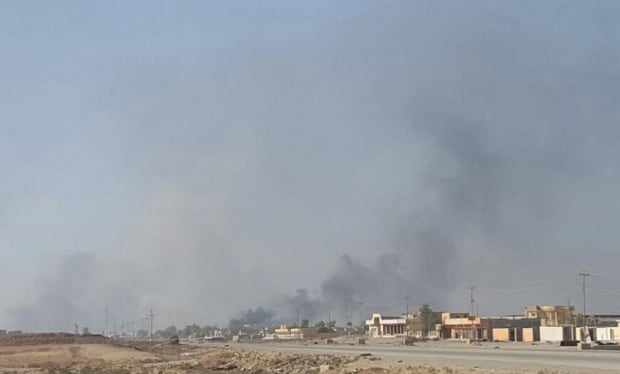
"The battle for al-Bab has been mostly about killing civilians and destroying the city, whether by Daesh or the Turks." "The town is almost half destroyed. Daesh takes cover in hospitals, schools and these end up getting targeted." Mustafa Sultan, al-Bab resident, media activist
"[Syrian opposition fighters . . . were supposed to be] the primary ground force." "[Some Syrian fighters have left the battlefield] and because of their lack of discipline in the field, Turkish commandos are now engaged in front-line fighting against ISIL." Metin Gurcan, former Turkish military adviser
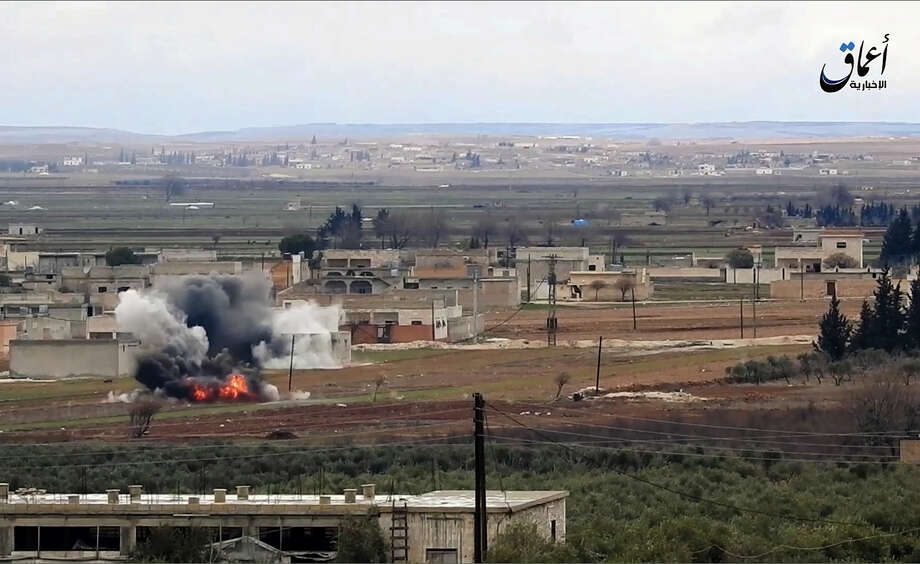
An image from militant video posted online by a media arm of the Islamic
State group on Monday purports to show the moment of a Turkish missile
strike in al-Bab, Syria .Photo UGC
Turkey is embroiled in a complex, multi-theatre conflict from which it will prove to be difficult to extricate itself without growing losses. But it is a conflict partially of its own choosing. The Justice and Development Party is complicit with its irascible head, President Recep Tayyip Erdogan, in returning to its deadly conflict with the PKK. While Turkey's military is the second largest within NATO, it is at odds with the first-largest NATO member, that of the United States of America, whose agenda is at variance with Turkey's.
The American military is fully supportive of the fighting skills and determination of the Syrian Kurds in battling the Islamic State fundamentalist jihadis. And it is the multi-faceted Syrian opposition that the U.S. has given a tentative approval to, in their resistance to the ongoing governance of Syria's Bashar al-Assad whose response to his Sunni civilian population's bid for equal treatment he responded to with chemical weapons and barrel bomb attacks, slaughtering hundreds of thousands he characterizes as "terrorists".
American support of the Syrian rebels has always been tentative, visualizing the potential support and arming by default of foreign terrorists who have flooded Syria and Iraq purposing themselves to the Sunni conflict with Shiite governments. Turkey's support has been geared toward any Sunni-led militias, inclusive of the Islamic State, while denying it does so, as a member of NATO, invested in their destruction as pure, unadulterated terrorists of the highest order.
Because of the demonstrated lack of combat readiness of both the Syrian and Iraqi armies, it was soon realized that no amount of training and re-training would suffice to instill in them the courage and determination to defend their countries without the considerable aid of outsiders whose military strength was superior to their own. Only the Kurdish militias were able to deploy men and women with the undiluted strength of purpose to confront the Islamic State group whose formidable reputation for barbaric slaughter demoralized Iraqi and Syrian fighting men.
The Turks, after initial hesitation, and led by their intention to ensure that the border between themselves and Syria was free of Kurdish YPG possession for fear of the PKK taking inspiration and re-dedication from their Kurdish allies, became fully involved in the conflict to combat Islamic State, in a complete turnabout from supporting them to routing them, while supporting the Syrian rebels and simultaneously attacking the Kurds. Making peace with Russia despite their polarized views on Syria's President Bashar, the Turks plunged headlong into the Syrian melee.
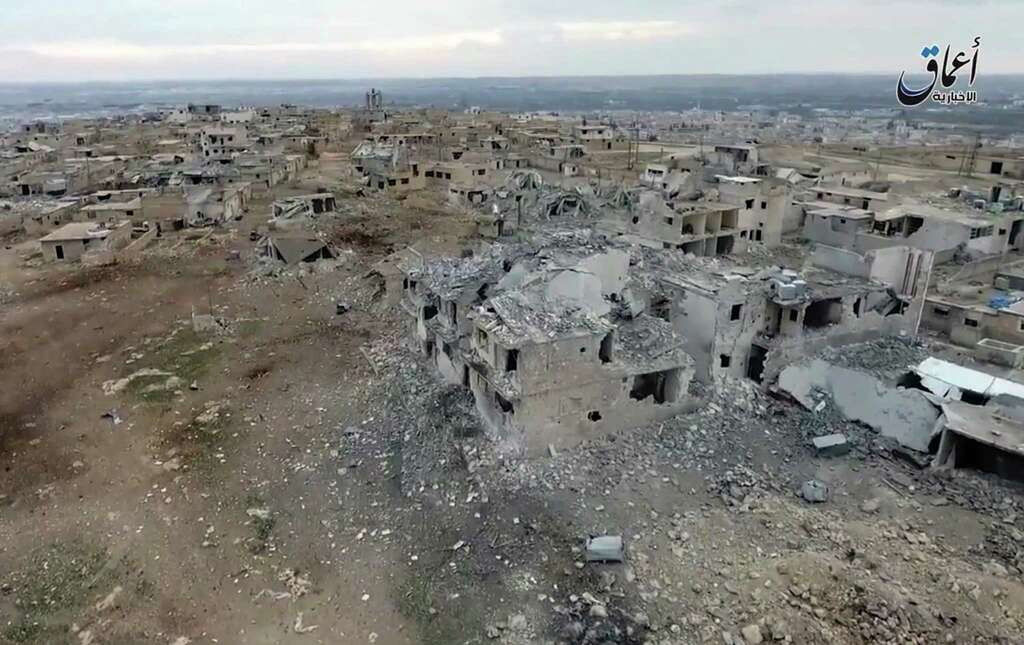
Photo: Uncredited, UGC This still image taken from drone footage posted online Monday, Jan. 2,
2017 by the Aamaq News Agency, a media arm of the Islamic State group,
purports to shows an aerial image of a neighborhood damaged by Turkish
airstrikes in the northern Syrian town of al-Bab, in Aleppo province,
Syria.
And that plunge has proven to be costlier than Ankara had anticipated. Turkey's original ground troop commitment has been expanded from 600 to four thousand. And in the process, there is a growing body count of Turkish soldiers to account for the two months since the first Turkish incursion across its border into Syria. In al-Bab, Turkey is fighting both ISIL and Syrian Kurdish fighters themselves at battle with ISIL. In the course of Turkey's targeting of the Kurds, it is drawing ire from Washington, supportive of the Kurds.
But Turkey hardly is concerned over its rift with the United States, having decided it would fill the gap with a growing reliance on Russia, despite that Moscow unequivocally supports the Butcher of Damascus, and Ankara does not. Since Erdogan is unable to find complete cohesion in the purpose of either America or Russia, it has opted to adapt itself to Moscow's plan of operation. To begin with, the personalities of both Vladimir Putin and Recep Tayyip Erdogan have much in common.
Close to fifty Turkish soldiers have now been killed through their country's Syria operation, most of the deaths taking place since the assault on al-Bab was initiated in mid-November. Fourteen Turks were killed in one day alone where ISIL has surrounded the town with trenches, where the streets of al-Bab are lined with landmines, and where the ISIL habit of ambushes and car bombing targeting besieging forces have made it a formidable foe. Every instance when Turkish-backed Syrian opposition fighters have made headway into the city they've been forced back out again.
The government in Ankara emphasizes the efforts it makes to ensure that civilians are not caught in the crossfire, despite which hundreds of civilians have been killed. Turkey's aim is to destroy the hold ISIL has near its border and in its place see that Sunni Syrians backed by Turkey hold the territory to the east and west, to prevent the Syrian Kurds linking geographically with the Turkish Kurds in a matched territory opposing continued Turkish-Syrian rule of Kurds, in hopes of establishing their own sovereign Kurdish territory.
Syrian
opposition fighters fire toward positions held by Islamic State jihadis
in al-Bab, Syria, Dec. 13, 2016. (photo by SALEH ABO GHALOUN/AFP/Getty
Images)
Turkish troops are now more numerous on the front against ISIL than the Syrian opposition fighters. The Syrian fighters are simply less effective, less dedicated to the task at hand than they were expected to be, given the extensive training they have undergone by Turkish military trainers, necessitating that increase in Turkish military presence in pursuit of accomplishing President Erdogan's hoped-for routing of ISIL, and installation of a Sunni Syrian presence on the border, precluding Kurds.
"I thought, 'This is it, it's over. We've lived under the rule of Islamic State for more than two years and we know that nobody survives such things." "They said anyone who disobeyed would be killed." "The Islamic State was breathing its last breath [in Mosul, Iraq] so I decided to run." "I thought of my wife and son and how I'd never see them again. I got shot, but I didn't know how many times. I felt things hitting my back." "They [Islamic State gunmen] were screaming and shouting. As soon as I heard that, I saw my chance." "It was dark, maybe they weren't that focused It seems they were just shooting randomly." "As for me, I've seen death, and I feel reborn." "Those people [Islamic State jihadi terrorists] are monsters, killers; they don't have any humanity." Imad, Islamic State victim escapee, Safiya, Iraq
An
Iraqi federal police officer examines human remains at a mass grave of
Islamic State victims near Hamam al-Alil. (Marko Drobnjakovic/AP)
The man who managed to escape an organized mass murder by sheer good luck, is grateful to be alive and hoping soon to be reunited with his wife and his infant son. He has returned to his native village while his wife and child remain in ISIL territory. He hopes, finally, to be able to live a normal life, having escaped death, while a witness to the mass slaughter of other men like him from the same village, and others yet who, like him were former police officers, targeted for death by Islamic State terrorists, working off their rage at losing their grip on Mosul.
He is a Sunni Iraqi and he cannot help but feel concerned over what life will be like for him and other Sunnis under the aegis of Iraqi forces, mostly Shiite, like the government of Iraq. He accuses the Iraqi forces of looting and damaging village property while in the process of cleansing it of Islamic State control. But he is resigned to take life as it comes now, reasoning that he and other Iraqi Sunnis living under the ordeal of punishing Islamic State dominion will learn to adjust to the hardships of living under Iraqi military rule.
He lived to tell his tale, after being blindfolded and bound, prepared to be shot in the head, his body discarded like a dirty rag, shovelled into a mass pit. He had been taken by truck along with about a hundred other former Iraqi police and army officers to an industrial area remote from town, about 15 kilometres south of Mosul. They had all been rounded up from nearby villages. His was the first truck unloaded. He was shot in the leg, and the other thuds hitting his back were stones kicked up by misfired bullets.
The terrorists had filmed their new atrocity, forcing each of the men to give name and security forces position they once held. Blindfolded, hands bound, they were informed they were "going to hell". In the darkness that prevailed in their isolated position, someone attempted an escape and a commotion ensued. When he was shot in the leg, Imad pretended he was dead until he saw an opportunity to beak away, run and escape re-capture.
Sunni Iraqis who had served in the police and army had been allowed for the past two and a half years to remain in the ISIL-held territory as long as they agreed to take part in a ceremony, through a process known as towba, to repent their sins. This did not remove them completely from suspicion, however, and as the terrorists came increasingly under fire by Iraqi troops assaulting them to retake Mosul, they began to round up the former police and military men from various villages surrounding the city.
Imad had been on the police force for seven years. He described his ordeal to the security forces into whose hands he fell after fleeing the roundup and death, by walking all night to free himself from the presence of Islamic State jihadis. Imad informed the security forces that double the number of 50 former police officers executed in Hamam al-Alil last month had been killed where he was taken, near a cement factory. Iraqi police forces found the mass grave at the location Imad described, containing 100 bodies.
"If the Kurdish YPG take the lead and play a serious role in the battle for Raqqa, that will make Turkey very nervous and it would be hard to see Turkey fully cooperate within the coalition." "Turkey wants to put a barrier to how far the Kurdish YPG can gain influence." Daveed Gartenstein-Ross, senior fellow, Foundation for Defense of Democracies
"The Raqqa operation should not be conducted by the PYD. The Free Syrian Army with active participation of the local population will be enough to beat IS and Turkey is ready to support this." "The U.S. must review its policy." Turkish Foreign Ministry
"The only force that is capable on any near-term timeline are the Syrian Democratic Forces, of which the YPG are a significant portion." "We think there's an imperative to get isolation in place around Raqqa because our intelligence feeds tell us that there is significant external operations attacks planning going on ... centralized in Raqqa." U.S. Army Lieutenant General Stephen Townsend, U.S. military commander, Iraq
"After the eventual fall of Mosul and Raqqa, ISIS won't hold territory with a substantial population, and this has distinguished ISIS from groups like al-Qaeda." "When ISIS loses key territory, the idea of the caliphate becomes patently false, and the group loses its narrative, making recruiting more difficult." Max Abrahams, professor of political science, Northeastern University, USA
"We are in close close contact with our
Turkish allies and that is why the chairman of joint chiefs is in Ankara
today."
"We want this to
be as coordinated as possible, recognizing that there will be a mix of
forces on the field and that many of those forces of course do not see
eye to eye, but they do share a very common and still very lethal
enemy." “It is a complex environment in Syria to say the least, but we are
constantly in touch with all the different players, and I think in terms
of the phasing of the overall Raqqa campaign we have a fairly good
understanding of what is to come." Brett McGurk, Obama administration envoy, U.S.-led
coalition
Fighters on parade in 2014 in Raqqa Province in Syria. The city of Raqqa serves as the Islamic State’s de facto capital.Credit
Reuters
It is the Kurdish forces that the United States is heavily reliant upon to carry the battle to Islamic State in their Raqqa headquarters. The Mosul offensive is ongoing, and attention was turned from Iraq to Syria, to destroy the caliphate's treasured swathe of territory obliterating the border between Iraq and Syria in the area ISIL captured in its initial vigorous advance when their reputation preceded them as a terrorist menace striking fear into the military of both Syria and Iraq causing opposition to melt away, giving free reign to the jihadists' occupation.
Thanks to the U.S.-led coalition that tide has turned, as gradually with air support the Free Syrian Army has assumed control of the opportunity to face and dispatch the ISIL fighters in Raqqa, with both Kurds and Arabs integrated into a fighting force with that purpose in mind, the Kurdish fighters leading. Their battle prowess has been proven repeatedly in the field so the main offensive falls to them. As it does, tension has gripped the Turkish forces who view Kurds as their enemies.
Since the Kurdish People's Protection Units (YPG) present as the obvious unified force in Syria, they have been recognized as such by the United States authorities present in Syria, even with the foreknowledge that Turkey is likely to be alienated by any operation including the YPG in the battle to destroy ISIS in Raqqa. The armed wing of the Democratic Union Party, the Kurdish YPG, is closely aligned with the Kurdistan Workers Party (PKK) which Turkey identifies as terrorists.
The Turkish concern is that as the YPG assumes increased prominence through military gains in Syria, the Kurds in Turkey will be encouraged and inspired to continue their struggle for autonomy matching the intentions of the Syrian Kurds. Since the Syrian Democratic Forces include the Kurdish YPG and the intention is that they will continue to be part of any combat operations in Raqqa, Recep Tayyip Erdogan has no option but to accept the American decision.
A U.S. fighter stands near a military vehicle, north of Raqqa city, Syria November 6, 2016.
REUTERS/Rodi Said
Since American intelligence has uncovered the potential for a terrorist attack targeting the West emanating from Raqqa, it has become even more imperative that the joint plans to oppose ISIL and drive it from Raqqa occur sooner rather than later. To that end, on Sunday, The Syrian Democratic Forces' alliance of Kurdish and Arab armed groups announced their campaign for Raqqa would commence within hours.
Euphrates Anger, as the operation has been dubbed, began with U.S. forces providing air cover. "The general command of the Syria Democratic Forces announces the blessed start of its major military campaign to liberate the city of Raqqa", stated Jehan Sheikh Amad, a spokeswoman for the SDF at a news conference in Ain Issa, a town north of Raqqa. Raqqa's civilian population of almost 200,000 mostly Sunni Arabs were warned by the SDF to avoid those areas dominated by ISIL fighters; to make an effort to move toward "liberated territory".
The SDF was assured by American and British officials that air support would be provided for the offensive. How the offensive, dominated by Kurdish militias planned to proceed lacked details. It is known that they will face an estimated five thousand Islamic State fighters, determined to fight to the last man in a concerted effort to maintain control of the city that has been the transit point for ISIL recruits travelling through the Turkish border to Raqqa and then on to Iraq and the training camps meant to transform them into Islamic State stalwarts.
Realistically speaking, however, the operation will be a long, drawn-out affair. The SDF is aware that Raqqa like Mosul, has been transformed into an ISIL arned warren complete with underground tunnels, booby-trapped buildings, ISIL sharp shooters determined to keep their attackers from the city centre. And since hand-to-hand conflict through cramped city streets lined with houses of civilians will complicate the operation, it is anticipated by U.S. authorities that it can take into the new year for both operations in Mosul and in Raqqa to be concluded.
In which case, it will fall to the incoming President of the United States to make decisions and oversee an operation that the outgoing president failed to see to a conclusion. Whether President Trump will be more decisive and strategy-capable than his predecessor will be a matter for conjecture until such time as Islamic State of Iraq and the Levant is routed and territory returned to those who anticipate that it will not entirely all be returned to the national administrations whose inability to hold their own against the jihadis caused their loss to begin with.
Recep Tayyip Erdogan's aspirations to acquire for his re-engaged Ottoman-Empire style Turkey disputed territory, will no doubt be dashed as opposition to his plans create the potential for another complex of expanded conflicts, even while Turkey continues to assault its own Kurdish citizens, despite warning from the European Union that Turkey's ongoing human rights abuses will not benefit its aspirations for EU membership. Turkey responding by threatening to open the floodgates of refugees within its borders anxious to tempt fate by washing up on European soil.
"The big difference between Mosul and the cities of Ramadi and Falluja is the size of the city." Lise Grande, United Nations humanitarian aid coordinator, Iraq
"Just in the sheer volume of fighting, a battle of this scale [Iraqi regime retaking Mosul from Islamic State] has never been done before in Iraq" It doesn't bode well for Mosul." Ibrahim al-Marashi, assistant history professor, California State University, San Marcos, Iraqi military expert
A city that once held two million people, reduced now to one million, with a mere trickle of several thousand thus far having left to find refuge in UN-operated refugee camps -- from the fighting between the Iraqi military, the Shiite militias and the Kurdish Peshmerga opposing the Islamic State of Iraq and the Levant that, once the city centre is penetrated, will become a close combat situation costly to life and limb on both sides -- has become an unknown as to its prognosis.
A majority Sunni city, the Shiite-led government of Iraq would no doubt prefer that the Sunnis no longer dominate. Turkey, with aspirations to widening and gathering into its own command land that it has long contested with Iraq, and the Kurdish population which history and colonial rule cheated out of their traditional heritage geography are all jostling with one another and with local tribes over the final disposition of Mosul.
It is entirely possible, once Islamic State fighters depart the scene in months' time when the conflict subsides and ISIL turns inward or outward to foreign destinations, despite the order of its caliph not to surrender one inch of Mosul, that a larger conflict may erupt, pitting all of those disparate interests against one another to make of the geography an unstoppable conflagration fuelled by tribal, ethnic and sectarian hatred. Accurately reflecting the heritage of the Middle East.
In Ramadi when the Iraqi military retook it in 2015 from ISIL, which dominated it for a number of months, the population of a half million, mostly Sunnis found there was little left to return to. A city obliterated thanks to the prolonged campaign with bombing runs by U.S. warplanes and street-by-street fighting. It also had acquired a network of underground tunnels and hiding places.
Once former residents returned it was to discover that bombs remained in the rubble, some placed in schools, homes and hospitals. A contamination of explosives covering 90 percent of the city which decontamination may cost $200-million to $1-billion to undertake. Funded by whom? Sue the Islamic State caliphate?
Security forces and contractors are clearing explosives in Ramadi after driving Isis out Reuters
Basic services have not yet been fully restored. The priority in Ramadi is to continue clearing explosive remnants of the conflict from schools, hospitals and water treatment plants, according to officials at the State Department's Office of Weapons Removal and Abatement in Washington, overseeing U.S. plans to help with the decontamination. "To clear Ramadi of every piece of IRW, you're talking about a years-long effort, hundreds of millions of dollars, well beyond what we have", stated the office's deputy director for programs. Funding for war? no problem.
Falluja was another Sunni-dominated city some 60 kilometers from Baghdad with the distinction of being the first to fall into the hands of Islamic State. It served them well, as an incubator for Sunni extremism bred of resentment of the exclusivity of Shiite dominance in the government of Iraq. It was left, after weeks of Shiite militias shelling the city along with vicious combat through the assault with whole city sections in rubbled ruin. Originally there were 3200,000 citizens in the city. At the present time around 70,000 have returned.
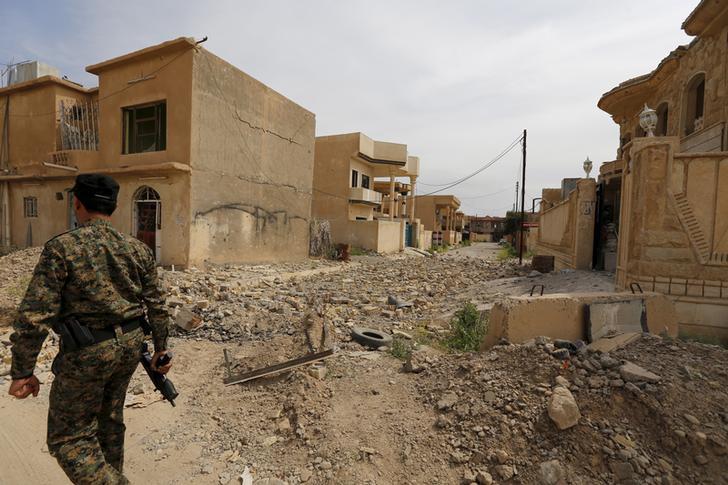
Pro-government fighter walking in
a rubble-strewn street in Tikrit, Iraq on April 1, 2015, after the city
had been recaptured from ISIS.
Tikrit was Saddam Hussein's home base, where he was born, where his tribal affiliations stemmed from. Most of its 140,000 residents returned after it was recaptured by the Iraqi military in April of last year. Returnees discovered there were few services left to them. Thanks to Shiite militiamen the looting had been wholesale, including the destruction of the main hospital. Ordnance lay in areas that had been combat-dense. Prime Minister Haider al-Abadi, according to Ms. Grande, directed a rebuilding effort in Tikrit by the federal government.
An event that is not expected to occur when Mosul is left free of Islamic State jihadis.
"If Daesh stand and fight, they're going to
be killed. There's no question about that. If they run, they will either
be captured or killed. They are not going to be allowed to escape."
"When we see them come together where there
are significant numbers we will strike them and kill them."
Col. John Dorrian, spokesman for the U.S.-led coalition
"When I knew the security forces were serious about liberating Mosul, I
came here," he said. "Daesh was preventing families from moving toward
the security forces and ordered them into the city centre, but I
refused."
Emad Hassan, 33-year-old former policeman, Mosul
Felipe Dana,The Associated Press
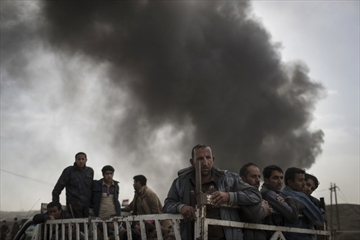
Displaced
people stand on the back of a truck at a checkpoint near Qayara, south
of Mosul, Iraq, Tuesday. The U.N. human rights office is lauding efforts
by the U.S.-led coalition in the battle against the Islamic State group
in Mosul. The office in Geneva says coalition flights over Iraq have
largely succeeded in preventing IS from bringing in 25,000 more
civilians to the city center, where the militant group has been using
people as human shields as Iraqi forces advance on Mosul.
Islamic State is using mortars and small arms against the Iraqi special forces' armoured vehicles including Abrams tanks, in response to the dawn assault launched on Mosul's eastern edge on Monday. Suicide car bombs greeted the advancing military while artillery and airstrikes struck at the Islamic State positions in Iraq's second-largest city where close to a million residents still remain. Up to the present, a scant several thousand residents have left Mosul, taking refuge in UN refugee camps.
The military units established their positions a mere kilometre from the eastern border of the city, some eight kilometres from the city centre. "We will enter the city of Mosul soon and liberate it from Daesh", boasted Brig.-Gen.Haider Fadhil of the Iraqi special forces. A Humvee, explosives-packed, raced before the 9th Division moving into Mosul from the eastern outskirts, attempting to ram the forces on their approach but it was blown up when Iraqi fire hit, plumes of smoke rising from it.
ISIL positions, hit by artillery, and airstrikes courtesy of the U.S.-led coalition planning to soften up the ISIL defence strategy. Residents hang white flags on windows, hoping to convince the special forces that they have no intention of 'resisting' government troops. The people were ordered to remain in their homes while Iraqi forces moved through the streets of close-by Bazwaya, taking precautions against suicide bombers.
An estimated 3,000 to 5,000 ISIL fighters are stationed in Mosul, according to American military estimates, with another 1,500 to 2,500 dispatched to the city's outer defensive belt. An estimated thousand foreign fighters are among them. Among those on the government side are Shiite militias whose presence could stir sectarian and regional tensions. The Shiite militia leaders launched an offensive about 40 miles west of Mosul, with over ten thousand fighters.
Prime Minister Haider al-Abadi can only hope that complications don't ensue with the presence of the Shiites entering the majority-Sunni city of Mosul. The Shiite militias have been accused of kidnappings and executions and it is critical to the future of the country how advancing forces treat the local population if trust between all Iraqis, Shiite and Sunnis, is to be restored. For the present, Shiite militia leaders agree to an imposed restraint to avoid revenge killings.
But the very issue of Iranian-backed militias incites Turkey, insisting on a role in Mosul's liberation, to invest its involvement at a deeper level, risking a wider conflict. Turkey insists it is duty-bound to protect the ethnic Turkmen of Tal Afar, even while its strategic interest lies in blocking Iranian influence in Iraq. With hundreds of troops stationed near Mosul along with local Sunni fighters, Turkey feels complacent in ignoring Baghdad's orders that it depart.
Smoke rises over Karama district in Mosul
where Iraqi troops are now in the third week of an offensive to
recapture the city from ISIS. (Stephen Kalin/Reuters)
Jawad al-Tleibawi, spokesperson for the Asaid Ahl al-Haq Shiite militia, spoke of Turkish forces in Iraq as "the enemy" whom "we already have plans to confront any intervention by them". Shiite militias aspire to retake Hatra and Baaj, hard by Kurdish peshmerga forces' presence, with whom they have violently clashed in the past.
Earlier this year after Iraqi forces regained Fallujah, Shiite militias were accused by humanitarian groups as well as local government officials, of kidnapping hundreds of men fleeing the city. The Shiite militia forces otherwise known as popular mobilization units were on the move toward "beloved Tal Afar" which had a minority of Shiites before the town was captured in 2014 when they fled, later to be recruited into the militias.
As though the combustible mix of sectarian and tribal and ethnic animosities isn't enough, Turkey intends to respond to any threat from Shiite militias to Tal Afar Turkmen. "Ethnic and sectarian balances must be taken into account in Mosul and Tal Afar" stated Turkish Foreign Minister Mevlut Cavusoglu, echoing Recep Tayyip Erdogan's intention to restore the Sunni majority to Mosul, in response to any possible plans the government of Iraq may be contemplating.
"The greatest period of anti-Western intellectual development in Salafi-jihadi thought took place in the years after the 9/11 terrorist attacks." "Salafi-jihadism is even more sensitive to this stimulus given that it is principally a militaristic ideology." "Salafists have made jihad into the pinnacle of Islam. They say it’s the
highest form of duty and obligation and also that it’s an act of
worship, a ritualistic act like praying, fasting, and giving charity.
You must engage in jihad. And for the Salafi-Jihadists, jihad is a
process of fighting, the very means to give Islam power and legitimacy
in the physical realm." "The third group [of modern-day Salafists] are the Jihadists. They are rejectionist in nature,
oppose the domestic structures of the state as well as internationalist
structures, and seek a radical and violent millenarian upheaval. This is
the smallest group of the three, but it has been dramatically empowered
recently, and is attracting some people as a result of its supposed
success in carving out a piece of land between Syria and Iraq which it
calls the Islamic State (IS), i.e. the Caliphate." Shiraz Maher, senior research fellow, International Centre for the Study of Radicalisation, King's College, London, author: Salafi-Jihadism: The History of an Idea
Islamic Stateconflates itself with piety. It recognizes in itself the purity of Islam dating from its inception. Whatever the Prophet Mohammad did and urged be done on behalf of Islam is what ISIL has committed itself to, in the establishment of its caliphate. While the modern world looks on in horror and disbelief as the Islamic State of Iraq and the Levant prides itself on the creative ways it undertakes to slaughter its enemies the methods they use are in fact, historical in the nature of Islam and its solutions for dealing with apostates.
Wahhabist Saudi Arabia is also Salafist, albeit portraying itself as a friendly agent to the West which has been responsible for helping it and the other Gulf States garner their fabulous treasury of wealth from the sale of fossil fuels, satisfying the world's unappeasable hunger for energy to enable it to grow economies. While oil greases the machinery that produce a way of life for first-world economies, it has also been responsible for turning an obscure corner of the world into one of fabulous wealth. Enabling the Saudis to dispense part of their wealth in building mosques and madrassas worldwide, to export their Salafist Islamism and send their clerics abroad to proselytize.
Wealth has gifted the Saudis with the wherewithal to practise both types of jihad, by proselyzation and through the support of Islamist jihadists, the evidence of which is seen in its madrassa graduates forming the backbone of jihadi terrorist groups one of which is al-Qaeda which led to the 9/11 attacks on the United States. The Islamic Republic of Iran, through the vision of its first Grand Ayatollah, Sayyid Ruhollah Mūsavi Khomeini, did its part in exporting the virtues of the Shiite version of global aggression and the support of terrorist jihadis. The Islamic State is simply the latest iteration of violent, vicious Islamism to enter the world scene with its adherents all over Europe, North America, Asia and Africa wreaking havoc and instability, preying on peaceful Muslims, on non-Muslims, Crusaders and Jews, on women and children, favouring enslavement and sexual predation in expressions of the 'purity' of Islam's introductory decades from the 7th Century imagination of a Bedouin mountebank. Shiraz Maher was born a British citizen of Pakistani heritage whose formative years took shape in Saudi Arabia where his accountant father took employment. After 9/11, Islam took on a mystique and attraction for him as it did for many other young Muslims, and he became anti-American in his outlook while becoming more Islamist and becoming a member of Hizb ut-Tahrir, a Sunni group planning to establish an authentic Islamic state from Morocco to the Philippines.
He returned to Britain where he attended the University of Leeds. While a graduate student at the University of Cambridge he rose in the ranks of Hizb ut-Tahrir from cell leader to regional director. His belief in its ideology began to falter as he questioned its expressed beliefs and on the day of the London Underground bombings in 2004 he surrendered his membership in the group becoming an opponent of jihad. Now he produces reports on counterterrorism strategy, yet another favourite of the intellectual West as an Islamist insider turned outsider. His contention is that jihadist authorities resurrected medieval Islamist rules like the punishment of excommunication as a controlling tool and its functionality "to license a fratricidal civil war against the Iraqi Shia community" by al-Qaeda in Iraq. He also believes that the extremism that now motivates Islamists is in the process of evolving, that ISIL's caliphate represents one belief set but there are others prepared to interpret the hadiths left by Mohammad for his faithful.
"Every minute passes like a year." "We have mixed feelings. We are happy that we will eventually be liberated and afraid of what will happen afterward." Sunni Iraqi resident of Mosul
"The recent airstrikes are really shaking the ground and houses. My wife prays and recites verses from the holy Qur'an when airstrikes start, while children cry." "We are afraid that one of those airstrikes might hit us." Sunni Iraqi resident of Mosul
"A lot of people are going to flee." "A lot of them are extremely fearful of what the battle might bring." Berkis Wille, senior Iraq researcher, Human Rights Watch
Volunteers of Kurdish Peshmerga fighters, some shown here in 2014, are
among those moving in to recapture Mosul, but a revenge drive is
building for after the Islamic State is driven out. File Photo by
Mohammed al Jumaily/UPI
The combined forces converging on Mosul are not all sympathetic to the civilians who have been trapped in the city, the second largest in Iraq, that was captured over two years earlier by the jihadist Islamic caliphate of ISIL. That they are Sunni Iraqis, and that ISIL represents Sunni jihadi terrorists makes them complicit with ISIL's holding of Mosul and other Sunni-majority towns, in the perception of Shiite militias and the Shiite Iraqi military.
That their status is seen as uncertain is understandable, fearing that because they remained in Mosul while ISIL ruled the city that they will be held in contempt and suffer the vengeful consequences of being Sunni in a city liberated from Sunni terrorists by mostly Shiite militias. The Kurdish Peshmerga, sympathetic to Christians, Yazidis, Shiites, are themselves mostly Sunni, but they have been given orders not to enter Mosul, but to remain on its outskirts.
The residents of Mosul know full well what occurred in those Sunni areas earlier liberated by Shiite militias. Ramadi was reduced to rubble when it was retaken from Islamic State, and Fallujah's liberation heralded a paroxysm of of human rights violations where hundreds of men escaping the city confines were detained, tortured, or simply 'disappeared'. So the immediate concern of the residents of Mosul is their safety while their city is being aerially bombarded.
When, as is inevitable, the 30,000 combined forces opposing the occupation of Mosul by ISIL, manage to rout the jihadis from the tunnels, alleyways, booby-trapped buildings and infiltration of civilian enclaves, there will rise up the second phase of concern, equally fearful to the first; that they will be held responsible for whatever ISIL accomplished in its bloody campaign, and pay for their Sunni connection with their lives.
The coalition, attempting to forestall a mass exodus of Mosul residents, difficult to control and to accommodate, has dropped leaflets instructing people to remain where they are, and inside their homes. At the very same time, human rights groups witness to this particular historical battle in a landscape fraught with horrendous potential, are concerned that despite instructions, many residents will flee Mosul to areas yet held by ISIL, fearing much worse treatment at the hands of those who 'liberate' them.
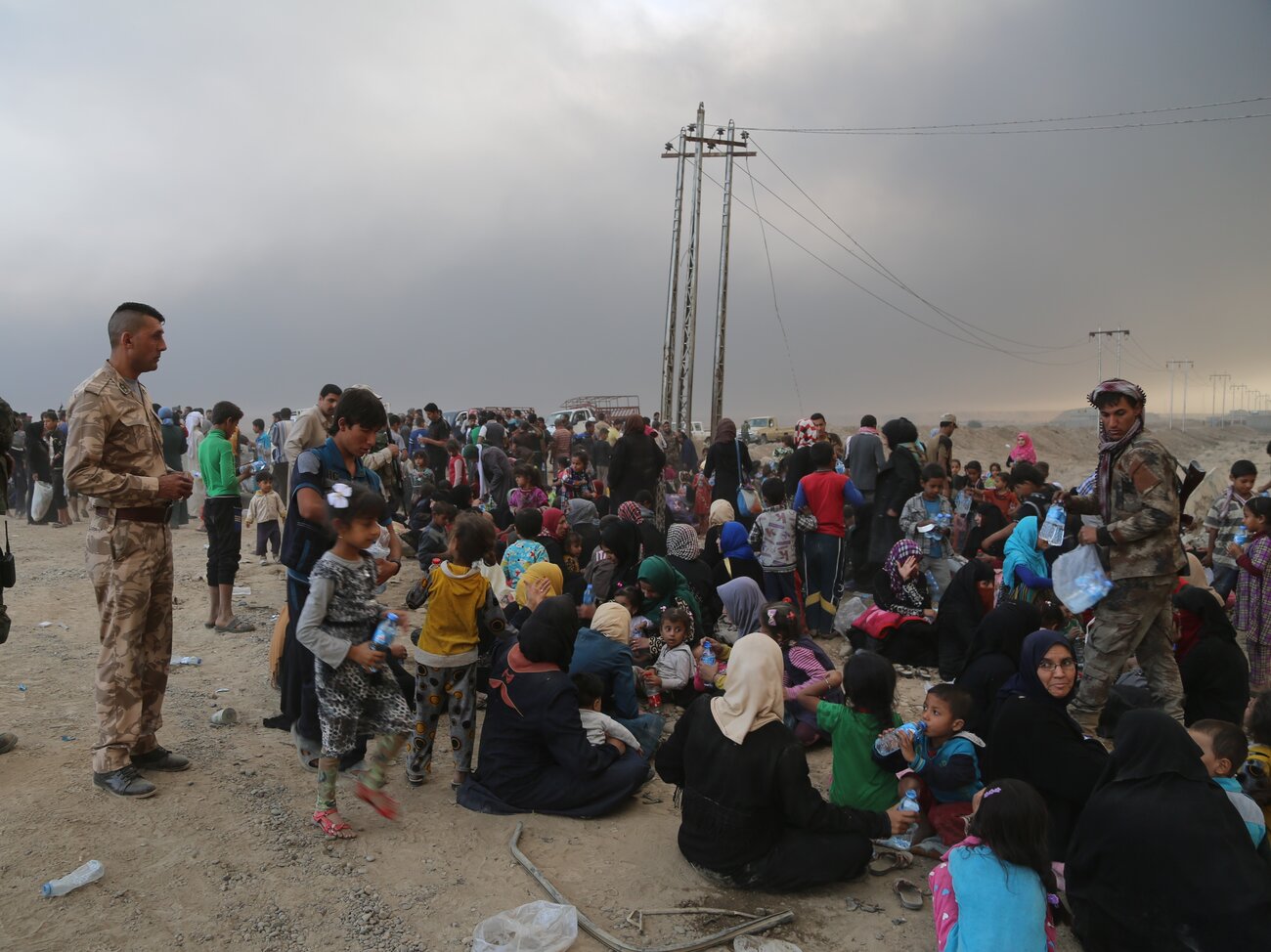
As the operation to retake Mosul continues, Iraqis
fleeing ISIS-controlled areas of the city arrived Tuesday at the nearby
town of al-Qayyarah, secured by the Iraqi army. Anadolu Agency/Getty Images
"Honouring a group of brave and for the most part, anonymous humanitarians represents the true values of the Nobel Peace Prize." Wendy Chamberlain, president, Middle East Institute, Washington "We called out: 'We are the Civil Defence. Is anyone able to hear us?'. They were on the first floor, with four floors above them, but they were protected by the ceiling, which had collapsed at a slant" "People are dying, and we run toward death." Mahmoud Fadlallah, Syrian Civil Defence
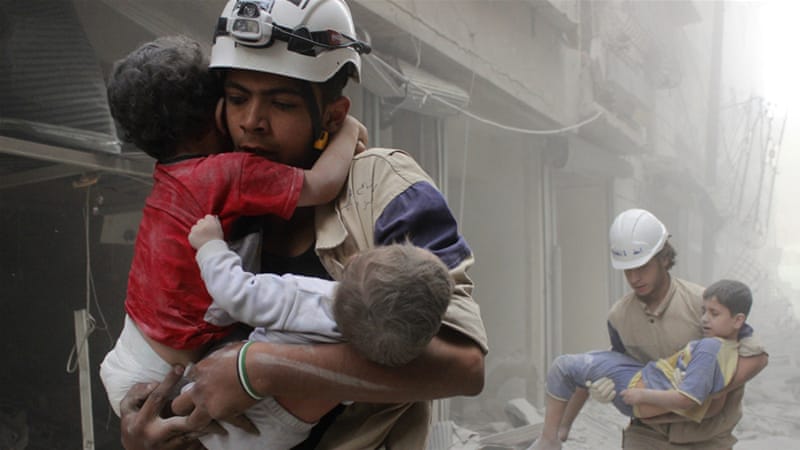
As
areas were bombed individuals emerged, who, when a bomb fell down on a
street would run and try to help their neighbours [The White Helmets]
"They are made up of former bakers, builders, taxi drivers, students, teachers, pretty much anything apart from rescue workers." "They are all a very diverse and disparate group of individuals,
all of whom made individual choices about what their contribution to
the revolution is going to be. They all had the choice whether or not
they want to pick up gun, to become a refugee - but they've all made a
choice to instead pick up a stretcher." "It started with the regime bombardment of areas that were being
described as liberated so by the end of 2012, areas in northern and
southern Syria the regime had pulled out of areas and that gave the
regime the space [...] to start bombing civilian communities."
"From within those communities emerged... individuals, who, when
a bomb fell down on the street, would run out and try to help their
neighbours, and they did so without training and without equipment." "In the early part of 2013, a group of leaders from northern
Syria came out and painted this very clear picture that communities on
the ground were being very heavily bombed, and they needed support." James Le Mesurier, founder, Syrian White Helmets program
The Syrian Civil Defence group, now called the White Helmets resulting from the headgear they have effected; helmets to protect them from falling rubble when they enter bombed-out buildings, white signifying that they come in peace with only rescue on their minds, now number three thousand volunteers. Their work is the mounting of searchp-and-rescue operations in wartime conditions reflective of a broken country mired in a civil war that their president has imposed upon its civilian population.
Since it is regime forces bombing areas held by the rebels who have been able to hold onto part of Aleppo only with the aid of foreign Islamist groups like Nusra whom the rise of the Islamic State of Iraq and the Levant have, by contrast, made look only moderately like terrorists, the Syrian Civil Defence operates only in the opposition areas. Where homes, schools, and hospitals are just as likely to be barrel-bombed as any areas that the Syrian military may believe the rebels have their headquarters.
Wendy Chamberlain of the Middle East Institute saw fit to nominate the White Helmets to the Nobel committee for the Nobel Peace Prize. They have chosen not to fight, but to save the lives of the vulnerable who have been targeted by a regime whose carnage has become legendary, rivalling the atrocities committed by the Islamic State, a regime which has in fact, slaughtered infinitely greater numbers of Sunni Syrians than ISIL has condemned to a barbaric death its assumed enemies.
Theirs truly has become the self-assigned "most dangerous job in the world", as their admirers assert. And nor are government forces ignorant of the work they do. That very work, abandoning personal safety to the more pressing imperative of making a heroic effort to find the wounded under the rubble left by explosions and to bring them to safety and medical care, has made them a target of the Syrian government forces.
That targeting is distinguished by a routine whose technique has been dubbed "double tap" attacks. In the wake of an attack, government warplanes have taken to circling about awaiting the arrival of the White Helmet forces to strike the same target a second time with the intention of victimizing the rescuers on their arrival at the scene of the first impact.
"Frequently, in between those first two bombs, there is a very
narrow window - 15 minutes or half an hour - where they often find
people, aren't able to get them out, and then a second bomb comes. Many…
have been injured because they haven't gotten away quickly enough, or
they have chosen to stay with the people they are trying to rescue", explained Mr. Le Mesurier.
One White Helmet volunteer, Khaled Omran Harrah, involved in the 2014 rescue of a ten-day-old infant trapped for ten hours in an after-blast rubble, out more recently with Mr. Fadlallah and five others at a blast scene were working on the difficult extraction of a survivor from the remains of a building when they were attacked by a "double tap". Taking shelter where they could, Harrah was killed, while the others received shrapnel wounds. The man they hoped to rescue died.
"The war in Syria is not a Syrian crisis. It is not even a regional crisis, although the impacts are disproportionately felt here. It is a global humanitarian crisis; an international failing that needs to be addressed coherently and collaboratively." "Instead, new, innovative solutions are required; solutions that address the reluctance of traditional resettlement countries, as well as the frustrations of traditional host states about unequal and unenforcable burden sharing." His Royal Highness Prince Hassan bin Talal, Jordan
We have it then, on regal authority that Syria's convoluted, Byzantine conflict where an Arab regime employs the most heinously unforgivable atrocities against its own civilian population to punish them for the sectarian violence that it has itself initiated in response to a civil request by that majority sect for equal treatment to the regime's own sect, that this war in Syria is not a Syrian affair. And nor is it a regional crisis, despite that, understandably, 'the impacts are disproportionately felt' in the region.
How could it be otherwise, when the neighbourhood is comprised of countries whose rulers are despots, tyrants and autocrats in the guise of oil sheiks, monarchs, and ayatollahs who excel in the Medieval art of control, division and isolation, leaving their populations to struggle with an utter lack of liberty, living within human-rights-abusing national enclaves portraying themselves as emerging democracies, Islamic-interpretive-style.
The world was given a lesson on regional conflicts and the absorption of refugees which the broader Middle East community had persuaded Palestinians to reflect on a temporary basis until 'their' geography would be restored to them when a pan-Arab collective of military might destroyed the presence of the nascent Jewish State of Israel. When that failed, the Palestinians who fled the area languished in refugee camps that the international community paid for, through the permanent auspices of UNRWA.
But none of the countries that permitted the refugee camps to exist within proffered a permanent place for them, prepared to absorb them as citizens, (with the notable exception of Jordan, since over half of its citizens are Palestinians), preferring to wait until such time as the Jewish state collapsed after one war imposed upon it and then another, all failing to produce the desired result, but leaving the festering wound of Palestinians insistent on returning with all their succeeding generations.
Once again, on the collapse of another 'nation' of Islam, surrounding nations that have the means to absorb the resulting refugees fail to do so, leaving those countries with a conscience to allow temporary camps, hoping that before long the conflict will cease and return to Syria will be possible. And one clever nation has been able to furnish conditions that prompt hundreds of thousands of those refugees to sail the distance from the westernmost shores of Turkey to Europe.
A man from Syria feeds his daughter as asylum seekers line up in Berlin on December 21, 2015. (KAY NIETFELD/AFP/Getty Images)
Enabling His Royal Highness to chastise Europe for insufficiently warmly greeting the flood of over a million haven-seekers and migrants as he deems their humanitarian duty, for, as he says, the burden must be shared. Not that the conditions and the situation that bred and led to the sectarian violence and the refugees must be solved, since that is obviously a task beyond the willingness and evident capacity of Islam to solve, though Islam has been the cause.
"There is no strategy planned by the [Kurdistan regional government]
to destroy or destruct any component villages, any component set up in
these newly liberated areas. [Peshmerga forces] have been in full obligation to
implement the standards of and principles of international human rights,
international humanitarian laws." "[But] there are a few cases where an entire village stood against the Peshmerga ... they fought in line [alongside Isis militants]." Dindar Zebari, Peshmerga spokesman, Iraq
"It
does appear to be a form of collective punishment of perceived
sympathizers [with Islamic State]. Rather than deal with individuals,
they [Kurds] are punishing whole [Sunni Arab] communities." "If
you're interacting with those forces Canadian special forces working
closely with Kurdish troops] I think you're obliged to know what they're
doing." "You have an obligation to ensure that violations of human rights and humanitarian law aren't occurring." Hilary Homes, spokesperson, Amnesty International, Ottawa
"By barring the displaced from returning to their villages and
destroying their homes KRG forces are further exacerbating their
suffering," AFP
This is the Middle East. This is the
geography of militant tribalism, of venomous sectarianism, of violent
attacks against minority groups, led for the most part by Islamist
distrust and hatred for non Muslims and 'apostates' alike. Where verses
in the Koran enjoin the faithful to conflict with the despised infidels
and Jews: "Do not take the Jews and the Christians
for your friends and allies” (5:51) and “You shall find none who
believe in Allah and the Last Day on friendly terms with those who
oppose Allah and His Messenger [i.e., non-Muslims] — even if they be
their fathers, their sons, their brothers, or their nearest kindred"
(Koran 58:22; see also 3:28, 60:4, 2:120).
The
incessant violence being perpetrated by one Muslim sect against another
reflects the culture of viral tribalism and poisonous sectarian
animosities. And when geography throws in the complications of ethnic
groups, the Kurds and the Yazidis, the Druze and other minorities whom
the majority groups view as inferior and think nothing of depriving of
their lives, the dangerous cocktail of Arab and Muslim dysfunction
erupts under the volcanic pressures of endemic and constantly erupting
issues of survival.
The
West and its human rights groups look on from afar at what unfolds in
the Middle East as one 'nation' after another implodes, and often with
considerable assistance from the meddling West. Remove a totalitarian
government and the vacuum that results invites even more intolerance and
violence to explosively erupt as tribal and sectarian and ethnic and
clan hatreds are inflamed, setting the landscape onto a trajectory of
inflicting utter disorder and bloodshed in generous proportions.
Destroyed homes in the village of Barzanke in Iraq's northeastern Diyala provincePhoto: AFP
A
new Amnesty International report highlights the region's Kurds taking
the initiative to seek revenge for the humiliations and violence and
depredations they suffered in Iraq under the regime of Saddam Hussein.
This is the militant Kurds who have given haven and protection to the
minority groups whom the Shiite Iraqis have persecuted more latterly and
whom the Sunni terrorist groups like ISIL have tormented, enslaved and
slaughtered.
According
to Amnesty its report accuses the Kurdistan Regional Government and its
allied militias in northern Iraq of bulldozing, exploding, or torching
thousands of homes in a deliberate campaign to banish Arab communities
from the area the Kurds claim sovereignty in. The displacement of Arab
populations by force and destruction reflects Amnesty's research of 13
villages and towns including testimony from eyewitnesses and victims.
"It
would be very hard to see how this was militarily justified [widespread
destruction of villages]. This is deliberate destruction, the punishing
of entire communities", commented Hilary Homes,
spokesperson for Amnesty International on security issues in Ottawa of
the report corroborated by satellite imagery. The claim is that Kurdish
Peshmerga forces and sometimes Yazidi militias and Kurdish armed groups
from Syria and Turkey operated alongside the Peshmerga to force
thousands of Arabs to abandon their homes.
Internally displaced Arab Iraqis at a camp in Khanaqin in Iraq's northeastern Diyala province Photo: AFP
And
the Kurdish Regional Government forces have barred those Arab civilians
from attempting to return to the areas recaptured from the Islamic
State of Iraq and the Levant, where the Sunni Arab civilians lived under
the banner of the Sunni ISIL jihadists. The Kurds are busy
consolidating their territorial gains in "disputed areas" claimed
traditionally by the Kurdish Regional Government as their own, in a
drive to address abuses from the past by the Saddam Hussein tyranny.
Kurds
had formerly been forcibly displaced by Saddam Hussein's military for
the purpose of settling Arabs in those very same areas. It was the Kurds
who launched the rescue of Yazidis trapped by Islamic State when the
jihadi terrorists captured Sinjar, slaughtered Yazidis, took their women
captive as sex slaves, and people fled in terror from the invasion onto
Mount Sinjar, trapped without provisions on the winter mountain. Little
wonder that Yazidis seek their revenge.
It
is dreadful that the revenge falls not on the jihadists who attacked,
raped and enslaved Yazidis, but on their co-sectarian civilian Sunni
Arabs who may have viewed their actions with favour, or indifference. On
the other hand, war is a dreadful human construct of misery and dread.
And in the Middle East empathy and compassion always appear to be on
short order unless it is directed at people of the same clan or tribe or
religious sect.
The
horrible excess of slaughter that has taken place under the command of a
tyrannical president in Syria punishing his civilian subjects who
protested their unequal treatment as opposed to that of the opposite
sect, just about equals the wretchedly grotesque butchery of the
non-state Islamist militias associated with al-Qaeda, and most
particularly Islamic State. It is the danger posed by the Islamists who
look beyond the region to inflict their brand of Islamic justice on the
West that democracies are engaged in bringing to a halt.
Thus
far, it is has not been the military of Iraq or of Syria that have
successfully contested the advance of the Islamists, but the courage and
perseverance of the Kurds in defending their people and their
territory. And it has been the Kurds whom the Americans and the
Canadians have favoured in tutoring in the art of successful warfare
against an implacable enemy of humankind. There should be the
recognition of a universal standard of human rights obligations, that
much is true.
The
old adage, when in Rome do as the Romans do might not fit exactly here,
but it does go a long way to explaining why and how it happens that a
large ethnic group long suffering persecution and existential hardship
is finally determined to claim its territory and to defend its
population and in so doing is deserving of the assistance of those
attuned to the situation and immersed in doing what they can to change
it.
Obama's solution? To let Iran
have legitimate nuclear bombs in a few years, along with
intercontinental ballistic missiles to deliver them to the U.S. -- or
perhaps from America's soft underbelly, South America, where Iran has
been acquiring uranium and establishing bases for years. Or perhaps
launched from submarines off America's coast, which would make the
identity of the attacker unknowable and a response therefore impossible.
Incredibly, America's politicians do not even seem to seem to be
concerned about that.
We have just sacrificed Sunni stability for American ideology:
empty slogans fed to us by clueless, if well-meaning, American
officials.
As we watched one stable Arab regime fall after another, we have
allowed ourselves to be destroyed from within by these bungling
diplomats -- from America, Europe, China and Russia. Instead of keeping
our eyes on the real threat, we exhausted ourselves in wasteful,
unending battles against the Jews -- meanwhile letting the Iranian
menace slip out of sight.
Obama really does deserve a Nobel Prize, but it should have been
awarded by the Ayatollah Khamenei, the Supreme Leader of Iran, in
gratitude for America's surrender.
"Nation building" seems to have fallen into disrepute in the West,
but it should not. It is vitally important -- as the successes of
Germany, Japan and South Korea attest.
Over the past few years, in our foolishness, we in the Middle East
swallowed the deceptive bait of "democracy" dangled before us, even
though we knew that it could not, in the misguided way it was presented,
be implemented in the Middle East.
The idea was superb, but here in the Middle East, possibly in being
impatient to "get credit" before the diplomats' term of office were
over, no one ever took the time to establish the institutions of
democracy -- equal justice under law, freedom of speech, property
rights, the primacy of the individual rather than the collective,
separation of religion and state -- to show us in the Middle East how
democracy actually operates, and to allow those institutions to take
root before ever holding an election.
So eager were Western leaders to take credit right away that they
refused "let the rice bake." Had the West introduced democratic
elections to Japan and South Korea (where they eventually worked
brilliantly) in the same way it muscled democracy into Iraq, it would
never have taken root in those countries either. Had the Germans had
been asked to vote right after World War II, they would most likely have
reelected the Nazis -- that was what they knew. It took seven years to
re-educate the public to understand and accept a Konrad Adenauer.
What seems clear is that we have sacrificed Sunni stability for empty
slogans -- and for clueless, if well-meaning, American officials. As we
watched one stable Arab regime fall after another, we allowed American
ideology to destroy us from within. Instead of keeping our eyes on the
real threat, we exhausted ourselves in wasteful, unending battles
against the Jews -- meanwhile letting the Iranian menace slip out of
sight.
If we try to look at the positive side of the Iran nuclear agreement,
it is just possible that Obama looked at the Sunni Arab states,
fractured and at each other's throats, and at the ruthless terrorist
groups gaining ground in the expanding battle zones, and decided that we
were too fractious for the U.S. to protect.
Sunni states such as Saudi Arabia, Qatar and Turkey have been
worsening the situation in the Arab world by funding Sunni terrorist
organizations, thereby putting it on a course of complete chaos. Despite
Arab wealth and power, we have been dealing almost exclusively with the
marginal issue of Palestine and the Jews, to excuse our inability to be
effective in giving U.S. President Barack Obama what he really needs:
regional stability.
Obama sees Iran and its terrorist organizations, which are all
unified, organized and obedient, opposing the Sunni Arabs. Obama may be
betting on Iran to bring order to the Middle East.
Imagine if we and our fundamentalist Sunni terrorist organizations
had actually focused on stopping the Iranians in Syria, Iraq, Lebanon
and Yemen. Imagine if we had abandoned, even momentarily, the dream of
the Muslim Brotherhood (what the West calls "political Islam") ruling
the world. Imagine if we had stopped our stupid, useless acts of hatred,
and could instead have focused on our common enemy, Iran. Our situation
now would be immeasurably better. We would not be deviating from the
teachings of Muhammad, because first we have to focus on the near enemy
and then on the distant one. Iran is nearer and more dangerous than
Europe and the United States, so Iran should have been -- and still
should be -- the first Sunni target. We might have led Obama to adopt a
different approach than allowing Iran to acquire a nuclear bomb in ten
years or sooner -- but we did not, because of our weakness and
distraction with marginal "causes." Thus Obama, from a desire to
stabilize the Middle East, seems to be betting on the strong horse,
Iran.
The truth, however, may be somewhat different. It is entirely
possible that Obama, who won the Nobel Peace Prize, is employing a
policy of "divide and conquer." In the U.S., instead of trying to
improve how children in the inner cities are being educated, he has been
busy stoking racial and economic conflict. The Arabs are becoming
increasingly suspicious that he is a historic "divide and conquer"
manipulator. He may deliberately be creating fitna (civil strife)
in the Arab world by whipping up conflict with Iran, so that America
will one again look like the big power-broker -- but at the expense of
the Arabs.
We Arabs are expert conspiracy theorists, and interpret every
political agenda as a hidden plot, but one only has to look at the Obama
administration's fawning support for the Muslim Brotherhood in Turkey
and Egypt, and how America supported the fall of Mubarak, and it
immediately becomes obvious that the U.S. is trying to manipulate the
fate of the Arabs.
Anyone following America's rejection of, and now only reluctant
support for, the reformist regime of Egyptian President Abdel Fattah
el-Sisi understands that the Americans prefer what they consider
"backward Arabs": those controlled by regressive Islam.
That is the reason we see Obama's policies as backing both the Sunni
Muslim Brotherhood and the theocrats in Iran. The ideologies of both the
Muslim Brotherhood and Iran's mullahs would lead to most dangerous and
regressive fate of both Sunni and Shiite Muslims around the world, as
well as Americans at home -- and these are the Muslims most loved by the
current American administration. Or maybe, as many of us say here on
the street, Obama is just trying to "get even" with the West and bring
it to its knees, for being white, "imperialist" and non-Muslim. Obama's
solution? To let Iran have legitimate nuclear bombs in a few years, with
the intercontinental ballistic missiles to deliver them to the U.S. --
or perhaps from America's soft underbelly, South America, where Iran has
been acquiring uranium and establishing bases for years. Or perhaps
launched from submarines off America's coast, which would make the
identity of the attacker unknowable and a response therefore impossible.
Incredibly, America's politicians do not even seem to seem to be
concerned about that.
Obama really does deserve a Nobel Prize, but it should have been
awarded by the Ayatollah Khamenei, the Supreme Leader of Iran, in
gratitude for America's surrender.
Perhaps
President Obama's Nobel Prize should have been awarded by the Ayatollah
Khamenei, the Supreme Leader of Iran, in gratitude for America's
surrender.
Bassam Tawil is a scholar based in the Middle East
"It's very sad to see wide areas empty, towns empty, villages empty, farms empty. Now, we are moving in the right direction." "The problem [tribal disputes] increases every time we liberate an area. The terrorists are destroying and destroying, and we have to mend our communities." "[Those with] blood on their hands [or who cooperated with ISIL will never be permitted to return]." Hisham al-Suhail, head, Iraqi parliament reconciliation committee
"We've told families not to all go into their homes at the same time, just one at a time [in case there are explosives]." Ahmed al-Karim, head, governing council, Salahuddin province, Iraq "It's a big concern to us with the return of the families. We are concerned about acts of revenge, especially in Tikrit, because of the Speicher massacre." Raed al-Jabbouri, governor Salahuddin province
"It's not just Sunni, Shia, Kurd, as people like to think. It's Sunni on Sunni, tribe on tribe -- such a kaleidoscope." U.S. official, unnamed
A
man rides a bicycle past shops and buildings in Tikrit, 130 kilometres
north of Baghdad, Iraq on June 21, 2015. (AP / Hadi Mizban)
Three million Iraqis have been displaced by the fighting that has consumed their country. From Tikrit, around 150,000 people were forced out by the conflict that raged there. People are now beginning to return to their homes where territory is recovered from ISIL. But those returns represent yet another challenge for the government of Iraq; one based on tribal, religious and ethnic sensitivities. Put another way, the challenge of tribal, ethnic, religious enmities.
Those Sunni residents who are beginning to return are suspected by Shiite militia groups who fought Islamic State, driving them out of the area, to have supported the terrorists. As a result the Sunni returnees themselves are now in danger, with the spectre of sectarian bloodshed in revenge killings becoming a reality, and not for the first time.
When former residents of Tikrit returned last week, it was to a city without services whose main hospital was destroyed and where water and electrical have yet to be restored in the ravaged city which was later looted by those same Shiite militiamen who had wrested it from Islamic State. Hard to tell the terrorists from the terrorists. Other than for the fact that one group is Shiite, the other Sunni.
The risk of unexploded ordnance remains. Ambulances parked on standby on the streets as the first buses full of returnees arrived. Concerning to the government is the very plausible scenario that emanates from Shiite militias who suspect those Sunni residents of having supported ISIL, which after all, celebrates itself as the champion of the Sunnis.
The mass execution of an estimated 1,700 Iraqi Shiite regime soldiers in Tikrit by Islamic State jihadis is burned into the vengeance-seeking streak of tribal Shiites. The separation and oppression of the Sunnis by the Shiite-led government, after all, is what initiated the conflict to begin with, and one might say that these are chickens coming home to roost, imperilling the country and all its citizens equally.
The liberation of Tikrit was celebrated by its liberators who took the pleasurable (to them) time to loot and destroy. Shops which had been intact the day after the city was restored to the government have now been destroyed. Tribal feuding has complicated the Salahuddin province countryside with the return of civilians. Sunni and Shiite tribes which fought with the regime have both objected to the return of other tribes who sided with ISIL while the extremists were ensconced.
Villages on the outskirts of Tikrit are deserted. Bombed-out buildings litter the landscape. The dominant tribe in an agricultural area of vineyards in Yathrab is comprised of both Shiites and Sunnis with the Shiites demanding "blood money" from the Sunnis before they will allow families to return. Still displaced from the town are 60,000 Sunni families. "It's tribal law, tradition. If members of a tribe kill someone from another, they should pay money or there will be retribution", said Yousif Mohammed al-Tamimi, negotiating for the Shiite tribal faction.
Many people in the region are not amenable to the prospect of letting things go. Even if reparations are paid, say some villagers, a buffer zone between the Shiite branch of the tribe and the Sunni side accused of siding with ISIL is demanded. If the Sunni tribal members return, "I'll behead them myself", said Zaina Fares Aswad, who lost eight members of her family in a September attack in the hamlet of Fadous.
This represents a general opinion site for its author. It also offers a space for the author to record her experiences and perceptions,both personal and public. This is rendered obvious by the content contained in the blog, but the space is here inviting me to write. And so I do.