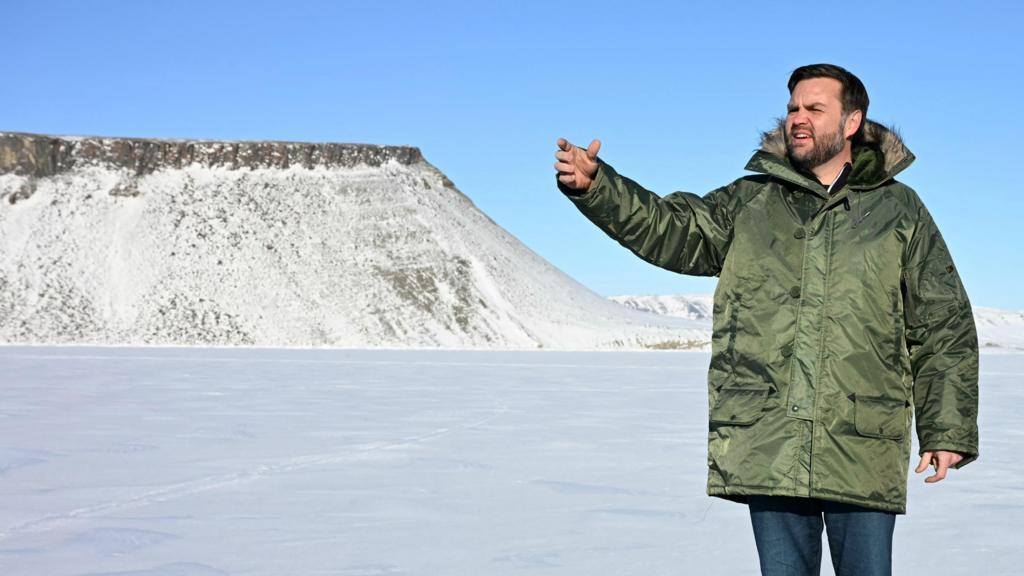
"As you all know, it's a big issue and it's only going to get bigger over the coming decades."
"It's cold as s--- here. Nobody told me."
"[Danish
leaders have] spent decades mistreating the Greenlandic people,
treating them like second-class citizens and allowing infrastructure on
the island to fall into disrepair."
"Denmark has not kept pace and devoted the resources necessary to keep
this base, to keep our troops, and in my view, to keep the people of
Greenland safe from a lot of very aggressive incursions from Russia,
from China and other nations."
"I
think that they [Greenlanders] ultimately will partner with the United
States. We can make them much more secure. We could do a lot more
protection. And I think they'd fare a lot better economically as well."
U.S. Vice-President JD Vance
JD Vance in Greenland BBC
"[The United States] needs Greenland for international security."
"Greenland's
very important for the peace of the world. And I think Denmark
understands, and I think the European Union understands it. And if they
don't we're going to have to explain it to them."
"We’ll get Greenland. Yeah, 100%."
U.S. President Donald J. Trump
"It is a time when we as a population are under pressure."
"We must stick together. Together we are stronger."
"[The U.S. visit signaled a] lack of respect."
Greenland's PM-designate Jens-Frederik Nielson
"[Donald Trump Jr's visit in January first sparked concerns] that’s
when we realized that his words are no longer just words, he actually means
what he says."
"We’re
afraid of being colonized again. We’ve been a colony for the past 300 years
under Denmark, it still feels like it. Now another colonizer is interested in
us."
"[Greenland needs to be] open-minded [and consider strengthening
relations with the US to secure a sustainable independence strategy]."
"Trump is only going to be president for the next four years so we also need to think about what’s going to
happen in 10 years, 15 years."
Qupanuk Olsen, Greenland politician, pro-independence party Naleraq
U.S.
Vice-President J.D. Vance was in Greenland on Friday, slamming Denmark
for not doing a good job in keeping its semi-autonomous territory safe.
But as Greenland content creator Qupanuk Olsen explains, many
Greenlanders did not roll out the red carpet for Vance. CBC
It's
hard to say whether President Trump's representatives in his White
House Cabinet really expected to be welcomed with huge enthusiasm by
Greenlanders in their shared trip to Greenland on Friday. Originally the
trip was to have lasted longer, and be more expansive, but in the face
of obvious push-back by offended Greenlanders who consider their
semi-autonomous government under Denmark's protection the arbiter of who
should embark on a state visit to their island, and that by special
invitation, an invitation that hadn't been extended.
As
far as Greenlanders were concerned, the visit by US. Vice-President
Vance, his wife and other senior American officials took it upon
themselves as an act of hubris to visit unannounced and uninvited; their
home, as it were, invaded by strangers. Strangers, no less, with
designs on their homeland that are extraordinarily offensive; offering
to buy a home that is definitely not for sale. In the end, the visitors
confined their trip to visiting the American military outpost at
Pituffik on the northwest coast of Greenland. In the process, evading
the risk of violating diplomacy through an uninvited delegation.
With U.S.
President Donald Trump threatening to take over Greenland, the country’s
prime minister has called a visit by a U.S. delegation a provocation
and highly aggressive. The Americans on the trip include national
security adviser Mike Waltz and Usha Vance, the vice-president’s wife. CBC
Nonetheless
both Greenlanders and Danes were offended that the trip took place at
all, but even more so that the original itinerary had been planned
without customary diplomatic consultation beforehand. Addressing
American troops at the U.S. Space Force Pituffik outpost informing them
that the Trump administration is very interested in "Arctic security",
Vice-President Vance advanced the Trump agenda. His entourage that
included national security adviser Mike Waltz, Energy Secretary Chris
Wright, and Senator Mike Lee of Utah then received briefings from
military officials present at the base.
"As you all know, it's a big issue and it's only going to get bigger over the coming decades",
Mr. Vance advised his listeners, as the first U.S. vice-president to
ever visit Greenland. In the process of President Trump expressing his
intention to 'buy' Greenland from Denmark, relations between the two
nations have become extremely strained, with the U.S. President
repeatedly suggesting the U.S. should control the mineral-rich territory
of Denmark. It is highly unlikely that any two such allies, both NATO
members, have ever collided over an issue where one coveted the
territory of the other.
Pituffik Space Base is pictured as Vance visits, on Friday in Greenland. (Jim Watson/The Associated Press)
President
Trump alluded to rising Chinese and Russian interest in the Arctic,
where sea lanes have begun to open in the North West Passage as a result
of climate change melting sea ice. Access to the Passage -- part of
Canadian territory -- will be yet another issue of aggravated
presumption between the U.S. and Canada where at present, diplomacy
argues that before embarking through the Passage, permission must be
sought from Canada. Which feeds once again into President Trump's
argument about U.S. 'security' in his wish to control Canada through
annexing it into the U.S.
Canada,
its government and its population are no more anxious to accommodate
the American President's desires of territorial expansion than is
Denmark/Greenland. The Pituffik Space Base owned and operated by the
United States with Denmark's permission, is situated remotely, 1,100
kilometres north of the Arctic Circle. Residents of Nuuk, Greenland's
capital, about 1,500 kilometres south of Pituffik, voiced their concern
with the U.S. delegation's visit underscoring their misgivings about the
most powerful nation on earth coveting their Arctic island.
Denmark's
Foreign Minister Lars Lokke Rasmussen expressed his exasperation
following the Vance trip to Greenland, stating that although Denmark can
deal with criticism, there is a collegial, diplomatic way of speaking
to a friendly democratic ally. Through a video he posted on social
media, he declared he had a message "for our American friends."
"Much is being said these days. Many accusations and many allegations
have been made."
"And of course, we are open to criticism. But
let me be completely honest, we do not appreciate the tone in which it's
being delivered."
"So you have to ask yourself: How are we going to solve that problem, solve our own national security?"
"If
that means that we need to take more territorial interest in Greenland,
that is what President Trump is going to do, because he doesn't care
about what the Europeans scream at us."
U.S. Vice-President JD Vance
"The
U.S. has a vested security interest in the Arctic region and it should
not be a surprise the National Security Adviser and Secretary of Energy
are visiting a U.S. Space Base to get first-hand briefings from our
service members on the ground."
Brian Hughes, spokesman, National Security Council
"[The
visit of] the wife of the United States vice-president and the United
States president's highest security adviser cannot be seen only as a
private visit."
"We can already see now, how big a mess it's caused."
"[If
allied countries] do not speak out loudly about how the USA is treating
Greenland, the situation will escalate day by day, and the American
aggression will increase."
"[Greenland's
allies should show support]; the only purpose [of a trip by Waltz is] a
demonstration of power to us, and the signal is not to be
misunderstood."
"We have been treated unacceptably."
Greenlandic Prime Minister Mute Bourup Egede
Demonstrators protested at the United States consulate in Nuuk, Greenland, earlier this month.Credit...Christian Klindt Soelbeck/Ritzau Scanpix Foto, via Associated Press
Second
lady Usha Vance, it appears, is preparing to travel to the autonomous
Danish territory of Greenland even as her husband, the American
vice-president, ratchets up U.S. security and "territorial" interests in
the Arctic island the new Trump administration has well-ventilated
designs on acquiring. The prime minister of Greenland has responded by
warning of "American aggression", lamenting a "mess" the upcoming visit has caused, even as JD Vance accused Denmark of "not doing its job" and "not being a good ally".
Presumably, a "good ally"
would fall into U.S. arms, swooning of its aspiration to become part of
the United States. Denmark, for which Greenland has historically been a
protectorate, even though Greenlanders themselves have an
understandable preference for total sovereignty -- separation and
independence from Denmark -- or any other country with designs on the
largest island on Earth which the indigenous population considers their
very own ancestral gift to themselves, anxious to be shed of the avarice
of other countries.
The
Trump administration may have inadvertently overlooked that Denmark,
completely resistant to American overtures to 'sell' Greenland, is, of
course, a member of NATO, as is the United States. Member-nations all
submit to the leading tenet of membership, that all members are
obligated to ensure the security of other members.
Greenlandic news outlet Sermitsiaq posted
photos of two U.S. Hercules workhorse military aircraft on the tarmac
in Nuuk, the capital, disgorging four bulletproof vehicles awaiting the
arrival of the American elite scheduled to visit, and not by invitation.
National security adviser Mike Waltz and Energy Secretary Chris Wright
are scheduled to travel to Greenland, along with "the wife of the United States vice-president".
During
his first term in office, President Trump had mused over buying
Greenland, despite Denmark responding that it wasn't for sale. Since his
return to the White House, Mr. Tramp repeatedly states that the U.S.
will control Greenland, insisting that it is a requirement for strategic
national security purposes, and certainly not because America is
fulfilling her divine destiny by expansionism.
A Greenlandic member of parliament told POLITICO a protest was planned
for Vance’s arrival. | Ritzau Scanpix/AFP via Getty Images
"When foreign dignitaries travel to our country on what are called private visits, it rightly causes concern."
"There is no reason to panic. But there is good reason to stand together and to demand respect."
"I do. And I will continue to do so."
Jens-Frederik Nielsen, Demokraatit, next Greenlandic leader
"A
lot people from Greenland [would] like to see something happen with
respect to their being properly protected and properly taken care of."
"They're calling us. We're not calling them."
"People from Greenland are asking us to go there. [And] some officials [were among those doing so."
"[Danish police had] a special focus [on Jewish institutions. Denmark
was not changing its terror threat level, which has been at "serious"
the second-highest level, since 2010]."
"Persons abroad have been charged... It is a serious situation. [The arrests were carried out
in] collaboration with our foreign partners; [those arrested
were part of] a network."
Flemming Drejer, operative head, Denmark's Security and Intelligence Service
"This is extremely serious."
"It is of course completely unacceptable in relation to
Israel and Gaza, that there is someone who takes a conflict somewhere
else in the world into Danish society."
Danish Prime Minister Mette Frederiksen
A police officer stands in front of the
court in Frederiksberg, Denmark, after police conducted an operation
that resulted in three people being arrested in the country who were to
be charged with violating terrorism laws, Dec. 14, 2023. Ritzau Scanpix/Emil Nicolai Helms/REUTERS
The four detained in Germany were identified as Abdelhamid Al A., born
in Lebanon; Egyptian national Mohamed B.; Dutch national Nazih R. and
Ibrahim El-R., born in Lebanon. Three of the men "have been longstanding members of Hamas and have
participated in Hamas operations abroad." The suspects were
"closely linked to the military branch's leadership" of Hamas,
considered a terrorist organization by the
European Union.
According
to German authorities, three people have been arrested on suspicion of
preparing to attack Jewish institutions in Europe. One person was
arrested in the Netherlands, but whether there were ties to the Hamas
investigation is yet unclear. Two people being held in Denmark were
ordered to pretrial detention until January 9. They were identified by
Danish media as a man in his 50s and a 19-year-old woman.
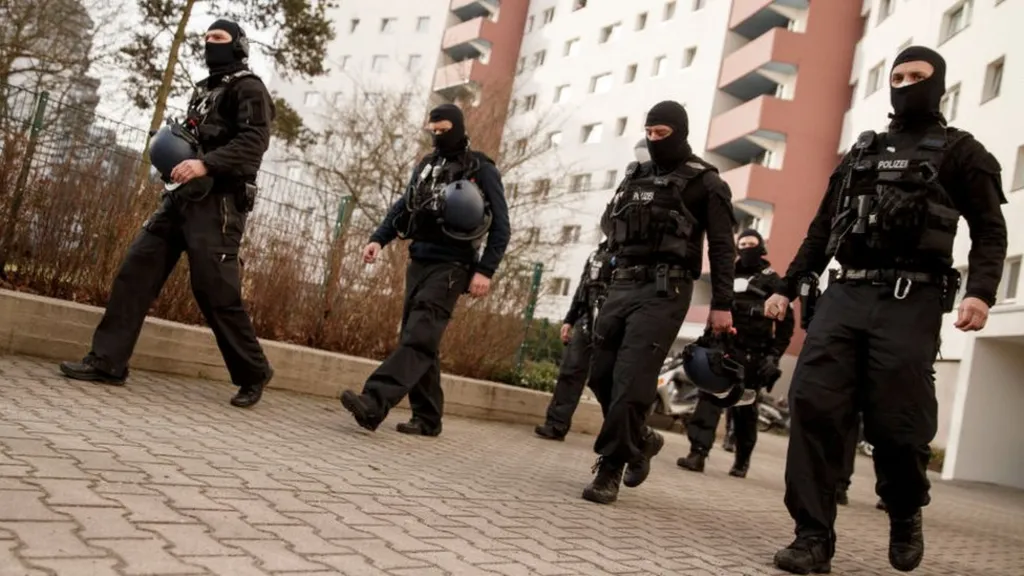
Police raided six locations in Berlin as part of the operation Getty Images
The arrests of the three on suspicion of plotting to carry out "an act of terror"
was announced by Danish intelligence agency PET. One individual
identified by Danish media is a 29-year-old man released after a
night-long custody hearing in Copenhagen. Prosecutor Anders Larssen
stated four other people were held in "pretrial custody in absentia", without mentioning whether authorities knew their whereabouts much less if an active search was underway. There remained "still someone at large", he said.
The
custody hearing was held behind "double closed doors"; no details were
made available on the case, shrouded in secrecy, while a court order
shields the suspects from identification.The three men detained in
Germany Thursday had been tasked with finding a previously set-up
underground Hamas weapons cache in Europe.
"The
weapons were due to be taken to Berlin and kept in a state of readiness
in view of potential terrorist attacks against Jewish institutions in
Europe", explained German prosecutors who allege the suspects "have been long-standing members of Hamas and have participated in Hamas operations abroad".
A
judge on Friday ordered the three suspects detained in Berlin held in
custody pending a possible indictment as members of a foreign terrorist
organization. German Justice Minister, Marco Buschmann, thanked
authorities for
the "successful investigation" which has "contributed to ensuring that
Jews in Europe can continue to live in safety and peace."
"Following the terrible attacks by Hamas on the Israeli population,
attacks on Jews and Jewish institutions have also increased in our
country in recent weeks. This is shameful and shocking."
"We must
therefore do everything we can to ensure that Jews in our country do not
have to fear for their safety again. And our security and law
enforcement authorities are working flat out to achieve this."
German Justice Minister, Marco Buschmann
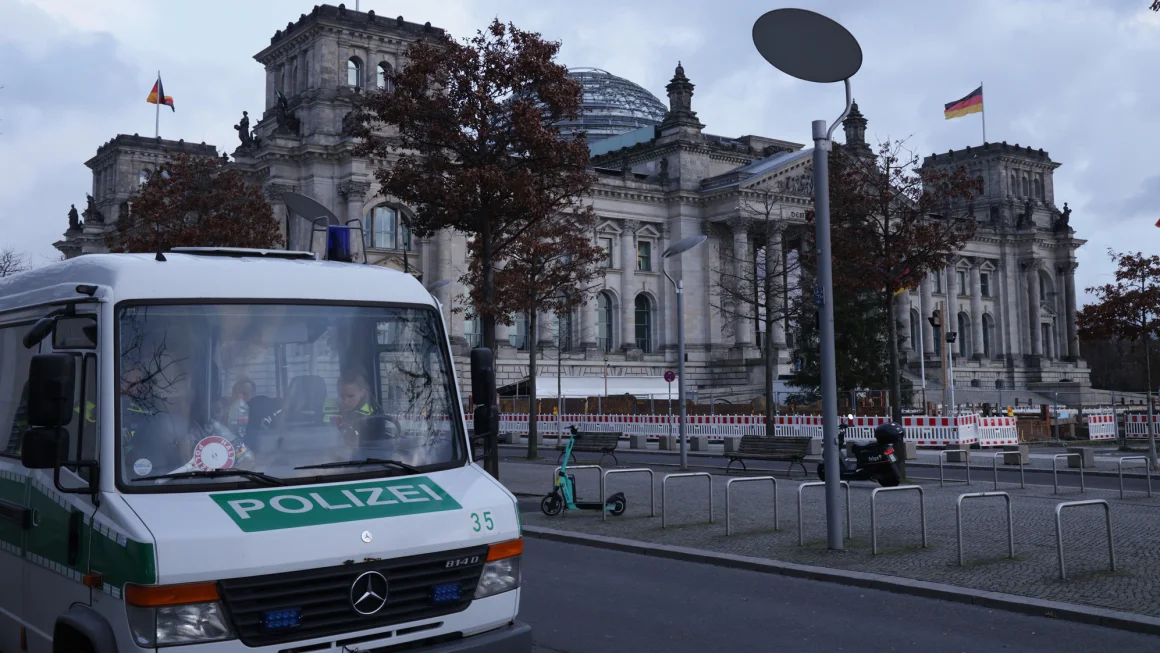
A police van outside Germany's parliament. Sean Gallup/Getty Images
Russia, Respecting The Rule of Law/Arctic Council Chairmanship 2021-2023
"A cross-cutting priority of the Russian Chairmanship in the Arctic
Council will be "Responsible Governance for Sustainable Arctic" through
promoting collective approaches to the sustainable development of the
Arctic, environmentally, socially and economically balanced, enhancing
synergy and cooperation and coordination with other regional structures,
as well as implementation of the Council's Strategic Plan, while
respecting the rule of law."
"The Russian Chairmanship will continue supporting the establishment of
the Arctic Council as the leading format for international Arctic
cooperation, improving its work, increasing the effectiveness of its
Working and Expert groups, the Secretariat, as well as developing
mechanisms for financing the Council's activities, including its
projects and programs, implementing decisions and recommendations, as
well as encouraging the dialogue and interaction with the Observers to
provide their meaningful and balanced engagement in the Council’s
activities. It intends to further intensify collaboration of the Arctic
Council with the Arctic Economic Council, the Arctic Coast Guard Forum,
the University of the Arctic. Among the priorities of the Russian
Chairmanship – promoting international scientific cooperation, in
particular, exploring the possibility to conduct an Arctic Council
scientific expedition to the Arctic Ocean."
His Excellency Lavrov Sergey Viktorovich Minister of Foreign Affairs of the Russian Federation
Sea ice in the Arctic Roscongress
"The
hopes for cooperation with Russia in the Arctic continue to cool. Days
after a U.S. diplomat stated that cooperation with Russia in the Arctic
was now virtually impossible, the Kremlin published amendments to its
Arctic policy. President Putin signed the decree earlier this week on 21
February 2023. "
"The updated document places
greater emphasis on Russian national interests in the region and removes
specific mentions for cooperation within the Arctic Council."
"While the original policy,
published in March 2020, called for the “strengthening of good
neighborly relations with the Arctic states” in the fields of economic,
scientific, cultural and cross-border cooperation the amended version
removes the above section and instead calls for the “development of
relations with foreign states on a bilateral basis, […] taking into
account the national interests of the Russian Federation in the Arctic”."
High North News
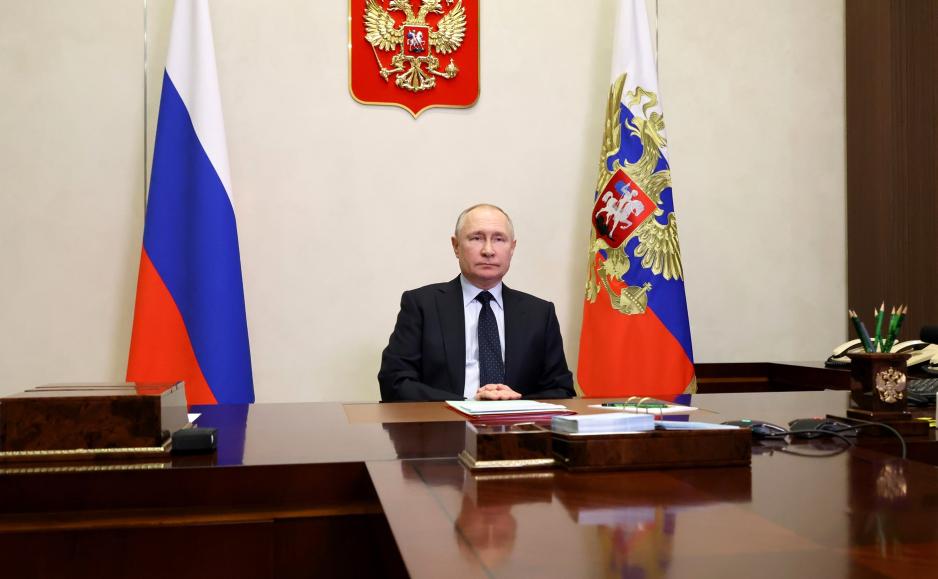
President Putin discusses expansion of Russia’s territorial claims with the permanent members of the Security Council.(Source: Kremlin)
The
eight Arctic states that comprise the Arctic Council are Finland,
Norway, Iceland, Sweden, Russia, Denmark, Canada and the United States.
All these states in collaboration and agreement have produced binding
agreements focused on preservation and environmental protection. The
council represents a rare platform that gives a voice to the region's
Indigenous peoples. Security interests are not part of the Council's
agenda,
The
Arctic Council for close on three decades has been an example of
successful post-Cold War cooperation. Its members have seen common
purpose in cooperating on climate-change research and social development
in recognition that this is an ecologically sensitive region of the
world and currently undergoing vast environmental transformation linked
to Climate Change.
All
that has changed. Following the Russian invasion of Ukraine other
council members were estranged from Russia as a rebuke of its imposition
of war on its neighbour, and stopped working with their Russian
counterpart. Norway now prepares to assume the Council chairmanship from
Moscow, on May 11. Leaving experts to ask whether the viability of the
polar body itself is at risk reflecting its inability to cooperate with
the very country that controls over half of the Arctic coastline.
There
could be dire future implications for the region's environment and its
four million inhabitants who face the effects of melting sea ice and the
interest of non-Arctic countries in the region's untapped mineral
resources in the face of an ineffective Arctic Council. With the end of
cooperation with Moscow a third of the council's 130 projects cannot
move forward, new projects cannot proceed, existing projects cannot be
renewed.
Arctic Council Meeting
No
longer do Western and Russian scientists share climate-change findings.
Cooperation for possible search-and-rescue missions or oil spills has
come to an end. "I am worried that this will really hobble the ability of the Arctic Council to work through these various issues",
stated US. Senator Angus King. Polar waters are opening to shipping as
sea ice vanishes. The Arctic is known to be warming four times faster
than the rest of the world.
Industries
are eager to exploit the region's endowment of natural resources that
include oil, gas and metals like gold, iron and rare earths. An
effective response to changes and the vital issues that loom are less
likely given discord between Russia and the other members of the Arctic
Council. "Norway
has a big challenge. That's how to rescue as much as possible of the
Arctic Council's good work in the absence of Russia", pointed out John Holdren, co-director of the Harvard Kennedy School's Arctic initiative.
For
its part, Russia points out that the work cannot continue without its
cooperation. Nikolay Korchunov, Russian Arctic Ambassador, said he was
not confident it "will be able to remain the main platform on Arctic issues, given that the council has become weak".
There is the possibility that Russia may decide that issues affecting
the region must be addressed with Russian interests only in mind. Or
that it may establish a separate Russia-centric rival council.
China warmly welcomes Putin’s state visit in 2018. After the
conversation between Xi Jinping and Putin, China and Russia reached a
consensus on deepening bilateral cooperation and signed a series of
cooperation agreements. Photo: Presidential Press and Information Office
Russia
has recently taken steps to expand cooperation in the Arctic with
non-Arctic states; signing a memorandum for example with China,
establishing cooperation between the two countries' coast guards in the
Arctic. China's interests in the Arctic revolve around shipping and
investing in ore extraction, particularly rare earth minerals. Russian
Arctic Ambassador Korchunov pointed out Moscow's welcome of non-Arctic
states in the region. With the proviso they not arrive with a military
agenda.
And
this is yet another area where Russia has distinguished itself, long
before its invasion of Ukraine occurred. It has rebuilt or refurbished
old Soviet military bases on its Arctic shorelines and islands that form
part of Russian territory. It is Russia under Vladimir Putin that has
militarized the Arctic, a condition it wants no other country to
emulate.
Mink breeder Thorbjoern Jepsen holds up a mink, as police forcibly
gained access to his mink farm in Gjoel, Denmark on Oct. 9. The Danish
government said Wednesday it wants to cull its herd of minks after a
report showed a mutation in the virus found in some people who
became infected by the animals. (Henning Bagger/Ritzau Scanpix/Associated Press)
"[Transmission of the mutated virus strain between animals and
humans is] a concern. Mutations [in viruses] are normal. These type of changes in
the virus are something we have been tracking since the beginning."
"We are working with regional offices ... where there are mink farms,
and looking at biosecurity and to prevent spillover events."
"[Denmark’s decision to cull its mink was aimed at preventing the establishment of] a new animal reservoir for this virus."
Maria van
Kerkhove, technical lead for COVID-19,World Health Organization
"We need to wait and see what the implications are but I don’t think we
should come to any conclusions about whether this particular mutation is
going to impact vaccine efficacy."
"We don’t have any
evidence at the moment that it would."
Soumya Swaminathan, chief scientist, World Health Organization
"There’s
always the potential that this can come back to humans. That is a concern because mammal species like mink are very good hosts
and the virus can evolve within those species, especially if they are in
large numbers packed closely together."
"[Other farm animals, such as pigs and poultry, have] very
strict [biosecurity in place to prevent viruses jumping the species
barrier]."
Mike Ryan, emergencies expert, World Health Organization
"Of course, we must not be the cause of a new pandemic. We do not know the professional basis for this assessment and risk ... but the government's decision is a disaster for the industry and Denmark."
Tage Pederson, chairman, Danish Breeders Association
Mink farmers protest in Holstebro in Jutland, Denmark, Friday Nov. 6,
2020. More than a quarter million Danes went into lockdown Friday in a
northern region of the country where a mutated variation of the
coronavirus has infected minks being farmed for their fur, leading to an
order to kill millions of the animals. Prime Minister Mette Frederiksen
said the move was contain the virus, and it came two days after the
government ordered the cull of all 15 million minks bred at Denmark’s
1,139 mink farms. (Bo Amstrup/Ritzau Scanpix via AP)
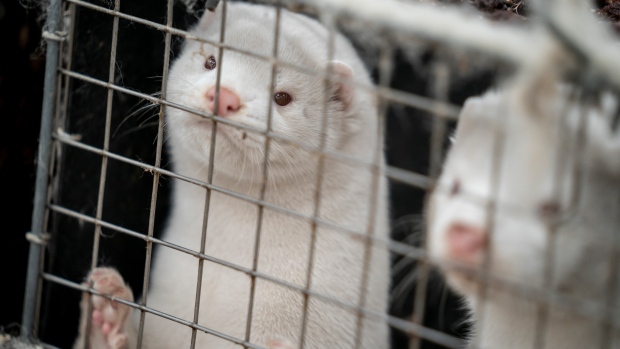
Who might even have imagined that Denmark has a thriving mink industry to supply the world with mink fur? All the more so at a time of growing sensitivity to culling animals for their fur for human clothing when industrial fabrics are able to mimic the warmth factor that animal fur represents? Now, a recent finding that mink held in breeding pens have contracted a mutated strain of the novel coronavirus amidst fears that this virus may spread and compromise the usefulness of a vaccine, has caused the Danish government to mandate an entire cull of all mink in the country, some 15 million in total.
Just as humans living in close proximity to one another become susceptible to contagious disease transmission, so too are mink in close confinement alongside one another similarly susceptible and the little creatures have become victims of a coronavirus strain. The fear is that they became infected through initial contact with a person or persons infected with COVID-19, and in turn themselves infected other workers, a situation that could readily become uncontrollable, mandating their entire cull as a preventive measure.
Authorities fear that the mutated version of the virus could become a more resistant threat against future vaccines. Now restrictions have been imposed on movement across county lines affecting seven municipalities in northern Denmark, where restaurants and bars are to be shuttered, according to Prime Minister Mette Frederiksen. Schools are also to be closed -- with all public transport shut down until December 3. Local inhabitants are encouraged to remain within their municipal boundaries and to get tested for the virus.
In this photo, minks in a farm in Gjoel in
North Jutland, Denmark. (Mads Claus Rasmussen/Ritzau Scanpix via AP,
File)
Denmark's mink pelt industry exports to the tune of $800 million annually, employing four thousand people, considered a fairly important industry for the small country. The proposed cull would surely result in a death knell for the outdated industry in a world where animal welfare concerns are becoming more mainstream and people increasingly reject the concept of wearing furs for their ornamental and practical uses. Denmark represents the largest producer and exporter of mink furs in Europe.
And oddly enough, it was a campaign launched first by Scandinavian countries, then taken up enthusiastically by the European Union, that gave a black eye to Canada's annual whitecoat seal hunt, and ultimately ended it. The annual hunt for adult seals by indigenous Inuit who traditionally hunt seals in season, to supplement their diets and who make use of every part of the animal in recognition of a culture and heritage in which this formed a way of life, is still realizing pressure from animal welfare groups.
Experts found agreement with Denmark's strategy to respond to the situation, according to state epidemiologist Kare Molbak, attending a meeting with the World Health Organization and the European Centre for Disease Prevention and Control. In Poland, another major mink pelt producer, no coronavirus has been detected. In neighbouring Sweden restrictions were imposed on mink farms after finding infections, but Sweden's infections are not reflective of the mutation discovered in Denmark.
(Mads Claus Rasmussen/Ritzau Scanpix via AP)
According to Denmark's State Serum Institute, tests showed the new strain had mutations on its spike protein, representing a part of the virus that invades and infects healthy human cells, posing a potential risk to future COVID-19 vaccines, based on disabling the spike protein. "The danger is that the mutated virus could then spread back into man and evade any vaccine response which would have been designed to the original, non-mutated version of the spike protein", explained Ian Jones, a virology professor at University of Reading in Britain, of the five cases of the new virus strain recorded on mink farms and 12 cases for humans.
"[This represents a good solution, for] such an essential and science-based step to protect Danish
citizens [has been decided in a total cull; there is hope that losing so many mink to the coronavirus
causes fur farms to get out of the business]."
"Although the
death of millions of mink — whether culled for COVID-19 or killed for
fur — is an animal welfare tragedy, fur farmers will now have a clear
opportunity to pivot away from this cruel and dying industry and choose a
more humane and sustainable livelihood instead."
Joanna Swabe, spokesperson, Humane Society International-Europe
"Of course, we recommend that people who are at increased risk remain aware and still look after themselves." "But we also recommend that you try to find a small group of people you can meet." "It is neither good nor necessary to isolate yourself in the long term. We have seen a tendency for some people to shield themselves almost a bit too much. Perhaps so much that they have become lonely and sad through sitting at home by themselves." Camilla Rathcke, co-author, Government of Denmark coronavirus advisory
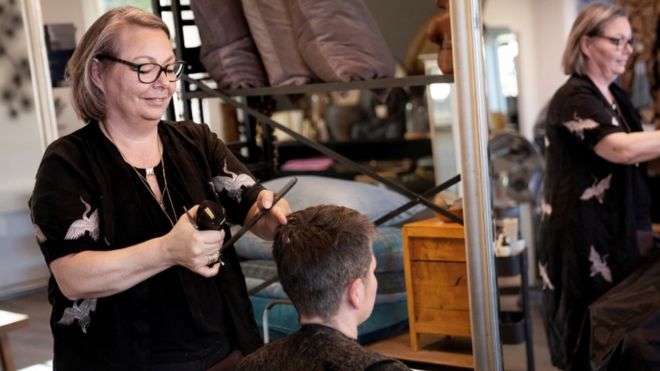
Hairdressers are among small businesses allowed to reopen in Denmark Reuters
As one of the first European countries to institute lockdown in response to the threat of the global pandemic, Denmark has also been the first country to begin easing lockdown restrictions, outside of Asia. The first in Europe to reopen schools and nurseries on April 15, retaining some measure of social distancing for children up to age 12. Small businesses opened up once again, five days afterward.
But for the present it remains a 'wait-and-see' atmosphere to try to judge whether any other restrictions might be safely lifted, perhaps around the 10th of May, accordign to Prime Minister Mette Frederiksen. Around that time, Denmark's government may consider further easing its lockdown to include reopening of shopping centres, cafes and restaurants, and more senior schools for children over age 12.
The government in Copenhagen a week ago proclaimed itself -- the spread of COVID-19, not having accelerated since the loosening of restrictions -- prepared to consider new freedoms for the population, given the "R rate", demonstrating the average number of infections passed on by one person with virus transmission increased but slightly in the past two weeks, remaining below 1. Elevated somewhat from its previous 0.6 rate under lockdown, to 0.9.
Now, after several months of severe restrictions where grandparents and grandchildren were unable to see or touch one another, a green light has been given and they may once again hug and kiss, thanks to the decision by the country's Health Authority under the issuance of new national guidelines covering people most at risk of contracting the coronavirus. "But avoid handshakes, hugs and kisses on the cheek with anyone apart from those closest to you."
The intention of the guidelines was to give an improved balance to the risk of infection from COVID with its long-term dangers to mental and physical health brought on by ongoing isolation, a primary consideration in all countries where similar lockdowns have taken place, now facing the gradual re-opening of their societies and economies, given the grim economic conditions that have ensued globally.
Where Denmark recorded 484 deaths from 9,670 confirmed cases of COVID-19, its neighbour Sweden, which had decided not to institute a lockdown, but to rely on its population to sensibly adopt social distancing on their own while going about normal life, with nothing closed but for schools for children under 16, Sweden's numbers of COVID cases and deaths have been far in excess of Denmark's with 22,721 cases and 2,769 deaths resulting.
Copenhagen, the capital of Denmark, at what would usually be rush hour on April 1.
Rasmus Degnbol/Anadolu Agency via Getty Images
"A great power play is shaping up between Russia, the United States and China, which is increasing the level of tension in the [Arctic] region." "It is likely that a part of China's buildup of knowledge about the Arctic and capacity to operate in the Arctic will take place in a collaboration between civilian and military actors." "This [Russia fortifying military capabilities] is an essential driving force for several other Arctic coastal states starting to strengthen their [own] regional military capabilities." Danish Defence Intelligence Service risk assessment report
"[Chinese research expeditions in the Arctic are not just a matter of science but serve a] dual purpose." "We have looked at Chinese research activities in the Arctic, and see that the Chinese military is showing an increasing interest in being part of that." Danish Defence Intelligence Service Chief Lars Findsen
US
secretary of state Mike Pompeo berated China for using its
growing Arctic research program as a Trojan horse for its military and
commercial goals.VCG/Getty Images
Russia and China appear to have reached a pact between them that neither will perhaps interfere with the plans of the other. China, halfway around the world, nowhere geographically close to the Arctic expressed its interest in having special observer status. While it is not an Arctic nation like Norway, Denmark, Russia, the United States and Canada, the allure of shipping through opening sea lanes as Arctic ice is beginning to recede, much less the Arctic's potential role as a military jumping-off spot, and the irresistibility of mining the vast stores of petrofuels and minerals on the ocean floor are all of great interest to this aspiring super power.
China has gone so far as to consider the Arctic as part of Beijing's far-reaching One Belt One Road initiative that would, in essence, bring the world itself closer to China. Having established a scientific base at Svalbard, Norway, it makes use of the front of scientific research as a way into the region, according to the Danish intelligence service report, warning of geopolitical rivalry in the Arctic intensifying over access to minerals. All the more so since U.S. Secretary of State Mike Pompeo pointed out Russia's aggressive military presence in the region
.
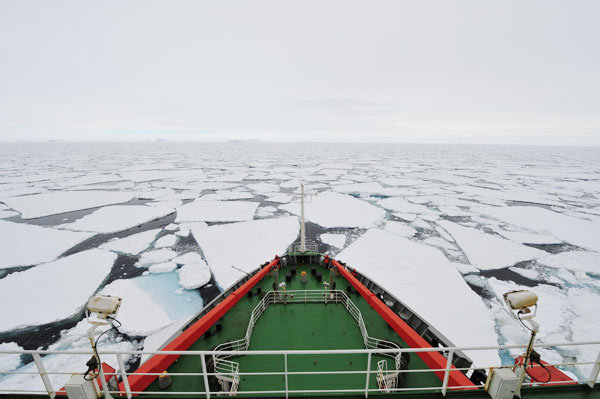
Chinese icebreaker Xuelong,
or Snow Dragon, arrives at the Zhongshan Station on Dec 2 on the
country's 30th expedition to the Antarctica that began on Nov 7.[ZHANG
JIANSONG / XINHUA]
China's infrastructure projects in any number of countries where it has made a presence throughout Africa, Asia and the Middle East, giving out generous loans and initiating badly needed infrastructure that will ultimately benefit China, while leaving those countries with monumental debts to be paid back ensuring they will remain as debtors in Beijing's orbit has allowed it to establish itself as a benefactor whom its beneficiaries remain economic captives to. Their initial pleasure at the building of bridges, roads, communications and greater trade prospects will eventually turn sour but in the interim it advances China's program.
Adding Arctic sea routes nicely rounds out Beijing's agenda for the foreseeable future. Denmark's priority on the other hand, is to ensure that the Arctic remains an area of international cooperation, that as issues surface political negotiations between those nations with Arctic territory can be depended upon. As Denmark's intelligence points out that goal, of regional cooperation in the greater interests of all concerned equally, is imperilled by the very reality of Russia's new military bases, and the emphasis by both Russia and China on building their expeditionary and military fleets of icebreakers and nuclear-powered battle ships which can only lead to confrontation.
The Russian race to the Arctic relies heavily on Chinese investment, and
fast-track shipping via the Northern Sea Route is especially attractive
to Beijing. Today, China is Moscow's biggest client for Northern Sea
Route shipments: Russia sent liquified natural gas tankers to China via
Arctic waters for the first time in July 2018, and lent Russian
icebreakers to escort a convoy of Chinese cargo vessels to Europe that
fall CNN
The Danish conclusion that "This is an essential driving force for several other Arctic coastal states starting to strengthen their regional military capabilities", expresses the reality that is all too obvious but which it appears that other Arctic nations with the exception of the U.S. prefer not to notice, since to do so would be to acknowledge their own need to meet this not-too-distant challenge with infrastructure and a commitment to defending their Arctic sovereignty with defences of their own military upgrades.
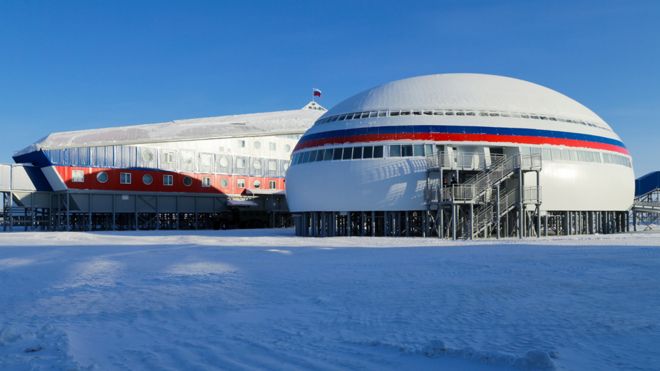
Russian Arctic Trefoil base: Special design features were used to cope with the severe weather Getty Images
"Our task is to monitor the airspace and the northern sea route." "We have all we need for our service and comfortable living [in Severny Klever military base, Kotelny Island, Siberia]." Lt.Col. Vladimir Pasechnik, base commander
"In Russia, the Northern sea route has been described as a bonanza with lots of potential of economic development." "And that's why there is a need for military capacity in the area." "It is likely meant as defensive, but it is being interpreted by the West as offensive." Flemming Splidshoel Hansen, Danish Institute for International Studies
"Norway is a small country, whose next-door neighbour is mighty Russia, which has placed the bulk of its military capacity right next to them." "Norway is extraordinarily worried." Kristian Soeby Kristensen, researcher, Copenhagen University, Denmark
The Mir-I is one of two Russian craft that dived to the Arctic floor
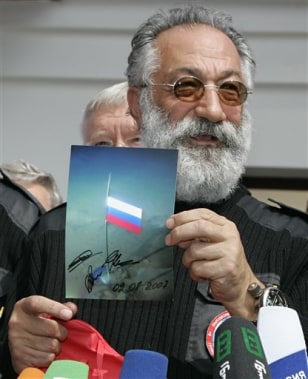
Russia symbolically staked its claim to billions of dollars worth of oil
and gas reserves in the Arctic Ocean today when two mini submarines
reached the seabed more than two and a half miles beneath the North
Pole.
In a record-breaking dive, the two craft planted a one metre-high
titanium Russian flag on the underwater Lomonosov ridge, which Moscow
claims is directly connected to its continental shelf. However, the dangerous mission prompted ridicule and scepticism among
other contenders for the Arctic's energy wealth, with Canada comparing
it to a 15th century colonial land grab. Descending to 4,300 metres, the mini-subs Mir-1 and Mir-2 collected
water and sediment samples from the seabed. Russian scientists hope the
samples will shore up their claim that the ridge is an integral part of Russia.
Advertisement
If
Russia's claim is approved by the UN, the country could gain rights
over supplies of hydrocarbons that some experts put at 10bn tonnes. The
ice cap is melting, making exploration and drilling for oil and gas
easier. The Guardian, August 2007
Alexander Zemlianichenko
/
APRenowned Russian polar scientist Artur Chilingarov holds a photo of the
Russian flag on the ocean floor upon his arrival at Moscow's Vnukovo
airport on Tuesday (2007).
The Arctic has many contestants for jurisdiction by nations bordering that frozen sea and whose claims contest Russia's, including the United States, Canada, Denmark and Norway. And then there is China which has no physical presence in the Arctic but would like to and claims observer status. The vast mineral and energy resources stored under the ocean and thought to be technologically accessible for exploitation has all Arctic nations interested in claiming ownership of 'their' portions of the Arctic. And some, like Russia, are particularly anxious and prepared to be aggressively engaged in pursuing their claims.
Russia has invested quite a bit of funding in its Arctic claims of sovereignty, upgrading and modernizing old Soviet-era infrastructure, and installing permanent military missions on its share of the Arctic where temperatures can and do plunge to minis 50C in the winter, with the short Arctic summers giving merely temporary relief while still freezing at night. Russia's new massive investment in its base between the Laptev Sea and the East Siberian Sea on its Arctic shipping route includes permanently housing 250 military personnel.
There, with sprawling new facilities, the base maintains sufficient supplies for over a year for fully assured autonomy. The sprawling facilities can all be accessed without anyone having to venture into the icy outdoors. The military personnel are responsible for the maintenance of air and sea surveillance at the facilities, along with coastal defences such as anti-ship missiles. This is serious business for Russia; any contesting of their claims, any sign of hostile approaches will be both monitored and responded to.
For Russia, in its view of Arctic security and economic competition, the region represents a vital priority in foreign policy. No other Arctic country, including the United States has undertaken a clear presence dominating the vast area, and a bristling military menace presence as has Russia. Its intentions were clear from the time in 2007 it staged a mock but serious claim of the Arctic seabed by planting a Russian flag and celebrating its publicity coup.
In 2015 Russia submitted a revised bid claiming vast territories in the Arctic, sending it to the United Nations when it claimed 1.2 million square kilometres of the Lomontov sea shelf, all of which it claims is attached to the Russian mainland, some of which Canada disputes. Russia's claim extends over 650 kilometres from its shore. To support its claim, it has spent massively on modernizing Soviet era installations, upgrades that no other Arctic nation has committed to.
By comparison, Canada's lackadaisical efforts reflect a total lack of commitment belying the government's claims of the vital importance of its Arctic sovereignty. The amount of investment that Canada has committed to shrinks to minuscule proportions in comparison with Russia's. A road completed to the Arctic coast at Tuktoyaktuk in the Northwest Territories and work embarked upon for a port at Iqaluit in Nunavut, the extent of Canada's commitment to this date, along with the first Arctic patrol vessel being launched and satellite surveillance enhanced with a naval refueling station on Baffin Island.
Russia, on the other hand, has launched a gigantic effort since 2014 to rebuild the Kotelny Island military outpost, neglected after the 1991 collapse of the Soviet Union. Where the Russian Defence Ministry recently showed off Bastion anti-ship missile launchers positioned near the shore and Pantsyr-Si air defence systems during a drill firing shots at a practice target. A large radar dome sits on a hill overlooking the coast, stressing the main mission of monitoring the strategic area from the base.
Full radar coverage of Russia's 22,600-kilometre Arctic frontier has been achieved through the expanded infrastructure, where fighter jets can be deployed to protect Russia's Alaska airspace. And its permanently deployed military can access new base features such as spacious living quarters, a gym, and a sauna.
1) North Pole: Russia leaves its flag on the seabed, 4,000m (13,100ft) beneath the surface, as part of its claims for oil and gas reserves 2) Lomonosov Ridge: Russia argues that this underwater feature is an extension of its continental territory and is looking for evidence 3) 200-nautical mile (370km) line: Shows how far countries' agreed economic area extends beyond their coastline. Often set from outlying islands 4) Russian-claimed territory: The bid to claim a vast area is being closely watched by other countries. Some could follow suit
"Long-distance spread of A.S.F. [African swine fever] can happen anytime, all over Europe." "Fences cannot prevent such events." Dr. Klaus Depner, Federal Research Institute for Animal Health, Germany "It's not a border fence. I don't want to hear any of that." "It's a veterinary fence made to protect our animals." Refslund Hansen, farmer, Denmark
"It's very un-European to build fences and boundaries between countries." "I fight for free movement in every other context. When it's right in this context it's because such a large part of exports is at risk." Minister of Environment and Food, Jakob Ellemann-Jenson, Denmark
An intersection near Mjolnerparken, a housing project in Copenhagen that is classified as a ghetto by the Danish government. Credit Mauricio Lima for The New York Times
African swine fever virus represents a threat to the production of pork which happens to be a major export for Denmark. The virus is readily spread, highly resilient and capable of surviving in pork products and feces for months, leading to easy transition. No vaccine is available nor any type of treatment against it. Outbreaks can only be contained by culling swine populations. Romania did just that, slaughtering 230,000 pigs in the process.
Some Danes are responding to a government initiative to build a fence along its border with Germany in hopes of isolating wild pigs on the other side of the border, with the suspicion that its true purpose is to keep refugees that have inundated Germany from using the European Union's 'invisible borders and free movement' to their advantage to exit Germany and enter Denmark.
Authorities in Denmark have reached the conclusion that the country has absorbed more than enough such migrants, with the concern that they are failing to adequately integrate.
Rokhaia Naassan, center, with her back to the camera, resents the new mandatory preschool program for “ghetto children.” CreditMauricio Lima for The New York Times
What the government poses as a deterrent to wildlife, those willing to absorb greater numbers of haven seekers identify as an opaque plan to deter refugees from entry to the country.
The virus in question is considered harmless to African animals such as warthogs and bush pigs as well as to people. Wild boars and domestic pigs are another story altogether; in them it causes a hemorrhagic fever that often becomes lethal. It has become widespread in Russia in recent years, and outbreaks have been reported in Romania, Belgium, Bulgaria and parts of China.
Denmark's government has conceived of a $20-million public awareness campaign, permission to hunt wild boars, and a fence some 1.5 meters in height along the 70-kilometer land border across the neck of the Jutland peninsula, from the Baltic to the North Sea. Environmentalists have appealed to the EU to stop the building of the fence, though work is set to begin early next year. There are planned openings for 14 border crossings, five waterways and local farmer passages allowing the movement of people and goods.
Boars are to be the target of the deterrent fence, although deer and otters will still be 'permitted' to cross. Perhaps signage will do the trick. Critics of the fence point out that wild pigs are intelligent and curious, foraging over great distances. The European Food Safety Authority concluded "there is no evidence that large fences have been effective for the containment of wild suids"(pig animal family)."It's like creating your retirement fund by buying a lottery ticket", jeered Hans Kristensen, a hunter opposed to the fence.
Cameras are to be placed where roads cut through the fence, ostensibly to record how frequently boars manage to circumvent the fence. A request has been received by the minister of justice from the Danish People's Party that the cameras be used as well to identify people attempting the illegal crossing of the border.
In reality, all Denmark has to do is to reasonably declare that they have absorbed more than enough Muslim migrants and have no intention whatever of taking in any more, just as Poland and Hungary have, and be done with it. No subterfuge is needed with a legitimate decision that enough is enough....
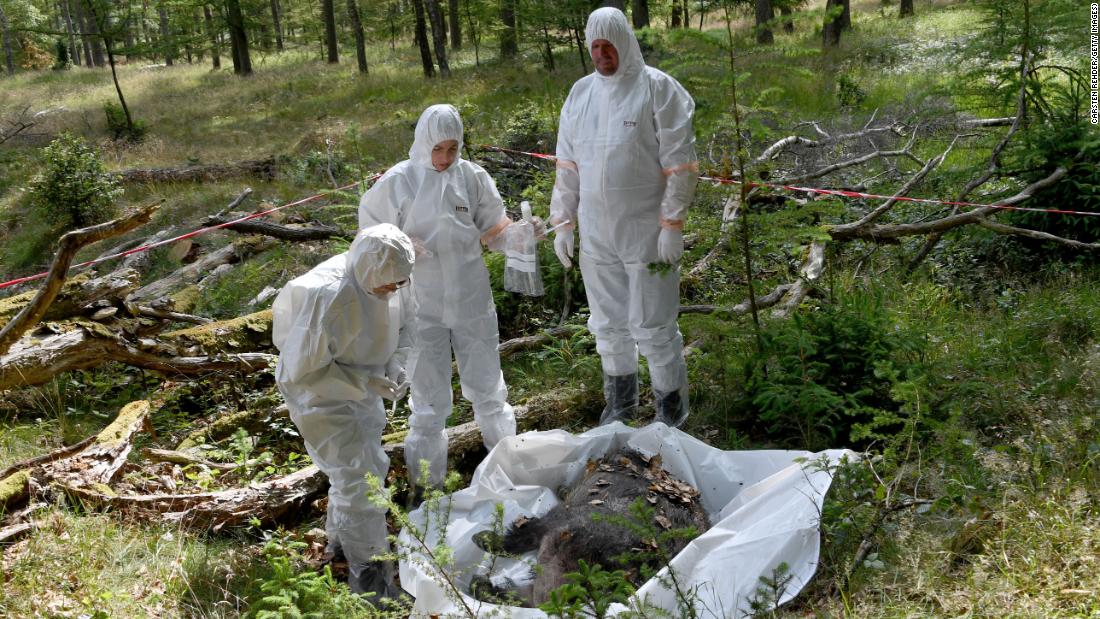
Veterinarians inspect a dead boar during an African swine fever outbreak exercise in Germany in June.
This represents a general opinion site for its author. It also offers a space for the author to record her experiences and perceptions,both personal and public. This is rendered obvious by the content contained in the blog, but the space is here inviting me to write. And so I do.