Manipulating Useful Dupes
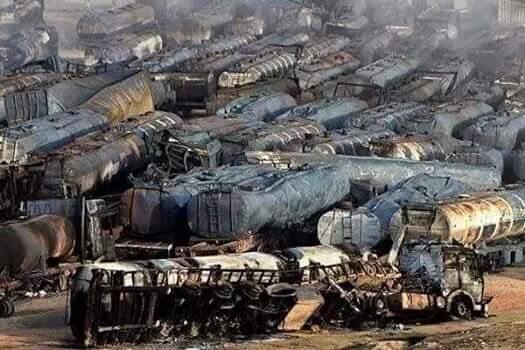
"Americans have a right to know that much of what they view online is being disseminated by foreign agents in an effort to disrupt U.S. energy policies."
"[Many of the Russian-linked accounts targeted] highly visible tension points [in America; protests against pipelines and over climate change]."
"The surge of American energy into the global marketplace heightens the Kremlin's desire to eliminate or mitigate the American energy threat and to do so by influencing social media users, American voters, and public officials."
"The Kremlin is attempting to make ... 'useful idiots' of unwitting environmental groups and activists in furtherance of its energy influence operations."
"Although this is not a new tactic in the Kremlin's playbook, it has been adapted to account for modern technological advancements like the Internet and social media."
"Throughout history, the Kremlin has engaged and manipulated unwitting individuals to disseminate propaganda in furtherance of its global agenda. By leveraging the sincerely held views and beliefs of unwitting agents, the Kremlin is able to exploit polarized issues in American democracy to influence action in furtherance of its agenda."
Report: U.S. House of Representatives Committee on Science, Space and Technology
Oh dear, the seething outrage of sanctimony! The American investigation by lawmakers in the U.S. linking Russian-sponsored agents to energy market manipulation in the United States. As though similar intrusive methods used traditionally and to the present by certain arms of the U.S. government would never, ever dream of engaging in such nasty underhanded interference in foreign countries. Condemning the Kremlin's appetite for disrupting American economic outreach, while portraying innocent American environmental groups as sincere but fallible dupes.
Such righteous displays of indignant frustration fail to sit well with reality where the C.I.A. has been involved not only in undermining all manner of groups abroad in efforts to alter their political landscapes with a view to favouring American policy, would have infinitely greater impact in a moral sense if official U.S. ethics were anything to celebrate from the perspective of a moral compass. Still, it makes for fascinating reading, if only to fully savour how impressively successful agents can be in launching their operations through social media.
The extent to which Russian agents have enthusiastically taken up the exploitation of social media platforms in the United States, influencing opinions on environmental and energy policies in the United States is quite enterprising. Social media companies such as Twitter, Facebook and Instagram have been most helpful in providing the investigation with documents revealing agents utilizing accounts linked to the Internet Research Agency, a Russian enterprise out of St. Petersburg established for the particular purpose of manipulating social and traditional Western media by the government of Russia.
And it has succeeded to an amazing degree in advancing Russian propaganda. Its now-legendary success in the political sphere dating back to the last U.S. presidential election represents a casebook study in fundamental, purposeful and successful interference on a grand scale. Eliciting howls of outrage from the unprepared Americans who have seen their own brilliant, world-altering inventions turned skilfully against them. That very same Internet Research Agency aided and abetted the election of a nincompoop to the American presidency whose lack of principle reflects Putin's.
It seems, however, that an astonishing amount of industrious energy on the part of computer expertise focused on social media was utilized to grand effect in the sphere of U.S. energy growth; roughly half the numbers used in manipulating the presidential election. According to Twitter, over four percent of all IRA
(Internet Research Agency) tweets related to energy or environmental issues in comparison to eight percent delegated to the U.S. election. An estimated 4,334 IRA accounts across Twitter, Facebook and Instagram were established between 2015 and 2017.
An unfortunate slop-over affecting Canadian energy futures also occurred. But then, Russia has no great love for Canada, either. The Canada that saw former Prime Minister Stephen Harper embarrass Vladimir V. Putin in grudgingly shaking his hand at a G7 event while advising him gruffly to
"get out of Ukraine". A Canada whose Minister of Foreign Affairs, Chrystia Freeland, has a rather undiplomatic hate-on for Russia. A Canada which chose to adopt the Magnitsky Act into law, further distancing itself from Moscow.
So that opposition stirred by Russian interface with U.S. environmental groups impacted the two pipelines vital to Canada's future energy exports: TransCanadaCorp.'s Keystone XL meant to transport Alberta oil to the U.S. Gulf, along with Enbridge's Line 5, of the Lakehead system to move Western Canadian oil to Eastern Canada through Great Lakes states. The masterminded protests through social media impacts linking U.S. energy and climate change, fostering and supporting both through propaganda and funding of environmental groups in the rejection of oil pipelines.
Social media posts were meant to and succeeded in inciting fear and loathing of oil spills, along with the "brutalization" of North American Aboriginal populations. According to one tweet, the Keystone Pipeline purposed to transport the dirtiest fuel on Earth, and another highlighted Keystone pipeline leaks in South Dakota. Nothing like fear-mongering and supporting peoples' neurotic concerns over worst-case scenarios, even in the face of reality diminishing the potential of those scenarios in the face of other options currently in use for transport known to be more dangerous, to motivate people to assemble and to protest, alerting politicians to the way the wind blows.
Russia sees the U.S. energy deposits and extractions as a huge challenge to their own markets, particularly in Europe. Its efforts are meant to impact on America's growing influence as a large energy exporter, threatening Russia's revenue and influence on energy-dependent Eastern Europe. The probe launched by the U.S. House of Representatives committee revealed that Russian sponsored-agents funded environmental organizations in the U.S., one of the recipients being the Tides Foundation which in turn funds campaigns in British Columbia against oilsands pipelines and liquefied natural gas.
Labels: Canada, Exploitation, Natural Resources, Oil Revenues, Propaganda, Russia, Social Media, United States
Venezuela Staggers in Dysfunctional Failure
"While they [Venezuelan bonds] are able to muddle through, your exposure to Venezuela is going to outperform almost everything else in the emerging-market bond universe."
"However, you have to be very careful to have an exit strategy. You're looking at an advanced stage of cash-flow stress."
Siobhan Morden, head of Latin America fixed-income strategy, Nomura
"The probability of default is rising."
"So far, their willingness to pay [Venezuela's interest on its international debt] has been pretty firm, surprisingly so given the political situation."
"But you have to ask how long that can continue when they are probably spending more on debt service than [on] imports."
Stuart Culverhouse, head, sovereign and credit research, Exotix Partners, London investment bank
 |
Demonstrators clash with riot police on
armored car during rally against Venezuela's President Nicolas Maduro in
Caracas, Venezuela May 1, 2017.
REUTERS/Carlos Garcia Rawlins
|
"I don't want a civil war."
"I convoke the original constituent power to
achieve the peace needed by the Republic, defeat the fascist coup, and
let the sovereign people impose peace, harmony and true national
dialogue."
Venezuelan President Nicolas Maduro
Thus, the May 1st announcement to his supporters of the production of a new popular assembly able to re-write the constitution, The new creation would have the power to call general elections and dissolve public powers. It would elect merely half of the current 500-member assembly, a process in which political parties could not become participants. Understandably, the opposition is calling for protests reflecting the obvious fears, that Maduro is intent on manipulating elected seats, giving additional weight to pro-government workers and unions while ensuring supporters filled the assembly.
In hopes that elections could be avoided, scheduled for next year. And since Venezuelans endure long wait lines for basic necessities while hunger is spreading, how likely would it be in a legitimate, uncorrupted election that Maduro would be re-elected given public reaction to his disastrous administration? His efforts to continue sidelining the opposition and pay the political cost of the recession and the fury of the suffering people of an ailing Venezuela make certain he will leave no feint untried to prolong his detested and failed government.
 |
Demonstrators wave as the helicopter
passes while rallying against Venezuela's President Nicolas Maduro in
Caracas, Venezuela May 1, 2017.
REUTERS/Carlos Garcia Rawlins
|
Venezuela's present and its future lie in ruins. Oil production and international reserves in an accelerated fall, the Maduro government's efforts to pay for imported food and drugs and meet its short-term bond payments have strained it to the fullest, even though imports have been slashed and shortages have impacted horribly on people's lives. This is a situation brought on by stupidity and neglect, of an industry in decline, the country's oil production in free fall.
Fifteen years ago, under Hugo Chavez with Venezuela in possession of money to spare from the sale of its oil, Chavez lavished funding on making a splash for the poor of Venezuela, improving their lives and future prospects in badly needed reforms. He also gave away oil to neighbouring countries, and went so far as to provide Venezuelan-subsidized oil to help poor Americans heat their homes for winter. This show of generosity to demonstrate what a socialist government was all about, neglected the nation's infrastructure.
Nothing was invested at a critical period in the country's natural resources extraction in upgrading its refinery infrastructure, and it is now in a state of disrepair with no funding available to modernize and make the industry effectively reliable. And nor will Venezuela's financial state improve while oil remains at $65 a barrel, at the most optimistic estimates. The external bond debt of the government has beggared the nation, an event that took its time but which the socialist government of Hugo Chavez initiated.
China, which had reliably given Venezuela the bulk of its new project loans guaranteed by oil shipments to an energy-hungry economy, has now stepped silently back; no more of that for China with a collapsing Venezuelan economy where inflation grows at a monthly 20 percent and where oil production is down to two million barrels a day; reduced by over a million barrels from the last two decades.
 |
Demonstrators hold placard that reads:
'No more dictatorship' while rallying against Venezuela's President
Nicolas Maduro in Caracas, Venezuela May 1, 2017.
REUTERS/Carlos Garcia Rawlins
|
Labels: Economy, Oil Revenues, Protests, Venezuela
Overlooking Human Rights Inconveniences
"[She] set out the sort of depth of expertise that there is in London and the U.K. in terms of financial services."
"[Also emphasizing] the depth of investment opportunities that there are in the U.K."
British Prime Minister Theresa May's Office
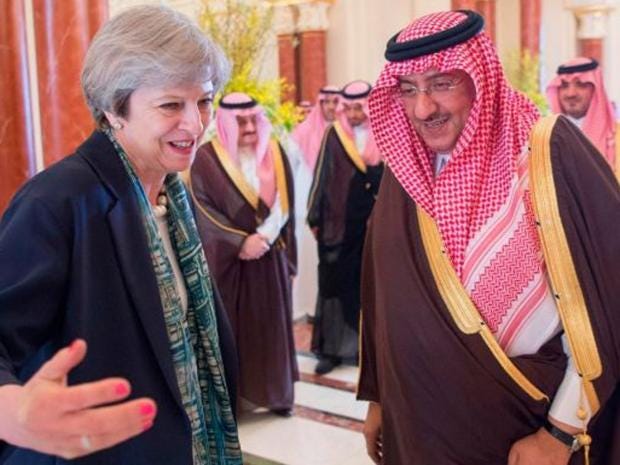 |
| Theresa May with Saudi Crown Prince Muhammad bin Nayef in Riyadh on Wednesday EPA |
"It's important for me as a woman leader and as leader of the
Government of the United Kingdom to maintain the relationships that are
important to us as a country, for our security, and our trade for the
future."
"But I hope also that people [women in Saudi Arabia] see me as a woman leader, will see what
women can achieve and how women can be in significant positions."
British Prime Minister Theresa May
Britain's Prime Minister has uppermost in mind how she can convincingly charm Saudi royalty in the Kingdom of Saudi Arabia to look favourably upon the London Stock Exchange at a time when Riyadh is in the throes of raising cash through international markets, listing shares of Aramco, the largest oil producing company in the world. The country's economy has come on hard times with lower oil prices, at a time when it continues to have many extremely large expenses.
The Kingdom ranks as the world's third largest spender on military hardware. It buys billions' worth of military hardware from the United Kingdom alone, and British arms manufacturers have reason to be grateful, and they are. Saudi Arabia happens also to be Britain's largest Mideast trading partner. Britain exported 6.5-billion pounds-worth of its goods and services to Saudi Arabia in 2015. And the prospect of even more Saudi money coming its way is reason enough for Mrs. May to ingratiate herself with the Kingdom's royal family.
Because Saudi Arabia plans to list five percent of Aramco on its own stock exchange and is looking about for an international venue, Britain is hoping that the London Stock Exchange will be viewed favourably for that choice in Saudi Arabia's search for an international exchange. The Prime Minister was moved to explain in detail how advantageous it would be for Saudi Arabia to list in the United Kingdom, and at her side was the CEO of the London Stock Exchange.
There's always something amiss, to rain on an enterprising nation's parade of self-exaltation, and in the U.K. it's the Campaign Against Arms Trade, which claims its government has licensed over 3.3 billion pounds' worth of arms to Saudi Arabia in the past two years, since Saudi Arabia alongside its coalition initiated a campaign of bombing against Houthi rebels in neighbouring Yemen.
The little matter of the humanitarian crisis that has since emerged in a country like Yemen known to be desperately poor, where 82 percent of the population -- around 21 million people -- are in desperate straits, urgently requiring humanitarian assistance, does not reflect all that nicely on Britain choosing arms profits over the morality of providing the tools to kill thousands of civilians, wounding many thousands more.
But rest assured, Mrs. May took the time to politely, no doubt quite discreetly, discuss the humanitarian crisis in Yemen during her meeting with King Salman. For her efforts she was presented with the Order of King Abdulaziz, the founder of Saudi Arabia, King Salman's father, a distinction meted out to former U.S. President Barack Obama as well.
This, no doubt, for overlooking the inconvenient fact that the Kingdom has exported its viral strain of fundamentalist Islamist Wahhabism worldwide, giving rise to such distinguished violent jihadi groups as al-Qaeda and Islamic State, among others.
Much is being made of Prime Minister May's decision to eschew the obligatory head scarf in her meeting with Saudi Royalty. In this way demonstrating to oppressed Saudi women that gender does not stand in the way of achieving greatness. Of course, wherever Mrs. May met with the Saudi royals she took great care to cover herself modestly, wearing voluminous coats to cover any dress that might have appeared too suggestively feminine.
 |
| Saudi Arabia's King Salman presents British Prime Minister Theresa May with the Order of King Abdulaziz in the capital Riyadh on Wednesday. Bandar al_Jaloub AFP / Getty Images |
Labels: Conflict, Human Rights, Oil Revenues, Saudi Arabia, Trade, United Kingdom, Yemen
Bolivarian Ruination and Starvation
"I used to have my own little market. Now I clean houses from 6 a.m. to 7 p.m. When I'm not standing in line [to access scarce market goods]."
"I'm 50 years old, and I've never been hungry like this before."
Venezuelan Marys Rosalba
"This government has looted our country. And they're still doing it."
"Over there [in Venezuela], you wait in line all day for a kilo of rice and sometimes it runs out before your turn comes, so it's all for nothing."
Carlos Ortega, 68, retired Venezuelan geology professor
 |
People arrive in San Antonio to cross over
the Simon Bolivar international bridge to Colombia to take advantage of
the temporary border opening in San Antonio del Tachira, Venezuela, July
17, 2016.
Reuters/Carlos Eduardo Ramirez
|
Both Marys Rosalba and Carlos Ortega were in Colombia; she to try to buy scarce market items in the border town of Cucuta, and he to attend a medical appointment there. While there he also indulged in a bit of shopping, procuring a few pounds of beans, sugar and flour. It was all his Venezuelan pension would allow him to buy. As for Marys Rosalba, she came away with laundry detergent, tampons and toilet paper.
Colombians always historically viewed Venezuela as their wealthy neighbour. It is a country, after all, with vast resources of fossil fuels. And there was a time not so long ago when Venezuela lorded it over its neighbours, and compassionately offered oil at a fraction of its production cost, happy to subsidize fuel for its less fortunate neighbours. Cuba did very well by its comradely mentoring of Hugo Chavez. Chavez is dead, and so is the price of oil.
Even poverty-stricken Americans profited from Venezuelan heating oil at a preferential low cost when Hugo Chavez, smelling sulphur in the wake of George W. Bush at the United Nations, tweaked his proverbial nose highlighting the American poor dependency on the great-heartedness of fuel-generous Venezuela. A Venezuela busily lifting its own indigent poor into a more comfortable national status with the proceeds of oil sales.
A Venezuela that lacked the business and entrepreneurial sense to invest some of its profits back into modernizing its oil extraction facilities and building oil refineries so it wouldn't have to re-import its product, refined elsewhere. But that's the Bolivarian revolution; its socialist-centric view on politics and social policies eschewed business management and the need to prepare for the future.
The future arrived without Hugo Chavez, but Venezuela was gifted with his successor who may have known how to drive a public bus, but appears remiss in knowing how to administer the affairs of a nation. The poor Colombian town of Cucuta is now a lifeline for desperate Venezuelans, eager to shop where supermarkets actually store food on shelves full of assorted products that can be bought.
Venezuelans in their tens of thousands now stream across the border to look for basic goods whenever the Venezuelan government succumbs to their pleas to allow them to cross. The world's highest inflation rate combined with hapless mismanagement of the economy has resulted in worthless bank notes and a wholesale absence of consumer goods at home, let alone food staples. The nation hasn't the financial resources to afford to import all the food it needs for its population.
"They used to come here to sell. Now they come to buy", observed Viviana Lozano, a Colombian shopkeeper who was forced to acquire a money-counting device in order to process the giant wads of Venezuelan bolivars proffered when making even minimal sales to those whose plight she could ease, to supply as much as they could afford. A 100 Venezuelan bank note has a value of ten cents, U.S. She has hired ten people to help her with the crush of shoppers each weekend.
Long-distance buses carry Venezuelans hundreds of miles to get to the weekend crossing openings. Where Venezuelans race madly to supermarkets to cram duffel bags and backpacks with sacks of rice, sugar, corn meal and milk powder. Nicolas Maduro resents any notion that the border can be viewed as a "humanitarian corridor" for desperately hungry Venezuelans. The very thought of Venezuelans being underfed is a figment of someone's crazy imagination.
The inflation rate sees consumer prices increasing by 700 percent even while the country's economy shrank ten percent in 2016. President Maduro insists that 40 percent of Venezuelan goods are smuggled out of the country by criminals looking to take advantage of their subsidized prices. Government price caps have added to the shortages, additionaly limiting the nation's ability to import basic food items.
The Venezuelan military has been deployed at the border, but armed sentries standing on guard, mostly turn away from the sight of Venezuelans making illegal crossings through the shallow river that takes them across the border. In central Cucuta, piles of containers of powdered milk stamped with the "Mercal" label of the Venezuelan government are unloaded for sale at inflated prices. The high-octane gasoline that sells for two cents a gallon at government service stations in Venezuela is sold for $10 in six-gallon plastic jugs.
The Venezuelan currency has lost over 90 percent of its value in the last several years. Bolivars have depreciated in value so swiftly that Venezuelans who arrive in Colombia clutching their cash cache discover that it isn't worth as much as they'd hoped. Leading Venezuelans to admit they are unable to have enough to eat, with meals consisting of little more than cornmeal cakes and fruit.
 |
People walk to cross over the Simon Bolivar
international bridge to Colombia to take advantage of the temporary
border opening in San Antonio del Tachira, Venezuela, July 17, 2016.
Reuters/Carlos Eduardo Ramirez
|
Labels: Oil Revenues, Social Dysfunction, Venezuela
The Western Hemisphere's Economic Basket Case
"[I order] all actions to recover the production apparatus, which is being paralyzed by the bourgeoisie."
"Venezuelan business people who sabotage the country [through halting plant production will be] put in handcuffs".
"Washington is activating measures at the request of Venezuela’s fascist right, who are emboldened by the coup in Brazil."
Venezuelan President Nicolas Maduro

Venezuela’s
President Nicolas Maduro speaks during a meeting with ministers at the
Miraflores Palace in Caracas. | Photo: Reuters
"If you obstruct the democratic way, we do not know what could happen in this country."
Opposition leader Henrique Capriles
"You can hear the ice cracking. You know there's a crisis coming."
Senior U.S. intelligence official
Venezuela's natural resource of the world's largest oil reserves, at 298 billion barrels, enabled the late Hugo Chavez to buy the loyalty of his country's marginalized population. That wealth was used by then-President Chavez, when oil was at a high-per-barrel demand, to mount a populist program heavy on wealth distribution from the wealthy to the poor. Although the government of Venezuela was swimming in revenues it invested none of it in upgrading its oil-extraction and -refinement infrastructure.
But it did subsidize oil to its neighbours, to its great supporter, Cuba, and even to the poverty-stricken in the United States where most of the Venezuelan oil was exported and where he delighted in showing his credentials as a radical. Now, a failing economy with a rampant inflation, imports oil from the United States, its mortal enemy. Under Chavez, and now under his protege, Venezuela consolidated warm relations with Iran and Libya, while blaming the U.S. for plotting its downfall.
Venezuela's poor and its disadvantaged continue to give full loyal support to the Chavista-style of governance where foreign investment shies away from an empty treasury in the country which seized assets of foreign investors, nationalized their companies, persecuted regime critics and stimulated an exodus of the nation's scientists, doctors and entrepreneurs who left in favour of starting over elsewhere.
In a country dependent for 94 percent of its earnings from oil exports, the collapse in oil prices means a collapse in the subsidizing of schools, health clinics, gasoline and basic foodstuffs. Venezuela, already beset with a high rate of violent crime has become the most violent and crime-ridden nation in the world. Where mass looting attacks take place and energy blackouts are common occurrences.
Most recently, public employees were placed on a mandatory two-day work week to economize power usage. Hours and days are spent on food lines and food riots take place, injuring people. There were only 15 days' worth of inventory left, according to the Venezuelan Chamber of Food. This, in a country where 45 percent of citizens admit to struggling to secure money to feed their families.
A petition to force President Nicolas Maduro to resign though his mandate is through to 2019 has acquired over two million signatures. This nation of 30 million people is suffering, and they want an end to their hopeless travail. Shortages of food, of medicine, or toilet paper, of hope and opportunity, is draining peoples' patience at the state of their country's fortunes, in ruination thanks to its extreme form of socialism.
Crowds demonstrate in Caracas, demanding that the National Electoral Council rule for the validity of the signatures favouring a referendum to allow the country to move forward. Yet a decree was given granting Maduro expanded powers in the face of this deep economic crisis. Presidents Chavez and Maduro succeeded in changing the constitution by invalidating term limits. Their loyalists pack key institutions.
Secretary General Luis Almagro at the Organization of American States may call for a special session to debate Venezuela's crisis, and to enable a vote on measures that might include expelling Venezuela from its membership; at the very least to rebuke the Maduro government for its administrative failures.
Labels: Economy, Oil Revenues, Paranoia, Venezuela, Violence
Russia, on the Troubled Home Front
"I don't think Uralvagonzavod will vote for Putin again -- we saw what that led to. This is the opinion of a lot of workers, but a lot of them are afraid to say it. We just don't understand why they are firing people."
"They say they have orders, but they also cut our salaries."
Yevgeny M. Shukhin, labour protester, Nizhny Tagil, Russia
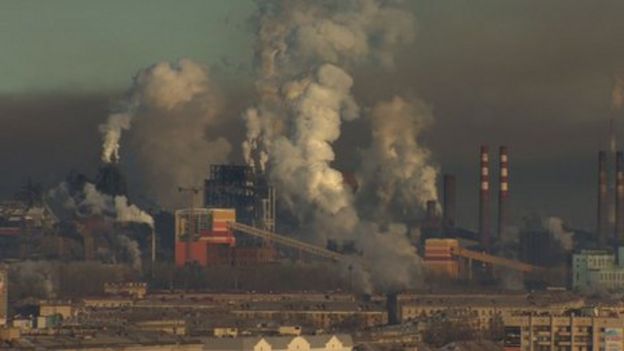 |
| Industrial pollution in Nizhby Tagil, BBC News |
In Nizhby Tagil there are two industrial plants, one of which produces steel and the other, Uralvagonzavod which turns out train cars and tanks. Both are pivotal industries. Both have announced worker layoffs. Since that initial announcement, however, Uralvagonzavod has stated that within its workforce of about 30,000, "optimization" will be of a voluntary nature.
The agony of these Russian workers is inextricably wound up with Russian President Vladimir Putin's extravagance in military spending, given the parlous nature of the Russian economy, stuttering since the fall in oil prices and struggling under the sanctions regime. But his dedication appears to be heavily in favour of continuing that military spending; there remains prestige and the promise of power in that direction.
The workers will have to fend for themselves. And they're doing that by angry protests. Uralvagonzavod is not yet fully feeling the pain, however. Workers on the train-car portion of the factory are now on two-thirds salary amounting to about $260 monthly, while the tank assembly lines are going full blast, and those workers are paid in full measure.
Russia's economic slump has seen real wages, adjusted for inflation, drop 6.3 percent in January. New car sales are down 50 percent. Labour unrest is stirring throughout Russia. The days of flush $100-a-barrel oil prices fuelling the economy are past. Once viewed as the champion of factory towns, the troubled industrial centers no longer view Mr. Putin as their knight carrying bailout funding.
As many workers as are out protesting, their presence is overwhelmed by more numerous police officers on Machinists Square. Those workers who did turn out were extremely aware of the presence of the uniformed and plain-clothes police. A local activist pulled a red banner printed with
"For Workers' Rights!" across the pedestal holding a statue of Lenin.
Back in 2012 during the presidency campaign, Vladimir Putin showed up in Nizhny Tagil in the northern Ural Mountains where a shift foreman at the factory had boasted on television that his "boys" from the factory were prepared to travel to Moscow to beat up the urban protesters.
"You showed who the Russian people are, who the Russian working man is", Mr. Putin said to the foreman, Igor R. Kholmanskikh.
"For more than a year, people go to work but do nothing", said Ilya Korovin. He grumbled that the assembly lines were idled while workers' pay was cut and grocery prices were going through the roof. And the factory management had no response, no direction, not the merest bit of alternative action, let alone response to the workers' crisis of confidence.
While back in Moscow, Ilya V. Yashin, a leader of the opposition movement that Mr. Kholmanskikh had threatened with his "boys" from the factory, empathized with the workers:
"Dear Workers of Uralvagonzavod! In the end, the workers who not so long ago threatened to scatter the protesters were themselves forced to go to protest against layoffs and violations of their labour rights. Time put everything in its place."
A retired shift boss at Uralvagonzavod, Mikhail G. Scherbakov, has a pension of $175 monthly, after 43 years of his working life on the assembly line.
"They either have no conscience, or they have no money", he noted glumly, prepared to give them the benefit of the doubt.
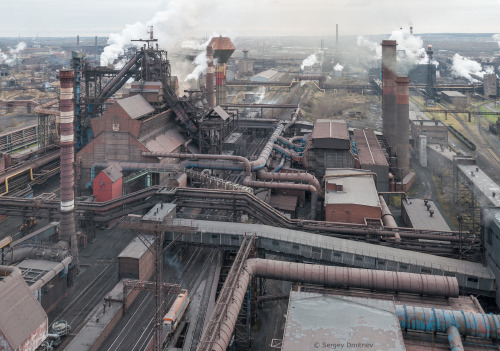 |
| Overviews of EVRAZ NTMK plant in Nizhniy Tagil - one of the biggest
Russian steel mills. Together with UVZ (machine building plant which
produces railroad carriages and tanks) and some smaller factories, this
huge combine covers almost half of the town’s territory. Currently only two blast furnaces are running at the site and two more
are under demolition. Also there are two coking plants, BOF shop,
numerous rolling mills, continuous casters and mechanical shops. steelphoto.net |
Labels: Economy, Manufacturing, Oil Revenues, Russia, Unemployment
Wot?!! Belt-Tightening in Saudi Arabia?
"I'm not going shopping as much, and I'm not spending like I used to. I'm spending more money on gas these days."
Mohammed Abdullah, Riyadh
"I think there is growing recognition here that we need reform."
Khalid al-Dakhil, Saudi analyst, Riyadh
"It was a Gulf phenomenon of wasting – money was flowing and there was
no accountability. The shock has come. We have to wake up,
especially the people who are not working. We have to start doing things
on our own, depend on our own selves."
"We have to get up and work,
really work hard – produce in factories; clean up our own places."
Khaled Al Maeena, former editor in chief, Arab News
 |
| A veiled Saudi waitress speaks to visitors at a coffee shop in Tabuk. Of
the 4.4 million jobs created in the 2003 through 2013 decade of booming
oil prices and prosperity, about 1.7 million, 39 per cent, were taken
by Saudis, according to the McKinsey Global Institute. Mohamed Alhwaity /
Reuters |
OPEC bows to Saudi Arabia. Whatever it dictates, will in the end become a unanimous decision of the oil cartel that represents the world's largest oil deposits, from Bahrain to Venezuela. And Saudi Arabia along with its oil-revenue-grabbing peers enjoyed the benefits of selling their product on a world market eager to consume at any price to keep the wheels of commerce spinning, acquiring a massive revenue stream that never seemed to be enough to keep them all in the style they accustomed themselves to.
While amassing a Saudi Monarch's ransom in wealth, creating the largest rainy-day fund in world history, suddenly that fund appears on the cusp of exhaustion. The oil giants that once complacently raked in their profits from energy resources now live in lean times of their own making. The Kingdom of Saudi Arabia invested its near future in a plan to punish both its nemesis Iran for its presumption in aspiring to become the Islamic world's leading light, and its ally the United States for shaking free from Saudi oil dependency through fracking.
As the custodians of the Islamic world's most venerated and noble religious sites, no other country, much less a non-Arab one, should have expressed the arrogance of conquest over the reigning Middle East religious power. Particularly one dedicated to the minority Shiite sect of Islam, aspiring to rule over the majority Sunni sect. Ironically, both Iran and Saudi Arabia, each infused with their own brand of Islamism chose to use their oil windfalls to promote fanatical Islamism.
The Islamic Republic of Iran used its oil wealth -- and continues to do so -- in establishing proxy terrorist groups to not only intimidate its enemies in the Middle East, but to subtly infiltrate the international community of non-Muslim countries to be enabled to rise at some future date when Iran feels sufficiently prepared to challenge the primacy of the Western democracies in their very homes, now being overrun by another aspect of jihad; the migration of peoples.
While Saudi Arabia made use of its vast treasury to fund the building of madrasas and mosques throughout the world of Islam and that of non-Muslim countries where its fundamentalist brand of Salafist Islam, Wahhabism, is taught and where Osama bin Laden and his ilk cut their jihadist teeth. From Yemen to Pakistan, Somalia to Australia, Turkey to Britain and well beyond, that infiltration, aided by Islamist dedication brought by the Muslim Brotherhood, oil money has greased the cogs.
Now gravitating to an era of austerity because OPEC at Saudi Arabia's insistence unleashed a glut of petroleum on the world market, undercutting profit and determined to grin and bear it, oil producers from Russia to Canada are suffering a loss of income, and all oil-producing countries from Nigeria to Qatar are realizing scant profit for their precious natural resources in energy production.
Saudis now see a reigning in of public spending, an imposition of hiring freezes and work slated on infrastructure halted. Horror of horrors Prince Mohammed of the House of Saud speaks of the possibility of taxes:
"We're talking about taxes or fees that are supported by the citizen", he intoned. Sending Saudi subjects into paroxysms of despair.
"We've basically stopped hiring, too" Mohammed, manager at a company which imports European foods, said gloomily.
Labels: Iran, Islamism, Jihad, Oil Revenues, Saudi Arabia, Terrorism
Daesh's Oil Resources
"We have the proof in our hands. We will reveal it to the world. In recent days a fashion led by Russia has emerged. Actually, Russia
does not believe this [Turkish oil trade with ISIL] either."
"Look, Russia has to prove that the Turkish republic buys oil from Daesh, otherwise this is a slander."
Turkish President Recep Tayyip Erdogan
"[Mr Erdogan is] stripped of his sanity [as divine retribution for
shooting down a Russian military jet over Syria]."
"We will not forget this complicity with terrorists. We always
considered and will always consider treachery to be the ultimate and
lowest act. Let those in Turkey who shot our pilots in the back know
this."
"In the 20th century, when people were not willing to join forces to
fight Nazism they had to pay for that with tens of millions of innocent
lives. Today we face this barbaric ideology [ISIL jihadists], and we should set aside our
differences and unite in one anti-terrorist front under international
law and the United Nations."
"Terrorists in Syria pose a special threat. They receive money and
weapons, build up their forces, and if they win there sooner or later
they will come back to Russia and we will have to fight them here.
Our forces fight in Syria for Russia - for the security of our people,
first and foremost."
"In fighting terrorism Russia is acting with extreme responsibility."
Russian President Vladimir V. Putin
 |
|
Remember when two Turkish warplanes shot down a Russian jet that had wandered for 17 seconds into Turkish airspace, and Russia, livid with indignation and rage, accused Turkey of laundering black market oil to benefit the Islamic State of Iraq and the Levant, and Turkey indignantly denied any such thing? There are always rumours, and rumours don't exist in a reality vacuum. The rumour that Ankara during the early stages of ISIL's formation and growing domination of territory in Iraq and Syria found support in Turkey had its foundation in fact.
And there is little doubt that ISIL's captured oil wells' product is filtered through Turkey, although not only through Turkey, since where there's money to be made and where strange alliances are made throughout the Middle East with its confounding medieval intrigues are concerned, fire and smoke go together quite naturally. Turkish President Recep Tayyip Erdogan is particularly incensed that Russian generals accused members of his family directly in importing jihadist oil for their personal profit.
Again, where there is rumour there is fact, and Erdogan's political colleagues and his son as well have all managed handily to profit from their association with illicit transfers, a matter he is only too well aware of. When those accusations surfaced within Turkey itself, Mr. Erdogan took immediate corrective steps by mass-arresting police, lawyers, members of the judiciary, until matters straightened themselves out nicely. Righteous indignation suits him well, a man of honour and commitment.
As for the President of Russia, his sanctimony sits well with him also.
Foreign Policy magazine has recently published an interesting article written by two journalists, one Turkey-based, the other working out of Washington, D.C.;
Ceren Kenar, and Ragip Soylu, respectively. They write that Syria had contracted with Russia in 2007 to construct a huge gas facility named Tuweinan, some 60 miles southwest of Raqqa which has since become ISIL's capital of its caliphate. The construction company is Stroytransgaz, owned by Gennady Timchenko, an associate of Mr. Putin's with links to the Kremlin.
Stroytransgaz, was in fact, named as a sanctioned company, imposed as response to the confrontation over Ukraine, the company singled out for engaging in activities "directly linked to Putin". As construction continued, Syrian rebel groups including the al-Nusra Front seized the facility in 2013. At that juncture Russian engineers and advisers had vacated the construction site. Since then, however, the rebel groups lost control of the gas plant to the Islamic State of Iraq and the Levant, who now have possession of it.
The Islamic State, however, gave 'permission' to Stroytransgaz and its subcontractor Hesco to continue with construction of the facility. Ever since, Russian engineers have worked there to complete the project. This is where realpolitik rears its practical head; no sense waving goodbye to such a good investment, after all, and with a sense of spirited cooperation, everyone could gain. Islamic State, which has grasped possession of the plant, Syria, which can use the oil, and Russia which stands to gain profit from its sale.
Without making mention that the gas facility was now under Islamic State control, the Syrian state-operated newspaper
Tishreen published a story corroborating the fact that there is quiescent agreement between the three. The paper cited Syrian government sources stating that Stroytransgaz had managed to complete by 2014 -- while the plant was in ISIL's possession -- 80 percent of the facility, preparing to hand the project over to the regime.
The facility's completed phase of production began around the end of 2014, becoming fully operational throughout 2015.
"Some of the natural gas goes to the Aleppo power station, which operates under the Islamic State's protection, and the remainder is pumped to Homs and Damascus", said David Butler, an associate fellow at Chatham House, based in London, who had seen documentation setting out the project's details.
And, according to Abu Khalid, a member of the Qwais al-Qarani brigade, part of the rebel coalition, Russian engineers still work at the facility. Haswani had brokered a mutually beneficial arrangement between Islamic State and the regime for gas production from the facility.
"IS allowed the
Russian company to send engineers and crew in return for a big share in
the gas and extortion money. Employees of the Russian
company were changing their shifts via a military base in Hama
governorate."
What was that last bit of sanctimony that issued from Vladimir Putin's lips? Oh yes:
"In fighting terrorism Russia is acting with extreme responsibility."Labels: Islamic State, Oil Revenues, Russia, Syria, Terrorism
Yearning for Better Days
"I
do not know what they will cut, but I know it will affect us. It is
clear that the government lacks the necessary resources to give us a
normal life."
"Russia
always lived with some manner of national idea, a goal: We were
building socialism and communism. But there is no national idea. Now, we
just go with the flow and it is not clear in what direction."
"The Russian people got what they wanted, a czar ruling the country."
"What we need is an effective manager, but what we got is the Olympics, soccer and war."
"The state, if it suspects you of something, can get access to
wiretapping through [a] court even now. No one is arguing — there will
still be problems. But the position is clear: The state has the right to
listen in."
Sergei Titov, 64, Krasnodar, Russia
"People
are more alarmed and more tense, because now we are speaking not only
about their well-being, but their lives in general."
Valery Fedorov, Russia Public Opinion Research Center
"The world is drowning in oil. Saudi Arabia is pumping at almost full
tilt. It is widely thought that the Saudis want to drive out higher-cost
producers from the industry, including some of the fracking firms that
have boosted oil output in the United States from 5m barrels a day (b/d)
in 2008 to over 9m b/d now. Saudi Arabia will also be prepared to
suffer a lot of pain to thwart Iran, its bitter rival, which this week
was poised to rejoin oil markets as nuclear sanctions were lifted, with
potential output of 3m-4m b/d."
"With GDP in Russia falling, the government could well face a budgetary crisis within months."
The Economist
 |
| Men walk past a board showing
currency exchange rates of the U.S. dollar and euro against the ruble in
Moscow, Jan. 20, 2016.
Photo: Reuters/Sergei Karpukhin |
Russia, only a few short years ago, resplendent in its oil and gas
reserves plumping up the economy, giving Vladimir Putin that flush
feeling that stimulated him to build his immense new palace, to splurge
on the Sochi
winter Olympics to show the world that Russians know how to party and
celebrate, even while waging an underhanded conflict in Ukraine, is now
in financial doldrums and nowhere to look to distract the populace, not
quite certain they want to be involved in a Syrian conflict.
The
world is turning as it must, ordained by nature and the nature of all
things, and as it turns events take us by surprise. Conflicts and
national umbrage over neighbours' entitlements and imperial designs
serve to upset the order of things, not natural necessarily, but
man-made of necessity. Falling oil prices going from a high of over $100
a barrel a mere year and a half ago triggered by China's diminishing
demand and OPEC's Saudi Arabia war on Iran, to $30 a barrel today.
A
worldwide oil glut has impacted investment on extraction and sales from
Venezuela to Canada, and Russia's falling income from oil sales packed
onto its losses from years of very effective sanctions have placed the
country into a financial bind. The sudden transition from big spender to
big-time thrift doesn't sit well with ordinary Russians since it's not
the Kremlin elites who suffer but those who work for what they earn.
And
now the Kremlin is faced with little choice but to state that
government spending must now be amended for the greater purpose of
keeping deficit numbers under three percent of the gross domestic
product. The Russian economy has been given an additional downward jolt
by the International Monetary Fund downgrading its 2016 economic
forecast. When the mighty fall they fall hard. And now Vladimir Putin
can muse on what will happen to his popularity level under the burden of
failing public expectations.
The required belt-tightening
resulting from a downgrade from a 0.6 contraction to a full one percent
will result in an anti-crisis concern put into action that will cost
$5.1 billion to impact the weakest economic sectors, including the
possible cut of the five-year-old social security program. When you
think back to 2014 and the expenditure in preparation for the Socchi Winter Olympics, $5.1 billion is a pittance compared to the Olympics total cost of $51 billion.
The
games themselves accounted for $6.5 billion, but it was the
infrastructure projects, roads, railroads, power plants and other
infrastructure that raised the total to an estimated $51 billion. True,
Moscow felt it did itself proud, and Vladimir Putin strutted the world
stage as a gracious host to those turning out for the event, but how now
does that investment help Russia? Best not to ask. Not even those who
were thrilled over Moscow's turn to play hospitable world host at the
time.
People whose public service employment
wages have been sharply cut back as emergency measures against the
drooping economy would doubtless prefer not to linger on the recent past
and its exuberant profligate spending. Regional governments are being
squeezed to reduce all manner of subsidies for older Russians. Unauthorized demonstrations are being held by disgruntled older Russians to chant
"Return our benefits!"
Across the vast country illegal protests and wildcat strikes are cropping
up by truckers, teachers, factory workers and all manner of Russians
whose steep government cutbacks as a result of falling revenue from oil
and gas are being seriously affected. Russia, so hugely reliant on
energy exports for a whopping 50 percent of its federal budget is in big
trouble. Will that mean that Mr. Putin will decide to pull back from
the Syria conflict?
By December of 2015 the economy had
shrunk 3.9 percent while inflation hit 12.9 percent. But Mr. Putin
interpreted that in a kind of wonky way, using it as an opportunity to
regale the population in a new year's speech with the glad tidings that
the worst of the recession was behind them, over, done with; to prepare
now for growth throughout 2016. Russia has been taught a lesson; it must
diversify its economy, and in that sense the oil collapse presented an
"opportunity".
How will Russia diversify? Renting out
their military to any countries embroiled in civil war who can see the
benefits of a mercenary force of skilled fighting men equipped with all
the latest that technology and oil money can provide them with? The
revenues to help bring food prices back to an affordable level, perhaps,
strained by Mr. Putin's sanctions on Western food imports to retaliate
for the West's sanctions over Ukraine. Rather circular, isn't it?
As
matters now stand, Russian companies and state-operated corporations
will revert to Soviet times by cutting working hours or holding back
salaries, while keeping the working force intact to forestall social
unrest. It can't much help workers grousing about the penalties imposed
upon them resulting from the faulty administration by their government,
particularly when they can see wealth all around them in the streets
reflected by Rolls Royce reporting a 5 percent leap in sales.
And Moscow's City Hall advertising for banquet tenders with the notation that menu items are expected to include foie gras and Parma
ham. On the other hand, Russians are culturally and socially
accustomed to hard times, to hunkering down and waiting out the bad
times to pass, prepared to welcome a new order in its eventuality when
all will once again be returned to a new normalcy of plenty.
Plenty
of vodka, plenty of health problems leading off from excessive alcohol
consumption, and early deaths. Something else that Russians do, often
too well.
Labels: Economy, Oil Revenues, Russia
And The Coordinates Are
"By the time we get to the end of 2016, I hope to be pretty well done with Daesh. That's probably aspirational, but I think we are putting pressure on Daesh. We have not seen from Daesh any major offensive in the past couple months. Most of the stuff we see is more harassing attacks. So they don't have the staying power that they're going to need to survive what we're putting on them."
Lt.-Gen.Charles Brown Jr., U.S. Air Force Central Command
"It is necessary to hit training centres, to hit those centres where this terrorist army is being trained. But the main thing is to hit the sources of financing, which give life in the first place -- first of all oil."
French President Francois Hollande
"These special operators will over time be able to conduct raids, free hostages, gather intelligence, and capture ISIL leaders."
"That creates a virtuous cycle of better intelligence, which generates more targets, more raids and more momentum."
"This is an important capability because it takes advantage of what we're good at. We're good at intelligence, we're good at mobility, we're good at surprise. We have the long reach that no one else has. And it puts everybody on notice in Syria. You don't know at night who's going to be coming in the window."
"And that's the sensation that we want all of ISIL's leadership and followers to have."
U.S. Secretary of Defence Ashton Carter
"I'm confident that we are on the winning side of this and that ultimately Russia's going to recognize the threat [posed by ISIL]."
"I don't expect that you're going to see a 180 turn on their strategy over the next several weeks."
U.S. President Barack Obama
©
AFP 2015/ DOD This
November 18, 2015 image from a US Department of Defense Twitter site of
the Spokesman for Operation Inherent Resolve (OIR), the US military
operation against ISIL, shows a leaflet warning civilians of upcoming
airstrikes
Earlier in the year senior American officers claimed that ISIL was on the verge of failure. And then, follow-up events rendered one of those 'Ooops!' moments. The American bombing focus is now on oil refineries taken over by ISIL and the truck convoys that carry that oil -- markedly through from and benefiting Syria and to Turkey where both countries blink hard not to notice the thriving black market trade that also incidentally benefits their political cronies personally.
Tidal Wave II launched fighter jet attacks on oil refineries and U.S. gunships and fighter jets destroyed 283 tanker trucks that will no longer be capable of smuggling oil from Syria to ... oops ... Turkey. French fighter jets as well have been attacking those facilities for oil extraction and production. Russia's quite legitimate questioning of Turkey's role in the lucrative ISIL oil production has led to predictable outrage and counter-charges.
Another facet of the conflict with Islamic State is a special operations force, a concept introduced by Ashton Carter who explained the
"specialized expeditionary targeting force" would conduct
"unilateral operations" within Syria as well as Iraq, and without the special permission of Syrian President Bashar al-Assad, another interference in sovereign rights that Vladimir Putin can hit Obama over the head with. Comparisons with Crimea? Utterly inconsequential.
Mounting Russian casualties with Russian troops on the ground giving military aid and emotional support to the Syrian regime and the lack of progress of the Syrian forces even with the Iranian-promoted Shiite militias and Hezbollah and the al-Quds contingent bespeak a true stalemate. One that President Obama is banking on to convince his Russian counterpart to join the coalition's more 'successful' efforts.
The new U.S. expeditionary force is to become a "standing" force, stationed in Iraq. Mr. Carter remains hopeful that Iraq will eventually become capable of defending its borders with rebuilt Iraqi security forces. Of course, the United States has experienced a long relationship with Iraqi forces, exposing them to expert American military practices, lavishing state-of-the-art military equipment on them, and witnessing them abandoning both regimental cohesiveness and arms at the first encounter with Islamic State militias.
Hope springs eternal. Perhaps recalling that, though Mr. Carter feels the expeditionary force could end up being only American staffed, the potential for a mixed force with Kurdish troops more skilled and determined to fight the Islamic jihadists might become a good option. Still, the focus on hitting ISIL in its bank account is progressing apace, with an estimated 43 percent revenue decline from oil profits hitting the caliphate.
One question here: If/when Islamic State of Iraq and the Levant is finally vanquished and its constituent parts wither and seep back under the rocks they slithered out from under, its spiritual ideation will remain to invigorate and incite Islamists to reinvent themselves again and again. There are so many manifestations of Islamist jihad, and a myriad of groups professing to be instructed directly from Allah, there will surely be another and more vicious incarnation of the jihad of conquest to surface.
Labels: Iraq, Islamic State, Jihad, Oil Revenues, Russia, Syria, United States
Hoping to Hit ISIL Where It Hurts
"Paris will forever be seen as the touchstone that led to a ramped-up effort against ISIS. Its impact was devastating and the response has been aggressive and, personally, I would like to see it even more aggressive."
Richard Nephew, (former) U.S. State Department official on Iran sanctions file
"We have been fighting a war on drugs for decades, and there are still people doing drugs. To expect that anybody has a magic wand to stop [the oil revenue] -- it is hard. I would argue that it is hard but it needs to be done."
Jon Alterman, senior vice-president, Zbigniew Brzezinski chair, global security and geostrategy, Center for Strategic and International Studies
"We've stepped up our attack [and] focused our targeting on other oil facilities ..."
"The purpose of the strike was to help cripple ISIL’s oil distribution
capabilities, which will reduce their ability to fund their military
operations."
U.S. army Col Steve Warren

John Moore/Getty Images Kurdish forces overlook a burning oil well on November 10, 2015 near the ISIL-held town of Hole, Rojava, Syria.
That having been done, four A-10 Thunderbolt fighters and two AC-130 gunships were deployed targeting up to 300 trucks used for the transport of oil for Islamic State
in the eastern Syrian city of Deir Ezzour, about 280 miles from
Damascus, according to Col. Steve Warren, a U.S. military spokesman in Baghdad. About 115 of the 300 trucks were destroyed in the attack.
Damascus itself has been known to use the black market oil that benefits ISIL; the regime's focus has been on eliminating the threat it sees from Syrian Sunni rebels, not so much Islamic State.
ISIL's oil revenues from oil are substantial although figures are hard to come by. Aside from those oil revenues, ISIL took in a half-billion dollars when it overran Mosul last year and cleared out the central bank in Mosul. ISIL's trade in antiquities garners it handsome profits. It is also continuing to be funded by wealthy Saudis and other Sunni sources in the region. Media reports suggest that ISIL's oil revenues could be around $50 million monthly from production of 40,000 to 50,000 barrels daily.
"The crude is sold to middlemen at a heavy discount, and Turkey, Syria and Iran are reportedly final destinations for the contraband product", a report by RBC Capital Markets in September announced. As well, ISIS has made an effort to operate refineries for a larger plan to maintain essential services for locals, recruiting engineers to aid with that effort, according to the bank.
Western coalition forces had refrained from targeting ISIL-controlled oil facilities with the thought they would be retaken by Iraq.
The spectre of Kuwaiti oil wells that burned for years after they were torched by Saddam Hussein's retreating forces in 1991 and the environmental devastation that resulted has ensured that targeting of oil wells represents a hazard best avoided. The second alternative was to bomb the oil tankers in their hundreds that line up for miles awaiting the opportunity to transport the oil to the ready-and-waiting black market.
Coalition forces isolated Ramadi, Beiji and Sinjar from ISIL recently, and an oil refinery in Beiji has been returned to the Iraq Ministry of Oil.
 |
| A French airforce Rafale fighter jet. Twelve planes took part in the overnight strikes on the city of Raqqa in northeast Syria.
Photo:
Reuters |
Labels: Conflict, France, Islamic State, Oil Revenues, United States
Energy Futures: The Environment?
"Lower prices are not all good news for consumers. The economic benefits are counterbalanced by increasing reliance on the Middle East for imported crude oil and the risk of a sharp rebound in price if investment dries up."
"It would be a grave mistake to index our attention to energy security to changes in the oil price. Now is not the time to relax. Quite the opposite: a period of low oil prices is the moment to reinforce our capacity to deal with future energy security threats."
Fatih Birol, executive director, International Energy Agency
"This is [a] man-made crisis in our industry we have created ... And I think all we're doing is irresponsible."
Mohammed bin Hama al-Rumhy, Oman oil and gas minister
"It's a movement of an era of scarcity to one of abundance; it's a movement from a world of unexpectedly strong demand and tight supplies to a world of ample supplies -- even over-supplies -- and weaker demands."
OPEC's not the only balance of the market. The United States is back in the role of swing producer, a role it hasn't exerted in six decades."
Daniel Yergin, vice-chairman, IHS Inc.
"As we saw back in 2008, high oil prices proved to be unsustainable, and the price fell sharply following the great financial crisis. But this works in the opposite direction. A prolonged period of low oil prices is also unsustainable, as it will induce large investment cuts and reduce the resilience of the oil industry, undermining the future security of supply and setting the scene for another sharp price rise."
Saudi Prince Abdulaziz bin Salman bin Abdulaziz, deputy minister, petroleum and mineral resources
 |
| OPEC fracked - The Commentator |
The chief of Saudi Arabia's state-owned oil company asserted the country plans to persevere in its record level production of crude oil and low profit, even though short-term economic suffering is the result. Originally, it was felt that Saudi Arabia's move in that direction, persuading all the members of OPEC to agree, was to punish Iran making it difficult for the country under sanctions to sell even on the black market. Now that the agreement over its nuclear program has become history, Iran is preparing to sell freely on the open market again.
The market will become even more crowded with excesses of fossil fuel inventories, forcing prices to remain low enough for investors to hesitate and explorations to halt; barely making extraction and refinement worthwhile. But this is a bubble that will eventually burst, with demand outstripping supply, and the concerns in the industry are that it will be unprepared to meet that demand.
China will not, as the world's largest consumer of fossil fuels, forever burn coal. As it is, their environmental pollution level is sky-high.
In the city of Shenyang airborne grit was so heavy that day looked more like night over the past week-end. Data released by the Shenyang Environmental Protection Agency revealed the density of toxic carbon particles -- PM 2.5 to be over 1,000 micrograms per cubic meter. A full 40 times greater than what the World Health Organization considers a safe level of pollutant. Locally, officials claim the pollution levels topped 1,20, but the Xinhus news agency put that figure at 1,400.
World oil prices are currently 50 percent of what they were last year. The United States, with its robust reliance on shale oil has found its way back into the mass production industry to satisfy a greater portion of its energy needs. And that state of affairs, even though the United States has its own share of carbon-polluting dirty coal plants, has led the American President to declare that his country has no need of a pipeline from Canada to Texas refiners, even while American pipelines have proliferated.
 |
| Lakota
24 west of Rocky Mtn House |
Canada has the world's third-largest store of petroleum, but these are oilsands, complicated to extract, and energy-intensive in the process; on the other hand so is fracking and just as polluting. Without an eager market in an atmosphere of over-production and cheap prices, there is little incentive for the investment required however, at the present time. China's weakening economy will translate to a pause in its acquisitions to meet its production requirements leading to needed increased employment levels.
"We are hopeful that we will see in 2016 ... a correction. Don't ask me how big, that's for the market to decide. Don't ask me who is going to play that role. It's not going to be OPEC only. This is an international effort. Everyone has a role to play."
Emirati Energy Minister Suhail Mohamed al-Mazrouei
Labels: Economy, Energy, Oil Revenues
The Trajectory of Violent Political Islam
"Nothing
has been more corrosive to the stability and modernization of the Arab
world, and the Muslim world at large, than the billions and billions of
dollars the Saudis have invested since the 1970s into wiping out the
pluralism of Islam -- the Sufi, moderate Sunni and Shiite versions --
and imposing in its place the puritanical, anti-modern, anti-women,
anti-Western, anti-pluralistic Wahhabi Salafist brand of Islam promoted
by the Saudi religious establishment."
Thomas Friedman, American journalist, The New York Times
"Wahhabism
has been a devastating invasive species in Islam's enormous ecosystem
-- it's the zebra mussel, the Asian Tiger mosquito, and the emerald ash
borer wrapped into one. The consequences have been fateful: A solid line
of causation from the slaughter in Islamic State-controlled Iraq and
the tragedy of 9/11 traces back directly to Saudi evangelization and the
many radical mosques and extremist NGOs it spawned."
Daniel Benjamin, Brookings Institution
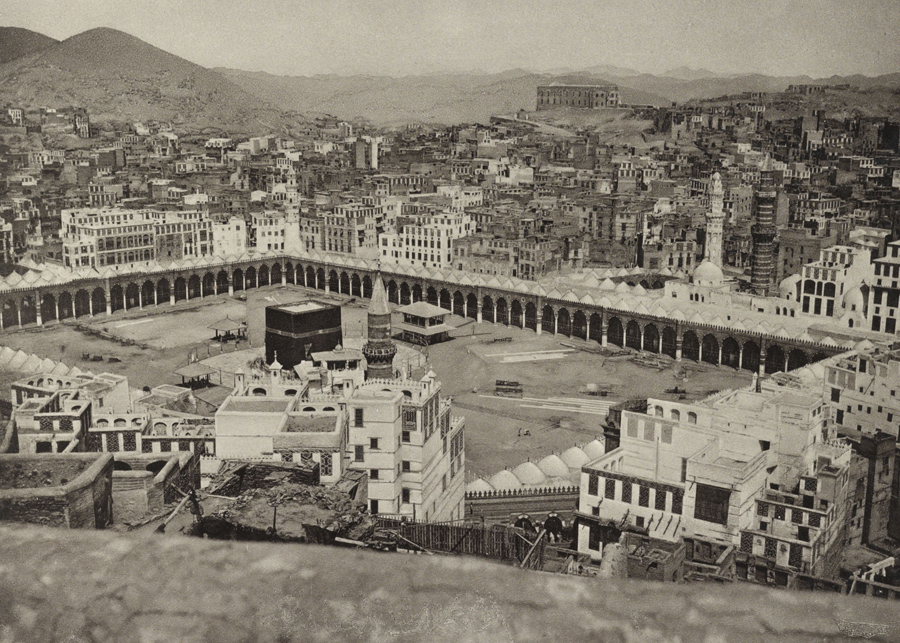 |
| A photograph of the Kaaba (center of photo) in the city of Mecca circa 1887 |
The Kingdom of Saudi Arabia's entree into
the sphere of those whom the United States considers 'friends' was its
oil wealth, which has protected the country from anyone wishing to look
too closely at its affairs as an exporter not only of oil on the world
stage, but violent Islamism as well. Saudi investment abroad in the
building of mosques and Islamic social centres has permitted it to also
export its brand of pure Islam into the consciousness of impressionable
Muslims the world over.
Through the medium of
madrassas, schools of Islamic teaching where the Koranic principles
dating back to the Prophet Mohammad are taught in Arabic, and infused
into the very psyche of those exposed to its teaching Islamism and its
core, jihad, has expanded exponentially. The Kingdom's type of Islam, is
hard-core and hostile to any other religions or other expressions of
Islam itself. In Saudi Arabia, state punishment is as harsh and
unforgiving as it was in the Medieval era.
"Insulting"
Islam or the Prophet can result in a death sentence, and death delivery
as a state enterprise in the Kingdom is not for the squeamish including
crucifixion, beheading, hanging. The Old Testament virtues of an
"eye for an eye, tooth for a tooth",
exemplifies Islamist justice. Where clan and tribe vendettas can
consume generations and where freedom from dire vengeance meted out as
per the Koran can sometimes be bought through blood money.
Saudi
money still supports al-Qaeda and other Sunni-dominated terrorist
groups; at one time the Muslim Brotherhood found a warm and inviting
home in the Kingdom, since the type of Islam both espoused fairly well
coincided. It is no accident that all of the 9/11 suicide-jihadists were
Saudis, nor was it accidental that while America reeled under the shock
of the attacks, the administration spirited back to the Kingdom through
a secret flight members of the Obama clan who happened to be in the
U.S. at the time.
And now, fourteen years later, the
families of the nearly three thousand victims of the September 11, 2001
terror attacks were shocked to hear that a judge claiming lawyers
working on their behalf failed to demonstrate evidence sufficient to
persuade him to link the country to the attacks, causing him to dismiss
the inclusion of Saudi Arabia in their lawsuits as a defendant. Saudi
Arabia's sovereign immunity from being sued was upheld.
It
is an exclusionary country, one which will not permit any vestiges of
another religion to be seen within its borders. Nor, with all its
riches, has it beneficently agreed to take in any Syrian refugees as a
fellow Islamic country, practising the compassion that the Koran is said
to impress upon its followers. That Germany has agreed to accept a
staggering number of Syrian refugees has impressed the Kingdom to the
degree that it offered to fund two hundred more mosques in Germany.
If
the millions of Muslims in Germany are not sufficiently engrained with
Islamism, Saudi Arabia is prepared to ensure that their Wahabbist brand
will furnish the grounding they need to impress them with the
fundamental requirements of jihad. That the United States continues to
support Saudi Arabia and its oil interests is one thing. That Canada
too, with its own emphasis on upholding human rights has refrained from
criticizing Saudi Arabia is inexplicable.
But of course
there are pecuniary interests at play here. Canada has recently signed
an agreement with the Kingdom for the sale of advanced weaponry. The
armoured tanks that Saudi Arabia will receive will perhaps help in their
ongoing conflict in Yemen, a poverty-stricken country where Iran, Saudi
Arabia's arch enemy is arming the Shiite Houthi rebels in a proxy war
that is victimizing ordinary Yemenites.
Just as the
proxy war involving Iran-Syria-Lebanon/Hezbollah-Iraq and now Russia, is
playing out in Syria, with Saudi Arabia-Turkey-Qatar countering with
the Islamic State of Iraq and the Levant as their Sunni choice to unseat
Syria's Alawite-minority president who has been busily butchering his
civilian Sunni population.
The Obama administration is
playing both ends against the middle; negotiating with Iran over its
nuclear-weapons program to manoeuvre the international community into
accepting that the unsigned 'deal' with Iran's nuclear aspirations will
keep it from attaining the nuclear weapons it so much yearns for to
augment its weapons delivery system to cap its advanced ballistic
missiles.
The hell-hole of the Middle East is
self-immolating and creating a nightmare of exodus and expectations of
worse to come. And it began with Saudi Arabia's exports; the oil that
furnished the lucre enabling the spread of Wahabbism, providing Iranian
Shiite Ayatollahs with the impetus to themselves create their own brand
of terrorism; the two colliding in an expression of Islam run amok.
Labels: Iran, Islamism, Middle East, Nuclear Arms, Oil Revenues, Saudi Arabia, Terrorism, United States