"Mossad found out what they deeply wanted in their lives and offered it
to them."
"There was an inner circle of scientists who knew more about
the operation, and an outer circle who helped out but had less
information."
"All of them are very safe today."
Unnamed source
"Unlike in the previous rounds of talks, Britain is currently
holding the strongest line. This is very much appreciated by Israel, as
there is a sense that the Americans are so desperate to return to the
deal that they would be too soft."
"However, it is quite clear that
Britain and the rest of the international community still sees
negotiation as the most effective track to rein in Iranian ambitions."
"Israel
is not convinced that this will be enough, and also doubt that more
problematic partners, like Russia and China, will be able to hold same
line."
"Therefore, the credibility of the threat from Israel needs
to be enhanced, reiterated and reimposed, as part of a dual effort to
put real pressure on Iranians."
"In terms of geopolitics, that is the message that these operations are sending to the international community."
Richard Pater, Executive Director, Britain Israel Communications and Research Centre (Bicom)
Blown up: Iran's Natanz nuclear plant, seen in 2007 (Photo by Majid Saeedi/Getty Images)
The
Israeli secret service knows that you can have all the technological
advantages in the world to enable the process of acquiring knowledge of
the machinations of other countries relating to their military plans, to
unlock the secret blueprints they keep to themselves irrespective of
the facade presented to the outside world, but there are no assets for
recovery of inside realities quite like the effectiveness and efficiency
of a core of insider recruits whose data delivery leaves no room for
guesswork.
Humint
-- human intelligence -- is the ultimate in revealing the plans of a
country derived from its own inner circles of those in the know.
Insider
assistance in carrying through plans of sabotage to set back the agenda
of government agencies is another invaluable tool, made all that more
approachable and successful with the willing aid of inside intelligence
and cooperation. When the actions of insiders in working against the
interests of the state are revealed, they pay a stiff penalty; their
commitment to undermining the resources of their own country owes much
to their dissatisfaction with the direction that country is heading in.
Conscience and sympathy are great aids in deception.
It
is a secret to no one that the Islamic Republic of Iran has been
working toward attaining nuclear weapons. It is just that aspiration,
linked to Tehran's Ayatollahs' support of Islamist terrorism fomenting
disorder and violent atrocities on behalf of the Republic's
determination to surmount resistance to its plans of Shi'ite conquest
and Persian control in a Sunni-majority region of Arab states that drew
the attention of the West to its malign purpose. The UN's IAEA's efforts
at monitoring the Revolutionary Iranian Guard Corps' uranium enrichment
program stems from the threat they pose to the region and the wider
world.
But
the one regional state that is indelibly in the crosshairs of the
Republic's lethal weaponry of mass destruction is undeniably Israel. The
message delivered time and again, publicly and with venomous intent is
the promise to obliterate Israel's presence from the Middle East. When
fundamentalist extremists are convinced that they have been selected by
an all-powerful heavenly entity to furnish the means by which a
perceived enemy can be extinguished, rational arguments based on human
rights have no impact.
The
Jewish state knows full well from historical events that it can rely on
no other forces than its own for protection from extermination. Its
secret services know how to convince others, vulnerable to uncertainty
over the morals involved in human rights violations that they have an
obligation and a part to play in overcoming the unconscionable plans of
dictators. And because Iran is just such a theistic dictatorship, its
people are restive and among them those in elite situations of command
who are prepared to intervene.
The
Mossad spy agency is renowned for its cultivated professionalism in
intelligence gathering. And it relies upon the secretive collaboration
of the dissatisfied to find purpose in aiding and abetting the downfall
of their own governments who have failed abysmally the most basic tests
of human decency.
A
number of Iranian scientists working in the Republic's structures
devoted to nuclear development acceded to requests for cooperation. They
were, however, duped into believing that it was a collaboration on
their part with Iranian dissident groups, not with an arm of a foreign
government they would be working with.
In
the process however, they were tasked with smuggling explosives into
the secure and highly protected underground vaults of Iran's nuclear
emplacements. In April, a blast destroyed the Natanz plant's independent
internal power system meant to energize centrifuges enriching uranium
in the protected underground reinforced concrete bunker. That blast
represented the second time in a year the base was attacked, by what
other countries' security officials identify as an Israeli project.
It
was not, after all, exiled Iranian dissidents with whom these
collaborative insiders worked, but with Israel. In some instances the
explosives were dropped into the facility by drones while allied
components were smuggled through security in catering trucks, reported The Jewish Chronicle,
which broke the story. Another July 2020 explosion was the work of
explosives hidden in building materials that formed part of the building
construction a year earlier.
A
motorcycle-size quadcopter drone carried out a bombing raid on the Iran
Centrifuge Technology Company in Karaj in June, north of Tehran. When
the news was revealed to the public eye, Israel, with its policy of
never claiming ownership of such events, made no comment. Attacks on the
Natanz plant, according to Iran's acknowledgement, had the effect of
setting its nuclear program back months. An ongoing search for the
Iranians suspected of involvement in the operation, now fugitives, was
foiled, since they are said to have been spirited to safety by Mossad
agents.
Tehran,
while spuriously claiming it has no interests in obtaining nuclear
weapons, has been steadily increasing levels to which it enriches
uranium far beyond the limit set by the Nuclear Agreement it signed in
2015, levels that outside nuclear scientists agree has only one
application, and that would be a military application. "From a technical standpoint, the enemy's plan was rather beautiful", said head of the Iranian parliamentary energy committee, Fereydoon Abbasi Davani rashly.
A map of north Iran showing the location of Mossad’s first assaults on Natanz and quadcopter attack on Karaj (Photo: GETTY IMAGES, ASINGUARDS, YOUTUBE. Illustration: Sheree Fadil)
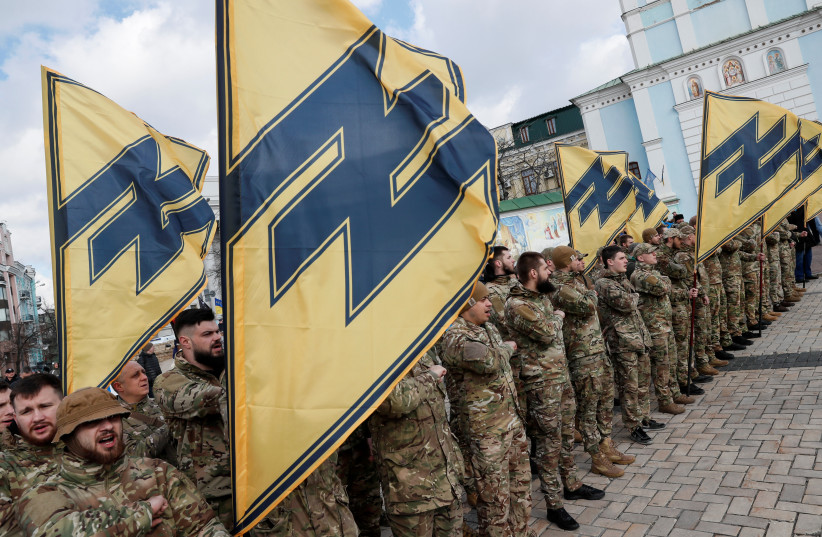
Members
of Azov battalion attend a rally on the Volunteer Day honouring
fighters, who joined the Ukrainian armed forces during a military
conflict in the country's eastern regions, in central Kiev, Ukraine
(credit: GLEB GARANICH/REUTERS)
"If
Canada is going to be providing military training to foreign forces,
then it is our responsibility to know we are not training neo-Nazis"
"It is our obligation to our Canadian veterans who sacrificed so much defeating fascism in Europe."
Jaime Kirzner-Roberts policy director, Friends of Simon Wiesenthal Center
"[Our
group's members serve at present as officers in Ukraine's military and]
have succeeded in establishing co-operation with foreign colleagues
from such countries as France, the United Kingdom, Canada, the U.S.A.
Germany and Poland."
"[We support] right patriots, nationalists, conservatives and Christians
currently defending the streets of Kyiv from [Kyiv Pride event]
perverts from the LGBT movement and their left-liberal sympathizers."
Ukraine fascist militia, Centuria
"White supremacy and neo-Nazism are unacceptable and have no place in our world. I am very pleased that the
recently passed omnibus prevents the U.S. from providing arms and
training assistance to the neo-Nazi Azov Battalion fighting in Ukraine."
"The State Department should pressure Kiev to dissociate itself with
this group and investigate whether any of our weapons or training have
already been provided to them,"
"This is
just one of many reasons why lawmakers should be concerned about
channeling huge amounts of weapons into this volatile conflict zone."
U.S.Rep. Ro Khanna
(D-Calif.)
"Evidence uncovered in this paper suggests that since 2018, the Hetman
Petro Sahaidachny National Army Academy (NAA), Ukraine’s premier
military education institution and a major hub for Western military
assistance to the country, has been home to Centuria, a self-described
order of 'European traditionalist' military officers that has the stated
goals of reshaping the country’s military along right-wing ideological
lines and defending the 'cultural and ethnic identity' of European
peoples against 'Brussels’ politicos and bureaucrats'. The group
envisions a future where 'European right forces are consolidated and
national traditionalism is established as the disciplining ideological
basis for the European peoples'."
"The group, led by individuals with ties to Ukraine’s internationally
active far-right Azov movement, has attracted multiple members,
including current and former officer cadets of the NAA now serving in
the Armed Forces of Ukraine. Apparent members have appeared in photos
giving Nazi salutes and made seemingly extremist statements online."
Illiberalism Studies Program
A new report from an American university
says far-right extremists in Ukraine’s military have bragged they
received training from the Canadian Forces and other NATO nations.
ANATOLII STEPANOV
/
AFP/GETTY IMAGES
George
Washington University in Washington, D.C. recently published a study
out of one of its institutes where social media accounts of the
far-right group Centuria in Ukraine were tracked, documenting the
fascist group's Ukrainian military members with Nazi salutes as they
engage in the promotion of white nationalism, praising Nazi SS units'
members. Nostalgia for another time and place where fascism threatened
the world order and committed the gravest atrocities against humankind
in the mid-20th Century during a time of a global-churning world war.
The
Ukrainian nationalists militia group Centuria has been active since
2018 at the Hetman Petro Sahaidachy National Army Academy in Ukraine,
according to the George Washington University's Institute for European,
Russian and Eurasian Studies. Members of Centuria have left their
handprint on social media, claiming to have received military training
from the Canadian military, as well as having taken part in military
exercises with Canada.
This
is hugely disturbing news to institutions dedicated to vigilance for
the appearance of fascist groups as threats to world stability. The
Canadian military was apprised of the presence of neo-Nazis within their
own services in the past year and speedily made efforts to root them
out, claiming it has no tolerance for fascists operating within its
ranks. Organizers with Centuria boasted on social media of their members
currently serving as officers in Ukraine's military establishment.
The
University of Washington report on their study has been widely read and
was of huge interest to the Simon Wiesenthal Center dedicated to
fighting fascism in memory of the institutional state obliteration of
six million Jewish lives during the Holocaust years taking place within
the theatre of the Second World War. The Center for Holocaust Studies
wrote to the Acting Chief of the Canadian Defence Staff, General Wayne
Eyre and to Canada's Defence Minister Harjit Sajjan asking them to
launch an investigation.
It
is the Simon Wiesenthal's position that the Canadian Forces should
conduct an investigation to determine whether its troops have been
involved in training neo-Nazis in Ukraine and to further devise a way to
make certain military instruction through Canadian Forces' auspices do
not reoccur. The response from the Canadian Forces was to advise that
Ukraine must vet its own security forces; the Canadian military is not
proactively engaged in determining backgrounds of foreign trainees, nor
do they search out support for far-right groups.
Ukraine's
government denies the very existence of Centuria. The hands-off
approach of the Canadian military has understandably failed to quell the
unease of the protesting Wiesenthal Center. In 2015 when the decision
was reached to send Canadian troops to Ukraine, the then-Canadian
defence minister was aware of the likely presence of far-right
extremists in the Ukraine military and discussions were led on avoidance
in training extremists.
The
decision was reached to stipulate that units of the Ukrainian National
Guard exclusively would be trained, avoiding the training opportunities
that some ad hoc militias that had appeared in Ukraine at that time,
seeking to take opportunities for themselves would be avoided. The
Canadian defence critic MP Jack Harris however, gave warning that
far-right groups were integrating themselves into the Ukraine military
and the difficulty that would ensue attempting to isolate extremists.
A
new report from an American university says far-right extremists in
Ukraine’s military have bragged they received training from the Canadian
Forces and other NATO nations.Photo by ANATOLII STEPANOV /GETTY
China, Helping Canada See the Error of its Ways ....
"I
had never even thought of China [back in 1979 when Beijing began
opening up to its version of democracy-plus-free-enterprise]. It was not
on my radar at all, but this sounded really interesting." "So,
my husband and I went over to China [to travel in China, which led to a
master's degree in international relations with a Chinese focus]." "When
I came home [40 years later], I decided to speak out. Up until January
[of 2019], I had never done an interview in my life. But I feel it's
important that friends of China -- former friends of China -- speak out
about this [Beijing's increasingly authoritarian streak]." "I'm not feeling very friendly toward China, if you can tell." Margaret McCuaig-Johnston, former vice-president, Canada-China Friendship Association
"We
are rolling over, we are acquiescing, at a time when Chinese aggression
is on the rise. We should be working with like-minded allies to send a
real signal that such conduct is not condoned." "[If keeping quiet and friendly were going to work with China, Spavor and Kovrig] would have been released months ago." Erin O'Toole, Parliamentary opposition, foreign affairs critic
"[Beijing] is good at co-opting former government officials and politicians by offering them seats on boards and contracts." "Obviously, then it becomes very difficult for you to become critical of China." Guy Saint-Jacques, former Canadian ambassador to China
"There's nothing like back door devices being installed by Huawei. So that's a groundless accusation." "So
we do hope that the Canadian side will provide a fair, just and a
non-discriminatory business environment for Chinese companies, including Huawei." "We do hope that the Canadian side will reflect on what has
happened and take concrete measures to push our relationship back to the
normal track. So that's the task for the government." "And we do
hope that those important people in the new [Liberal] cabinet will play an active
role in making sure that relations of our two countries return to their
normal track on the basis of mutual respect and equality." Ambassador of the People's Republic of China to Canada Cong Peiwu
Cong Peiwu spoke to reporters at China's Embassy in Ottawa CBC
"When
they get Huawei into Canada ... they're going to know every health
record, every banking record, every social media post -- they're going
to know everything about every single Canadian." "What
the Chinese are doing makes Facebook and Google look like child's play,
as far as collecting information on folks. The Huawei Trojan horse is
frightening, it's terrifying." "I
find it amazing that our allies and friends in other liberal
democracies would allow Huawei in ... I'm surprised that there's even a
debate out there." "[Such
an intrusion would impact on Canada's participation in the Five Eyes
Intelligence alliance of Australia, New Zealand, the U.K. and the
U.S.]." Robert O'Brien, U.S. National Security Adviser
Ambassador Cong, in delivering Beijing's message to Ottawa, is using
coded language when he urges the Liberal government of Prime Minister
Justin Trudeau to 'return to their normal track', and to 'take concrete
measures to push our relationship back to the normal track'. He has
outlined the 'task for the government' of Canada. There is nothing
necessarily that Beijing must do to restore relations between the two
nations, for it has done nothing untoward. It was Canada's concurrence
through its extradition treaty with its southern neighbour that launched
the unfortunate decision to comply with the U.S. by assaulting China.
For in arresting Huawei Technology's CFO Meng Wenzhou at the behest of
the U.S. State Department, this is what Beijing has accused Canada of --
criminal malfeasance, defying international law. Whereas China's
response to the insult bestowed upon one of its citizens by summarily
arresting two Canadians in China for business purposes and accusing them
of plotting against China -- charging them with espionage,
incarcerating them under harsh conditions while Ms. Meng, out on bail,
lives in one of her luxury mansions in Vancouver -- has been mindful of
and obedient to the rule of law.
Beijing knows with whom it is dealing. While former Liberal Prime
Minister Jean Chretien was in office he led numerous elaborate 'trade
missions' to China from Canada, familiarizing himself with useful
Chinese officials whom he called upon once he left office to become a
private citizen and continued to lead trade missions to China, the
prestige of a former prime minister opening doors, and with his insider
status intact. When former Conservative Prime Minister Stephen Harper's
policy was to regard trade with China as second to its human rights
abuses, Mr. Chretien poured scorn upon him; nothing should impede
unrestrained trade alliances with China.
This Liberal government under Justin Trudeau has tread softly around
China's outrageous response to the U.S.-Canada extradition treaty, when
Beijing arrested two Canadians, imposed death sentences for drug
smuggling on another two Canadians and placed punishing constraints on
the importation of Canadian canola, soy, peas, pork and beef products,
devastating the Canadian agricultural sector through punishing sanctions
on a country that refused to come to heel and release the Huawei
executive.
Michael Spavor, left, former Canadian diplomat Michael Kovrig, right (Canadian Press)
Margaret McCuaig-Johnston had dedicated her working life to enhancing
relations between Canada and China, collaborating to advance the
relationship between the two countries. She aided China in its science
and technology development during its period of reform, as a Canadian
civil servant, while considering herself a staunch "friend of China".
And then, after forty years of work in that realm the arrest of Meng
Wanzhou, followed by the incarceration of Michael Kovrig and Michael
Spavor, she discovered her locked luggage had been unlocked and rifled
through in her Shanghai hotel room.
Soon a local business acquaintance informed her of a list of 100
Canadians that Chinese authorities had compiled representing those who
could be detained and interrogated, among the hundreds of thousands of
Canadians who live and work in China; Hong Kong alone has 300,000 people
with Canadian citizenship. In other words, Canadians living in Hong
Kong are also under scrutiny and their security is of concern as well,
particularly given the violent turn of the protests in the partially
autonomous city.
And China has warned Canada, through the stern advice of its latest
ambassador that it would not be in Canada's interests to 'interfere' in
China's internal affairs.
A protester is detained by riot police while attempting to
leave the campus of Hong Kong Polytechnic University (PolyU) during
clashes with police in Hong Kong, China November 18, 2019. (Thomas Peter/Reuters)
The current Liberal government in Canada takes advice from its past
prime minister on such issues; and no doubt the advice was not to
further ruffle any feathers, to sit back and let events take their
course. Naturally, the imprisoned Canadians, despite the harsh
conditions they are suffering, would staunchly opt to sit back and
suffer their circumstances, in support of their government's position,
for no sacrifice is too great to protect Canadian trade with China.
Some 140 and more signatories in the academic and diplomatic global
community demanded through a joint letter that China release Kovrig and
Spavor. A mere 6 Canadian academics and six former Canadian ambassadors
to China signed.
It has been observed that more than a few advisers to the Liberal
government have what they consider to be valued and hard-won ties and
interests in China. The new ambassador to Beijing, Dominic Barton, among
them. Many Canadian academics, politicians and business leaders have
compromised positions finding it difficult to criticize China, for to do
so would be to risk the status they have won and cherish for the
opportunities and funding that status guarantees them.
"It is time to call to account the owner of the gun barrels pointing at Kobani. From now on, all major cities are our fields of action and all enemy forces are our primary targets. When Kobani is burning, Turkish cities will not be sleeping comfortably. TAK will transfer the conflagration at Kobani to enemy forces in big cities and take them to hell." Teyrenbazen Azadiya Kurdistan (TAK), militant PKK faction
"We have to be realistic. The only forces on the ground
that have proven to be a reliable partner to the international coalition
are the Kurds, the Kurds in Iraq and in Syria. We have seen it now in
Kurdistan, where the Peshmerga forces are fighting IS and have proven to
be successful, and in Syria we are seeing it in Kobani and other
areas." "We are ready to do whatever we can to support Kobani but we have to be
mindful of the fact that we have got a front line with IS which is 1,035
kilometers long. "We have been fighting them since June,
when they came and took control [of] over one-third of Iraq's
territory, the western part, and since August we have been engaged in
fighting on a daily basis with them." Falah Mustaf, foreign minister Kurdish regional government (KRG), Iraq
Smoke rises after a strike on the Kurdish town of Kobani as seen from the Turkish-Syrian border. (File photo)
Turkey, called upon repeatedly by the international community, by NATO, by the United States, and by Turkish Kurds, and now appealed to by Iraqi Kurds, to do more than mass its troops on the border between Turkey and Syria, and employ them to watch through binoculars as Islamic State fighters close Kobani in on three sides while Syrian Kurdish forces desperately attempt to restrain and push them back, still does nothing. Nor will it even commit to allowing humanitarian aid to cross the border into Syria.
Despite which, the United States and NATO do not appear to have adequately and accurately received Turkey's adamant message that nothing will move it to lift a finger, shoot a bullet, express a concern, much less permit PKK members to infiltrate the border and join their Syrian counterparts in defending Kobani. And so the U.S. Defence Department states that Turkey will permit U.S. and coalition troops to use its bases.
Only to have Ankara deny they agreed to any such thing. They will, however reluctantly, though, assent to training Syrian opposition forces struggling against the Islamic State terrorists. After first vetting any whom they permit to cross into Turkey to ensure they're not Syrian Kurds, the most efficient, well-organized and capable fighting groups in Syria committed to forestalling Islamic State ambitions.
The Incirlik air base in southern Turkey from which Defence Secretary Chuck Hagel stated Turkey has agreed could be used by the U.S.-led coalition is not, after all, available for their use in combating what NATO members have every reason to believe all its members regard as a violent threat. On the other hand, should the coalition agree to bomb the Syrian regime, perhaps Recep Tayyip Erdogan could be persuaded to change his mind.
Sounds like a good idea, actually, but not one that the U.S. and its allies appear too eager to embark upon for reasons known only to themselves. Which doesn't exonerate Mr. Erdogan from his pathological foibles in considering all Kurds, whether located in Turkey, Iraq, Iran or Syria, his mortal enemies, to be considered a greater threat than the Islamic State.
His detestation of Syrian dictator Bashar al Assad is somewhat of a mystery, given Erdogan's love of Hamas, and his clear affection for the Islamic Republic of Iran.
Turkish soldiers hold their position on a tank as they watch the town of Kobani on the Turkish-Syrian border in the town of Suric, October 13, 2014, AFP/Getty Images
More recent reports of Syrian Kurds desperately trying to hold their own against the pincering three-sided Islamic State onslaught, some of which violent action takes place less than a kilometre from the Turkish border for easy entertainment viewing for the Turkish troops massed on the border, give indication that the Islamic State jihadi groups may be in possession of some of the Syrian regime's chemical arsenal.
Photographs published by the Middle East Review of International Affairs (MERIA) on Sunday appear to show bodies of three Kurdish fighters marked by burns and white areas with no visible wounds or external bleeding, the hallmarks of chemical weapons.
"We hope that all provisions of the law will be implemented
responsibly. It is clear that the attempts of
well-known political groups in Ukraine to cancel it or change its
essence will renew the confrontation in the southeast and undermine
efforts of the international community and sensible politicians in the
country to normalize the situation."
Russian Foreign Ministry statement
Ukrainian Nationalist Party supporters burn torches
Wednesday outside the presidential office in Kiev to protest autonomy
for rebel-held areas.
European Press photo Agency
The recently-enacted response-to-reality law passed by a practical-minded Ukrainian President Petro Poroshenko trying to save what he can of his country, yet granting self-governance powers to the ethnic-Russian separatists in eastern Ukraine has been challenged by disgruntled politicians in Kyiv recognizing it for what it is: yet another, albeit totally grudging giveaway of Ukrainian geography to Vladimir Putin.
On the other hand, the Ukrainian Parliament also passed this week legislation ratifying the pact that had been rejected in 2013 by previous president Viktor Yanukovych, in sync with what his Russian masters demanded. This symbolic move putting on hold free trade provisions for the time being is demonstration enough that what is left of Ukraine will not settle for Russian domination any longer, preferring to move toward the democratic West.
In his visit to Ottawa today, Mr. Poroshenko has demonstrated his intentions in forging closer ties with Western nations whose support for Ukrainian sovereignty and absolute rejection of Russian hegemonic forced ties is unequivocal. More symbolism; in President Poroshenko's visit to Ottawa, there is the acknowledgement that Canada hosts the greatest number outside Ukraine itself of ethnic Ukrainians as Canadian citizens.
Canada, through Prime Minister Stephen Harper's firm statements abhorring Vladimir Putin's machinations in surreptitiously dispatching Russian military to Ukraine to aid the rebels it incited in capturing Donetsk and Luhansk, and his previous annexation of the Crimean peninsula has placed Mr. Putin beyond the pale. The settlement of enhanced authority for the east is a coverup by Kyiv of the reality that will eventually take place; the total russification of Novorossiya.
The ethnic Russians champing at the bit to move Ukraine's east completely into Russia's orbit find even the temporary placatory move by Kyiv unbearable. They want it all, and they want it now. As for Ukraine, granting temporary self-rule to the separatists will inevitably result in total separation. The man who once asserted with authority that he intended to reclaim Crimea for Ukraine appears now to have submitted to the reality that Crimea is lost forever.
He once also stated that there would be no amnesty for the ethnic-Russian Ukrainians who were guilty of violence; they would be apprehended and they would be tried for their crimes. Now, reality is that he has been forced by circumstances beyond his ability to control, to offer amnesty to the separatists. Most of whom have indeed been deeply involved in violence. As for those involved in the criminal act of shooting down a Malaysian passenger jet, how likely is it that any will face justice for a crime they deny having been involved in?
But then, where at one juncture it appeared certain that Moscow would continue to incite the separatists to take greater possession of south-eastern Ukraine with Russian troop assistance clearly intending to take possession of regions north of the Sea of Azov as well as a land corridor to Crimea through Mariupol, that ambition also may have been stunted by NATO, European Union and U.S. actions including financial sanctions to forestall what seemed inevitable.
Ukrainian servicemen ride on an armored vehicle Wednesday near the town of Pervomaysk.
Reuters
At that time, the hoary, frightening prospect of the stand-off turning into unthinkable combat leading to another world war, appeared imminent resulting from the level of territorial aggression unthinkable in today's world. Quietly and suddenly the isolation, threats and condemnations appear to have filtered through to Vladimir Putin's deliberately dulled consciousness, and he seems to have withdrawn his most ardent ambition at least for the present.
While speaking of a perceived 'threat' to ethnic Russian Estonians. Always the warning, the opening gambit for renewed Russian aggression. The threat is, of course, to Estonia itself, as demonstrated with the abduction of an Estonian policeman by Russian security agents. Intimidation softening up toward aggression. And this time NATO would have to respond in kind.
Now, while the Russian-approved ceasefire embarked upon on September 5 appears to be holding with a smattering of scattered violence, Russian troops have been pulled back out of Ukraine and the inflamed rhetoric with reference to "nuclear" and how easy it would be for Russian troops to take Kyiv in "two weeks" has been toned down.
The cold-war shattering of the USSR's corpse is still twitching.
"Poland has been there for the United States, and today, as the transatlantic community confronts Russia's unacceptable aggression against Poland's neighbour, Ukraine, a sovereign and independent state, we have a solemn obligation in the framework of NATO to reassure Poland of our security guarantee." Stephen Mull, U.S. ambassador to Poland
The
first American troops arrive at the airport in Swidwin, Poland on April
23, 2014, after Washington said it was sending a force of 600 to the
Baltic states as the crisis over Ukraine deepens. (photo credit:
AFP/Janek Skarzynski)
"There is no reason not to believe that the Americans are running the show." "Russian citizens being attacked is an attack against the Russian Federation." "If our interests, our legitimate interests, the interests of Russians have been attacked directly, like they were in South Ossetia for example, I do not see any other way but to respond in accordance with international law." Russian Foreign Minister Sergiy Lavrov
It all comes down then, to a simple matter of interpretation. The international community is convinced that Moscow has defied international law in exploiting a split within the Ukrainian civilian population, with the eastern and southern portion of the country hosting ethnic Russians opting for closer ties with Russia and the rest of Ukraine comprised mostly of ethnic Ukrainians resistant to Russian domination.
By surreptitiously albeit clumsily infiltrating Ukraine with members of the Russian military posing as "pro-Russian" Ukrainians, inciting to defiance of the non-elected interim provisional government with the removal of Moscow's approved president, Vladimir Putin engineered a secessionist movement that enabled him to react to a 'referendum' inviting Russian intervention and expropriation of Ukraine territory.
With the happy knowledge that Ukraine is not part of NATO and therefore not making it likely that the West would physically seek to interfere in the affairs of two closely aligned eastern European countries that share a common heritage, culture and wartime experience during two world wars, Russia engaged in its deception and defied interference by claiming it was simply reclaiming territory that was historically its own.
Its dire threats against Ukraine for betraying their close relationship of trade, manufacturing and cultural exchanges has resulted in Ukraine being pushed further toward total economic breakdown. Moscow has charged that a financially feeble Ukraine owes it tens of billions in gas fees alone. It has disrupted trade between the two, even though Russia is hugely dependent on Ukraine for critical manufactured military parts. And it has imposed an 80% increase in the charge for gas.
The Kremlin's machinations did not stop with the annexation of Crimea. Vladimir Putin figures why not go for broke? If Crimea was such an easy take, why not the industrial heartland of the country as well, since ethnic Russians abound in eastern and southern Ukraine too, and the populace, at least a middling proportion of it, can be urged to become as restive as the Crimeans succumbed to. The assemblage of tens of thousands of troops at the ready on the border represents a huge incentive.
And NATO is left to hush the fears of Poland, Estonia and the other Baltic States that it is there for them, and will protect them from Russia's further expansionist plans. Crimea is gone, and hopes that the rest of Ukraine will remain intact teeter on the brink of collapse, since an irredentist Moscow is enjoying its latest period of displaying the power of a nation willing to resume its past role as a super power even if the resources to do so are absent.
U.S. paratroopers arriving as a deterrent to Russian ambitions, allaying the fears of allies ups the ante somewhat and points to an eventual impasse. The "persistent presence" of American troops in the region with a company-sized contingent of well-armed and super-power-backed denial of effortless hegemonic land grabs by a president who appears to have gone somewhat lunatic, may serve to temper the times of conquest.
And perhaps Russia will, in the final analysis, see the reason in listening to the warnings issuing from the White House through John Kerry who "urged Russia to tone down escalatory rhetoric, engage diplomatically in the east with the OSCE and Ukrainian government, and issue public statements calling for those occupying buildings to disarm and stand down in exchange for amnesty".
Such sane endings have occurred in the past, after all.
Russia orders exercises after Ukraine moves on separatists
BBC News online -- 24 April 2014
Oleg Boldyrev reports from the scene of the operation near Sloviansk
Russia
has ordered new military exercises on its border with Ukraine in
response to an operation by Kiev against pro-Russian separatists.
Russian Defence Minister Sergei Shoigu said Moscow had been
"forced to react" after Ukrainian commandos moved on the separatist
stronghold of Sloviansk.
President Vladimir Putin had earlier warned Ukraine of "consequences".
Pro-Russian separatists are occupying key buildings in a dozen eastern towns, defying the central government.
Mr Shoigu was quoted by the Interfax news agency as saying:
"If this military machine is not stopped, it will lead to greater
numbers of dead and wounded.
"We are forced to react to such a development of the situation."
Ukrainian troops now have a checkpoint on the road south from Sloviansk to Artemivsk
The exercises will be in Russia's southern and western military
districts, with Mr Shoigu adding that "the air force will conduct
flights to train for manoeuvres along the state borders".
At least two pro-Russian separatists were earlier reported
killed as Ukrainian commandos, backed by armoured vehicles, cleared
checkpoints on the outskirts of Sloviansk.
There was also unrest in the south-eastern city of Mariupol.
Interior Minister Arsen Avakov said government forces had ousted pro-Russian militants from the city hall building there.
At the scene
Steve RosenbergBBC News, Sloviansk
We drove into Sloviansk expecting to see signs of a major
confrontation between Ukrainian security forces and heavily armed
pro-Russian militiamen. Earlier, Ukraine's interior ministry reported
that a number of "terrorists" had been killed in a gun battle and three
roadblocks cleared. We saw people strolling through the town centre, children
walking down the street, and traffic on the roads. The makeshift
checkpoints, set up by the militiamen remained. We've also been to Artemivsk. The interior ministry said a
military base there had been attacked by up to 70 armed separatists and
that they had been repelled. Apart from a broken window and a damaged
door, there was little sign of a battle. Kiev says its military
operations against pro-Russia militants continue. But what we saw
suggests the need for caution about claims and counterclaims in this
conflict.
At the scene
Natalia AntelavaBBC News, Mariupol
On Thursday morning, Ukraine's Interior Minister Arsen Avakov
updated his Facebook status with news that government troops had freed
the administrative building in Mariupol. But when we got there the
picture was very different. The building is still surrounded by barricades made of barbed
wire and tyres, and dozens of angry protesters are still in control of
the entrance. Protesters said that soldiers and civilians stormed the
building overnight. A fight broke out and police said five people were
hurt. Among the civilians, they said, was the mayor. His office
confirmed he went into the building to "assess the situation", but would
not give further details. Police here do not seem to know, or are not
willing to disclose, much either. They told me they were treating what
happened overnight as a "criminal incident" rather than an
anti-terrorist operation - another sign that Kiev is struggling to
control local law-enforcement.
However, the BBC's Natalia
Antelava in Mariupol says that although it appears the mayor and an
armed contingent did enter early in the morning there is no sign of
Ukrainian troops now.
She says pro-Russian activists plan to re-enter once the building has been checked for mines.
Some reports say the Ukrainian armoured vehicles and troops in the Sloviansk operation have now pulled back.
BBC correspondents visited one checkpoint, south of a village
called Makatikha, and reported seeing smoking tyres and broken
sandbags. But they say there was no live fire and no sign of bodies.
The BBC's Steve Rosenberg, in Sloviansk, says the centre of
the town appears calm, with people in the streets and the makeshift
checkpoints set up by pro-Russian activists still in place.
Speaking on Russian TV as news of the Sloviansk operation was
coming in, Mr Putin said: "If the regime in Kiev has begun using the
army against the population inside the country, then this is undoubtedly
a very serious crime.
"Of course, this will have consequences for the people who
take such decisions, and this also affects our inter-state relations."
Meanwhile, US President Barack Obama has accused Russia of
flouting a deal on Ukraine reached in Geneva last week, under which
illegal armed groups, including those who have seized public buildings,
would return home.
Mr Obama told a news conference in Japan that Moscow had
failed to halt actions by militants in the region and warned that the US
had further sanctions against Russia "teed up".
A contingent of US troops has begun landing in Poland for
military exercises amid concerns among Nato's eastern member states
about Russia's intentions.
Mr Shoigu said on Thursday: "Planned exercises by Nato forces
in Poland and the Baltic countries do not foster normalisation of the
situation surrounding Ukraine."
Separately, the funeral has been taking place in Horlivka for
pro-Ukrainian politician Volodymyr Rybak, who was abducted and killed
in Donetsk region.
The BBC's Steve Rosenberg, who was earlier in Horlivka, said
friends and relatives of Mr Rybak stood nearby listening to an Orthodox
Christian priest chanting prayers amid a mood of shock and of deep
pessimism for the future.
Moscow has said it will respond to any attack on its
interests in Ukraine, and has tens of thousands of troops along its side
of the border.
Unrest began in Ukraine last November over whether the country should look towards Moscow or the West.
A Ukrainian commando outside Sloviansk on Thursday
Some reports say the Ukrainian troops have now pulled back from around the town
Abducted local politician Volodymyr Rybak was buried in Horlivka on Thursday
US paratroopers arrived in Poland on Wednesday for exercises
"Yes, I'm from Crimea, and of course I took part in the operation to restore order there. We've got about six guys from Crimea. The other guys are from Kharkhiv, Dnipropetrovsk, and other places." pro-Russian gunman
"We've been taken prisoner by dirty means. I'm surrounded by 500 people, what do you want me to do?" Ukrainian commander
"There is only one directive for the Ukrainian Foreign Ministry -- the Russian government has to immediately withdraw its commando groups, condemn the terrorists and demand they lave the installations." Arseniy Yatsenyuk, acting Ukraine Prime Minister
"[The Kremlin is feeding Russians] misinformation exaggerations, conspiracy theories, overheated rhetoric and occasionally, outright lies [through state-controlled media]. It is an extraordinary propaganda campaign that political analysts say reflects a new brazennness on the part of Russian officials." The New York Times
A combat vehicle with pro-Russian gunman on top goes through downtown
Slaviansk on April 16, 2014. The troops on those vehicles wore green
camouflage uniforms, had automatic weapons and grenade launchers and at
least one had the St. George ribbon attached to his uniform, which has
become a symbol of the pro-Russian insurgency in eastern Ukraine. (EFREM LUKATSKY/ASSOCIATED PRESS)
Television channel Rossiya 24 on Tuesday reported that between four and 11 innocently peaceful pro-Russian supporters were killed, strafed by helicopter gunfire near Kramatorsk. Unbelievable, that Ukrainian military is resorting to the kind of bloodthirsty atrocities the world has come to recognize as the barbaric practices of the Syrian military led by Bashar al-Assad. Except that, in reality, a helicopter landed near the town at an airfield, and when a Ukrainian commander emerged, he was attacked by the pro-Russian crowd.
"The continued strong presence of the Russian military along the Ukrainian border and the continued inflammatory reporting by Russian state media that are also watched in eastern Ukraine are a destabilizing factor" stated German government spokesman Georg Streiter, after Chancellor Angela Merkel informed President Vladimir Putin that his country possesses "the main responsibility" to calm the spiralling-to-conflict situation he has himself inflicted on Ukraine.
Hopelessly inept, the interim government hardly knows how next to respond, other than to repeat the querulously-worded condemnations of Russian actions against Ukraine's stability and autonomy. Ukraine did order in its armed forces, but both the military and the government has suffered yet another blow to their self-esteem after pro-Russian separatists took possession of six armoured personnel vehicles, replacing the Ukrainian flags with Russian flags and paraded them proudly.
Pro-Russian gunman clears the way for a combat vehicle
with gunmen on top in Slovyansk, Ukraine, Wednesday, April 16. AP Photo
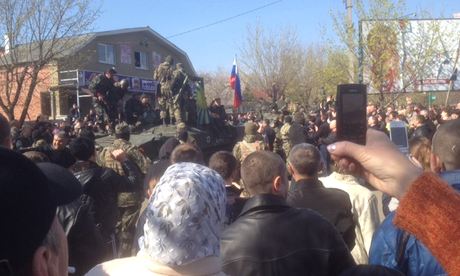
Shouts of "Russia! Russia!" rang through the streets from the upturned faces of joyous crowds of supporters in the eastern Ukrainian town of Slavyansk, seized and held by rebels. Taken from Ukrainian troops in Kramatorsk, the vehicles were driven the 20 minutes to Slavyansk. Instead of being used to disperse an armed rebellion taking control of the area, the vehicles were used to contemptuously display Ukrainian helplessness.
Simply put, the Ukrainian soldiers were unprepared to fire on the protesters. So they were themselves disarmed, surrounded by crowds of rebellious residents eager to see Russia prevail and Ukraine brought to its knees. "Let's say we didn't buy them in a shop. We came by them in the course of things, if you know what I mean" said a masked gunman, claiming that the crews of the vehicles had defected. Reports suggested they were forced to surrender.
Crowds look on as pro-Russian separatists drive round the city on armoured vehicles. Photograph: Luke Harding
"They made a decision to give us their vehicles", a gunman who offered his first name, Vladimir, stated describing himself as an army veteran from Donetsk. A group of 40 Ukrainian servicemen were placed on buses heading out of town. Not far away, another 15 armoured troop carriers were surrounded and stopped in their tracks by a pro-Russian crowd eager to humiliate the Ukrainian paratroopers.
Attack helicopters circled, a Ukrainian air force jet flew low passes hoping to disperse the crowd as the standoff continued, but neither was successful. The paratroopers, unwilling to use force on civilians stood by to await instructions. The troops, isolated and surrounded were persuaded to remove the clips from the rifles, then the firing pins, and finally to surrender their ammunition. Ultimately, the unit was disarmed and retreated.
At the four-party talks between Russia, the EU, the U.S. and Ukraine in Geneva, Russia demanded that Ukraine assume a federal system of government and agree to granting eastern regions autonomy, while Ukrainian leaders understand very well that full federalization opens a path to Russian annexation though they claimed to be prepared to consider the devolution of some powers to the regions.
There is no mystery regarding the presence of Russian military in eastern Ukraine, dressed as well armed ethnic Russian Ukrainians, without identifying signia, urging action upon Russian speakers in emulation of what had expeditiously turned the tide in Russia's favour in Crimea. Men equipped with machine guns, sniper rifles and rocket launchers are not persuasively local. Ukrainian commanders believe at least some of the gunmen are Russian soldiers, leading the way, inciting to rebellion.
And Russia has sternly warned Ukraine that an armoured offensive in the eastern region would not be countenanced by Russia. "You can't send in tanks and at the same time hold talks. The use of force would sabotage the opportunity offered by the four-party negotiations in Geneva", warned that master of hypocrisy, Russian Foreign Minister Sergei Lavrov.
And for its part, NATO too has issued warning shots across the bow, aimed at the Kremlin. Secretary General Anders Fogh Rasmussen vowed that its aircraft will fly increased sorties over the Baltic, and ensure that allied ships are deployed to the Baltic Sea, and the eastern Mediterranean, as required. "We will have more planes in the air, more ships on the water and more readiness on the land."
The sound and the fury is there, but there is something elementally fundamental somehow lacking.
Ukraine says Donetsk 'anti-terror operation' under way
BBC News online -- 15 April 2014
Daniel Sandford reports from a new Ukrainian army checkpoint
The
acting President of Ukraine, Olexander Turchynov, has announced the
start of an "anti-terrorist operation" against pro-Russian separatists.
The operation had begun in the "north of Donetsk Region", he
told parliament, and was being conducted "stage by stage, in a
responsible... manner".
Ukraine's defence ministry was quoted as saying an operation had begun at an airfield in the town of Kramatorsk.
The US and Russian presidents have discussed the crisis by telephone.
Barack Obama urged Vladimir Putin to use his influence to
make separatists in Donetsk and other parts of eastern Ukraine stand
down.
Mr Putin denied that Russia was intervening in the crisis.
Russian news agencies reported that firing had broken out at
the airfield in Kramatorsk which had previously been occupied by
pro-Russians. Some reports spoke of casualties in the fighting but this
has not been confirmed.
Pro-Russian rebels have seized buildings in about 10 towns
and cities across Ukraine's eastern provinces, which form the heartland
of Ukraine's heavy industry.
Thousands of Russian troops are reported to be deployed along
the border, kindling fears that any crackdown on the rebels could
trigger an invasion.
Russia annexed the Ukrainian province of Crimea last month,
after it broke away and held a controversial referendum on
self-determination.
Ukrainian armoured personnel carriers could be seen on the road from Odessa to Donetsk
Pro-Russian protesters manned barricades in Sloviansk
Guards struggled with anti-separatist protesters outside the Ukrainian parliament in Kiev
In other developments:
Russian Finance Minister Anton Siluanov said the country's economy faced "the most difficult conditions since the 2008 crisis",
with capital flight in the first quarter of this year of $63bn (£38bn;
46bn euros), because of "risks seen by the population and by investors"
German utility company RWE AG said in a statement it had started supplying gas to Ukraine, which faces Russian cuts over unpaid bills
Mr Turchynov said the aim of the operation in Donetsk was to
"protect Ukrainian citizens, to stop the terror, to stop the crime, to
stop the attempts to tear our country apart".
Militant protesters gathered outside parliament in the capital Kiev to demand action against the separatists.
After days when there was little sign of the Ukrainian
government exerting its authority in eastern Ukraine, Tuesday saw a very
public display of force at a checkpoint just north of the Donetsk
region, in the Kharkiv region, the BBC's Daniel Sandford reports.
Our correspondent saw seven armoured personnel carriers,
several tracked vehicles armed with large guns, a military helicopter
and dozens of Ukrainian police officers.
There were reports overnight of gun attacks on rebel
checkpoints near the Donetsk town of Sloviansk, where pro-Russian
militants seized a police station and a security services building at
the weekend.
A police building in Kramatorsk was also seized but the militants there have reportedly now handed back control to the police.
Russian Foreign Minister Sergei Lavrov warned that any use of
force by the Ukrainian government in the east could undermine talks on
the crisis involving the EU, Russia, the US and Ukraine, which are due
to be held in Geneva on Thursday.
"You can't send tanks against your own citizens and at the same time hold talks," he said on a visit to China.
But German Economy Minister Sigmar Gabriel, speaking in
Berlin, said Moscow had to show it was serious about a de-escalation by
pledging specific steps to ease tensions.
"If Russia is not ready to make sure the escalation finally
ends, it must expect that Europe and Germany will be ready to start the
third phase of sanctions," he added.
Mr Obama, the White House said in a statement, had also threatened Moscow with wider sanctions.
In a statement,
the Kremlin blamed the unrest in Ukraine's south-east on the
"unwillingness and inability of the leadership in Kiev to take into
account the interests of Russia and the Russian-speaking population".
"There will be far-reaching change in our relations with Russia -- possibly including a broad palette of economic measures -- if Russia takes further destabilizing measures in Crimea in addition to those already undertaken, or takes military action." "I hope it doesn't get to that point." German Chancellor Angela Merkel
"Growth in Russia has slowed up quite a lot. It's about 1.3% right now and it's also a time when the rest of the world is picking up. If sanctions are slapped on, then the economy could go into recession." "The other way [Russia] could retaliate, which is questionable, would be turning off the gas. Turning off gas supplies wouldn't necessarily be doing them a favour. The risk of that is that in time Europe would regard Russia as an unreliable supplier and in time would actually think about finding other supplies of gas." Paul Rawkins, senior director, Fitch Ratings (global debt rating agency)
"There should be a greater degree of stringency of Russian companies interacting with western companies. Companies that have opaque accounting practices or opaque operating practices, we should be guarding against these." "[It] is a form of sanctions in a sophisticated way. It has the benefit of being the right thing to do, not just as a response to this particular crisis." "You don't have to argue it from a saintly point of view. You can argue that if we don't do this the next time [the problem] will be bigger and bigger. It's good policy and moral policy." "In a game of chicken, if you like, the West will win because Russia will be forced to fold before us. Economically, he's in a lot of trouble. It makes him very vulnerable indeed."
James Nixey, head, Russia and Eurasia program, Chatham House, British think tank
Uniformed
men (rear), believed to be Russian servicemen, watch Ukrainian
servicemen walk past a Ukrainian military base in the village of
Perevalnoye, outside Simferopol, March 6, 2014.
Well, isn't that a turn-about. Russia, one of the five permanent United Nations Security Council members alongside China, the United States, Britain and France, one of the two permanent members that always balks at imposing sanctions against any country because the Russian Federation, like China, doesn't subscribe to such means to convince sovereign countries of their misdeeds and the need to conform to human rights codes, is itself now on the other side of the divide.
Russian oligarchs have been busy sending their billions out of the country and to presumed safety. That kind of capital flight has taken wings, with about $15.5-billion leaving of late, and another $4.2-billion judged to have left in January. Russia's spectacular reversion to the growling bear of the Soviet years has spooked its wealthy; since the Russian invasion-that-never-was of Ukraine, panic is growing in financial quarters.
World leaders seem now to look back on the Russian annexation of South Ossetia and Abkhazia in 2008, prying them away from Georgia, and sending troops to meet the Georgian military, an ugly post Cold War reversal that world powers hoped would not be repeated, and preferred to condemn but also to overlook. It was obviously, not a one-off attempt to strong-arm a former Soviet satellite back into the fold, or suffer the consequences.
And, at this juncture, with the current explosion of activity in Ukraine, with the fate of Sevastopol and Russia's Black Sea fleet comfortably ensconced in what now is effectively Russian territory, the fears are that Crimea in total will defect to Russia. Given the vote in a week's time and judging by the fever to secede by what appears to be the majority of Crimeans, it seems a foregone conclusion.
Which, it can be debated, would satisfy Russia sufficiently to leave the rest to Ukraine for who wants to pick up that enormous debt? And leaving Ukraine certainly humbled by the experience of opposing Russian hegemonic plans.
Russia, economists now believe, is in a fragile financial situation. While remaining the world's largest exporter of natural gas, a new competitor is looming on the horizon. Shale gas and oil extraction in the U.S. is leading that country to consider becoming a major exporter of both to energy-hungry world markets, and where else would the United States focus on selling but to its democratic partners in Europe? Many of whom have begun weaning themselves off Russian gas coming through Ukraine.
The volatile nature of dealing with the Kremlin and specifically the prickly Vladimir Putin, enraged over the EU's, NATO's and the United States' incursion into Eastern Europe as though deliberately intending to give the Russian Federation both black eyes and bloody nose for its intemperance and future designs for its Eurasian economic plans, has put the EU states dependent on Russian energy on edge far too often for comfort. Using energy as a tool for aggression doesn't sit well.
And when it's done repeatedly and as transparently has has occurred the past years during the vulnerable winter months, the backlash was likely inevitable. A former U.S. ambassador to Ukraine, Carlos Pascual now leads the State Department's Bureau of Energy Resources and he states that though the American exports would not be immediate to solve Europe's problems:
"It sends a clear signal that the global gas market is changing, that there is the prospect of much greater supply coming from other parts of the world. This is a radically changed market. Our challenge is to look at U.S. production in the global context and understand how we can influence what happens."
Armed men, believed to be Russian soldiers, walk near the Ukrainian naval base at the Crimean port of Yevpatorya March 8, 2014.
This represents a general opinion site for its author. It also offers a space for the author to record her experiences and perceptions,both personal and public. This is rendered obvious by the content contained in the blog, but the space is here inviting me to write. And so I do.